






 Portuguese
  Spanish


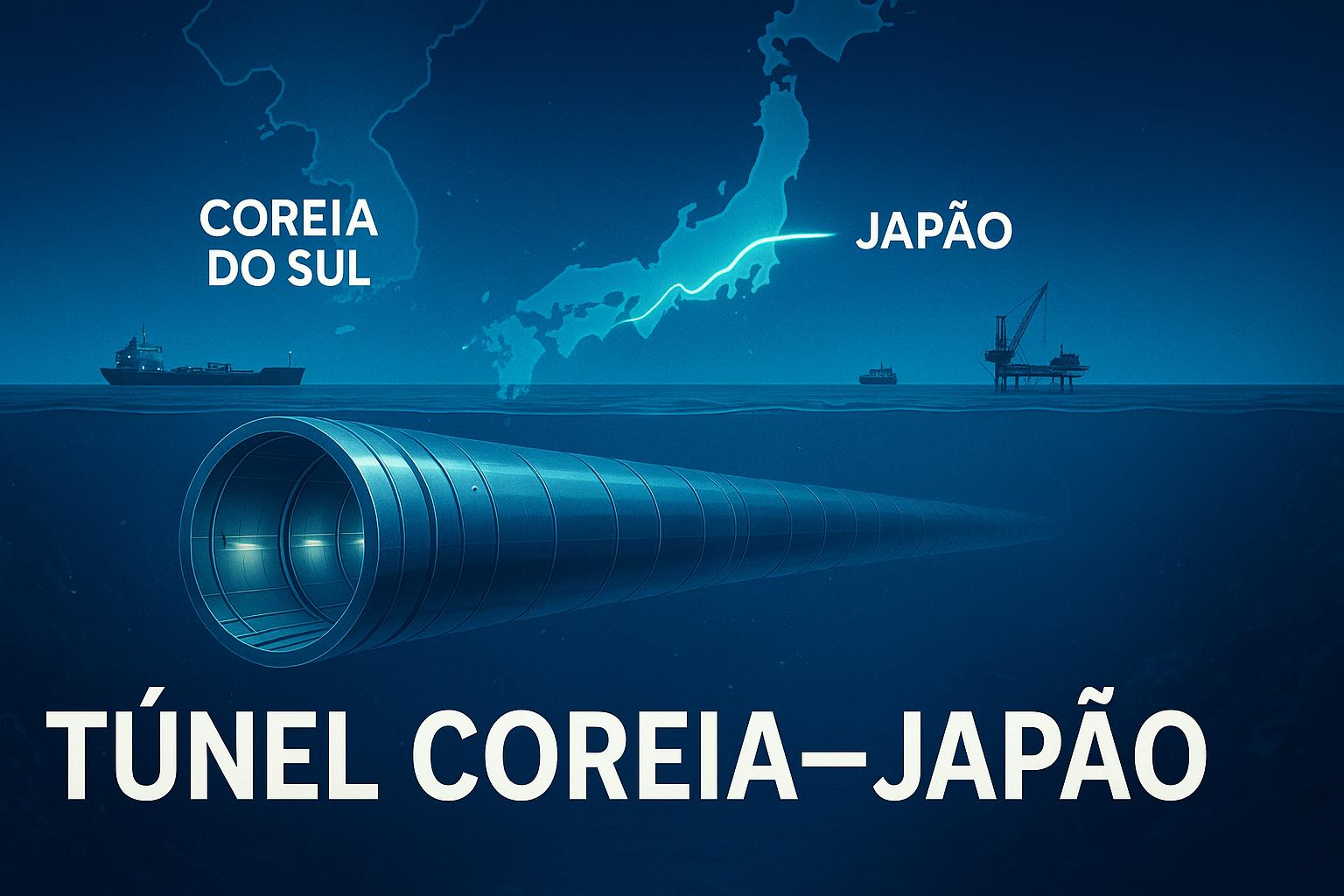


A Submarine Megatunnel of Up to 135 Km and More Than US$ 60 Billion Could Connect South Korea and Japan, Surpass the Eurotunnel and Transform Logistics and Geopolitics in Asia.
The possibility of building the largest submarine tunnel in history, more than 135 km under the ocean, linking territories marked by historical rivalry has returned to the international debate as one of the most ambitious projects ever studied in Asia. Valued at estimates exceeding US$ 60 billion, the proposal could integrate strategic rail routes, drastically reduce travel time between two of the planet’s most dynamic and militarily relevant centers, and, in an ideal scenario, help reshape one of the most sensitive geopolitical borders of the 21st century.
The idea, discussed intermittently by governments, academics, and planning organizations since the early 2000s, has come back to the radar with force in recent decades due to the intensification of regional disputes, advances in underwater infrastructure technologies, and economic pressures for the integration of increasingly faster trade corridors among the largest economies on the continent.
In a world where physical connectivity is as valuable as diplomatic alliances, the tunnel appears, at the same time, as a symbol of futuristic ambition and as a colossal challenge, capable of uniting regions that today rely on long air routes — when flights are available — and whose political relationship has been marked by conflicts, invasions, diplomatic breakages, and decades of military tensions.
-
28-meter, 156-ton titans traveled 20,000 km from China to the port of Santa Catarina: Portonave received 7 fully electric megacranes, part of a R$ 210 million package, to double container handling.

-
They exchanged the idea of a large house for a 35 m² warehouse, spent US$ 12,000 on the structure, and created a tiny house in Colorado with space to live and work.

-
A newly opened terminal in the middle of the Amazon has begun transporting soy and corn through Amapá, eyeing the queue of ships that is congesting the ports in the South.

-
Goodbye to old tiles: renovation technique without construction transforms bathrooms in a few hours, eliminates debris, and reduces costs with coverings using special paints, high-resistance adhesives, and modern finishes that completely renew the space.


A Project That Would Surpass All World Records
To grasp the scale of the challenge, the Eurotunnel linking the United Kingdom and France is 50.45 km long and cost around US$ 21 billion in updated values. The tunnel currently holding the record for the longest in the world is the Seikan, in Japan, measuring 53.85 km, built over 24 years and completed in 1988.
The Asian megaproject now being studied would more than double this mark, reaching up to 135 km underwater, with sections designed for extremely unstable geological environments, seismic zones, and deep waters.
The technology involved would require the use of next-generation tunnel boring machines, unprecedented ventilation and evacuation systems for long submarine stretches, as well as integrated multimodal infrastructure for the transport of cargo, passengers, and, in strategic scenarios, logistical mobilization.
Preliminary studies also suggest the combination of submarine sections with artificial technical islands for maintenance and ventilation, a concept similar to that adopted in the Hong Kong–Zhuhai–Macau megaproject, the largest bridge-tunnel in the world, inaugurated in 2018.
The Geopolitical Weight: Economic Integration or Risk of Strategic Pressure?
The choice of the two regions involved is never stated directly in the headlines to preserve editorial suspense, but in the content we need to clarify: it involves studies concerning South Korea and Japan, countries separated by about 200 km of sea, historical allies of the U.S. and with sometimes tense relations due to territorial disputes, memories of the Japanese occupation of the Korean Peninsula, and strategic balances in the face of the Chinese military rise and the unpredictable North Korean regime.
The proposal for a rail connection between Busan (South Korea) and Fukuoka (Japan), with models varying between 110 km and 135 km of submerged tunnel, emerged as an alternative to create a logistics corridor integrating the Korean Peninsula with Japan and the future high-speed network of Eurasia.
If it ever moves forward, it would also be a military and strategic achievement: it would reduce air dependency, strengthen advanced industrial chains, especially semiconductors, automobiles, defense, and energy, and would position Japan and Korea even more centrally in the Indo-Pacific security matrix.
Colossal Costs, Gigantic Risks, Incomparable Benefits
Proponents assert that the tunnel would create a new global economic axis, accelerating the flow of people, goods, and technology between two industrial hubs that together account for nearly US$ 7 trillion in GDP.
Critics, however, question:
• regional geopolitical instability
• seismic and volcanic risks
• technological and military dependence on physical corridors
• long-term financial viability
• historical diplomatic difficulties
For diplomats and analysts, the tunnel would be, at the same time, a symbol of lasting peace and a potential strategic target during periods of tension.
Beyond Engineering: The Future and the Geopolitical Narrative of Asia
There is still no definitive timeline, nor formal decision to commence, and this may be the greatest testament to its challenge. But the mere fact that a project like this remains alive in committees, universities, industry chambers, and strategic plans already demonstrates something important: Asia is about to undergo an infrastructure revolution that could overshadow everything produced in the 20th century.
And if one day this tunnel comes to fruition, it will not just be a construction; it will be a civilizational milestone, as symbolic as the Trans-Siberian Railway, the Eurotunnel, or the Suez Canal. A gesture of technical and political audacity capable of rewriting maps, routes, alliances, and the very global balance.







Enquanto no Brasil, Gigatúnel da corrupção. Quanto + tempo passa + aumenta o buraco.