






 Portuguese
  Spanish
  7 min of reading
  0 comments


3,300-Year-Old Shipwreck Found at 1.8 km Depth in the Mediterranean Reveals the Oldest Ship Ever Discovered in Deep Waters
In May 2024, an underwater robot operated by the British natural gas company Energean was scanning the Mediterranean seabed off the northern coast of Israel when its sensors detected an anomaly in the marine sediment. The operation was part of a routine technical inspection procedure associated with the company’s natural gas extraction fields in the region. The technical team aboard the ship Energean Star decided to capture detailed images of the formation detected on the seabed. Upon examining the photographs taken by the underwater vehicle, the operators noticed something unusual: what initially appeared to be an irregular cluster of clay containers partially buried in the sediment.
The images were immediately forwarded to specialists from the Israel Antiquities Authority (IAA), the body responsible for overseeing archaeological discoveries in the country. The response arrived a few hours later and surprised even the most experienced archaeologists. What seemed to be just a set of ancient jars turned out to be the oldest shipwreck ever found in deep waters anywhere on the planet. Initial analyses indicated that the ship had sunk about 3,300 years ago, during the Bronze Age, and that its cargo had remained virtually untouched since then.
Archaeological Discovery in the Mediterranean Occurred During Inspection of Natural Gas Fields
Energean operates several natural gas extraction fields in Israeli territorial waters, including areas known as Karish and Katlan. During a routine inspection in the Katlan field, the company sent a ROV (Remotely Operated Vehicle) — a remotely operated underwater vehicle — to examine the seabed.
-
Facing high rent costs in Brazil, couple swaps apartment for life on a sailboat, reducing expenses significantly.

-
Avoiding the rental cycle, 26-year-old transforms school bus into a solar-powered mobile home for road living, spending up to $35,000 on renovations.
-
Survivor of 1966 SS Daniel J. Morrell Shipwreck in Lake Huron Recounts 38-Hour Ordeal in Extreme Cold

-
The Greatest Hoax in World Cup History? The Film That Denied Brazil’s 1958 Victory and Exposed How Fake Evidence Can Seem Convincing on TV


The equipment was operating at approximately 1.8 kilometers deep, in an area located about 90 kilometers from the Israeli coast. This depth places the site far beyond the reach of human divers and even conventional archaeological operations.
During the inspection, the robot captured images of a row of ceramic containers partially buried in the mud of the seabed. The appearance of the objects caught the operators’ attention, who decided to send the material for archaeological analysis.
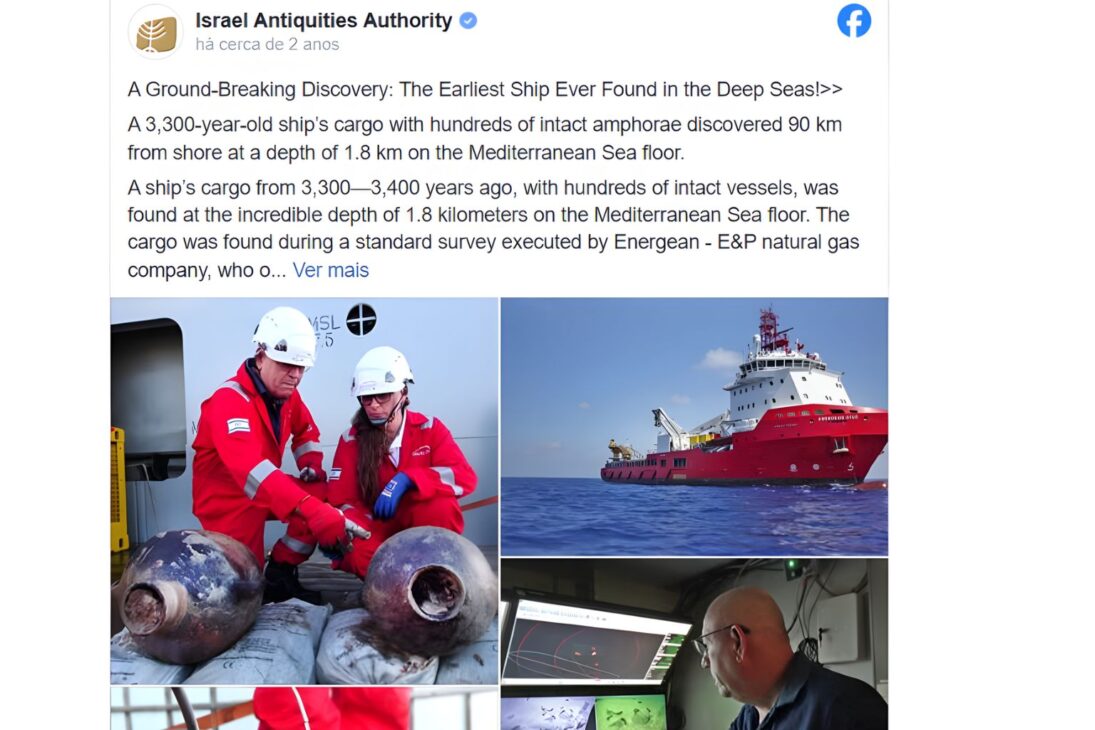
When the images reached Jacob Sharvit, director of the Marine Archaeology Unit of the Israel Antiquities Authority, the recognition was immediate. The containers were Canaanite amphoras from the Bronze Age, dated approximately between the 13th and 14th centuries BC.
According to Sharvit, “this is one of the most important discoveries ever made in the history of maritime archaeology”. In June 2024, the Israel Antiquities Authority made the discovery public, drawing the attention of the international scientific community.
Canaanite Shipwreck Challenges Traditional Theory on Ancient Navigation in the Mediterranean
The most surprising element of the discovery was not just the age of the ship, but the location where it was found. Until then, all known Bronze Age shipwrecks in the Mediterranean had been located relatively close to the coast. The most famous example is the Uluburun shipwreck, found in 1982 near the coast of Turkey.
The academic logic behind this concentration was simple: it was believed that ancient navigators rarely strayed from the line of sight of the mainland. Without compasses, modern navigation instruments, or accurate maps, coastal navigation was considered the safest way to travel.
The ship found by Energean completely challenges this theory. The shipwreck is located about 90 kilometers from the coast — a distance at which no land is visible in any direction, only the maritime horizon.
According to Sharvit, this discovery profoundly changes the understanding of the capabilities of Bronze Age sailors.
“It is the first ancient ship found so far from the coast, in an area where there is no line of sight to the mainland.”
Astronomical Navigation May Explain How Canaanite Sailors Crossed the Open Mediterranean
If ancient sailors navigated so far from the coast, an inevitable question arises: how did they know where they were? The most accepted hypothesis by archaeologists involves the use of primitive astronomical navigation.
To maintain routes in the open sea during the 13th century BC, Canaanite sailors likely used celestial references for guidance. During the day, the position of the sun in the sky could indicate direction and approximate latitude. At night, stars and constellations would serve as natural guides to maintain course.
This type of navigation, centuries later, would be used by Greeks, Phoenicians, and other maritime peoples of the Mediterranean. The discovery suggests that Canaanite sailors already mastered advanced astronomical navigation techniques much earlier than previously thought.
The historical context reinforces this possibility. The 13th century BC represented the peak of economic interconnectivity in the eastern Mediterranean.
The Egyptian and Hittite empires dominated large territories in the region, while the Canaanite peoples acted as commercial intermediaries between different civilizations. Products such as olive oil, wine, copper, tin, ivory, and aromatic resins circulated intensely between Egypt, Cyprus, Crete, Anatolia, and the Levant. Archaeologist Eric Cline, from George Washington University, describes this period as “the first era of globalization of the ancient Mediterranean”.
Hundreds of preserved amphorae reveal the original cargo of the Bronze Age ship
Although the ship’s hull has not yet been completely exposed above the sediment, surveys conducted with sensors indicate that wooden structures remain preserved under the layer of mud.
The environmental conditions at the bottom of the Mediterranean — high pressure, low current circulation, and absence of oxygen — created an ideal environment for archaeological preservation. On the surface of the sediment, robots identified hundreds of Canaanite storage jars, organized in relatively intact layers.
These containers, known as amphorae, were widely used in antiquity to transport agricultural and commercial products such as wine, olive oil, and dried fruits. The arrangement of the jars suggests that the ship sank quickly, without the cargo having time to disperse.
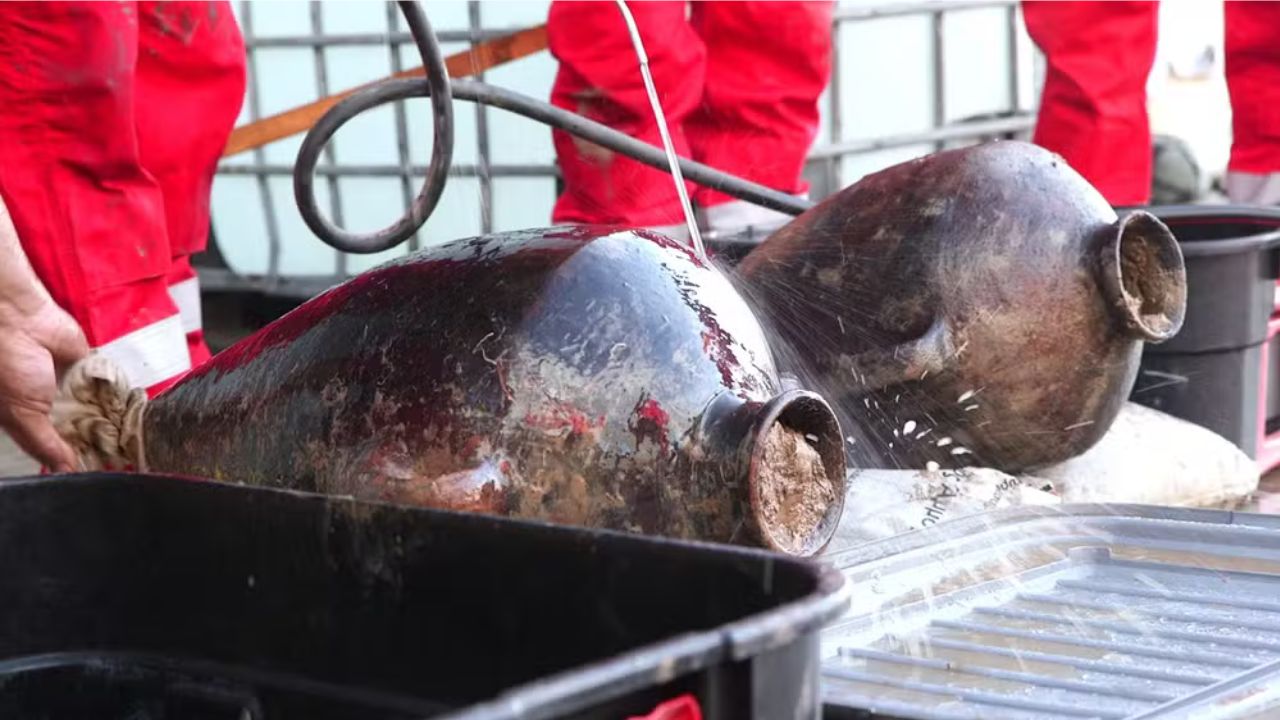
To confirm the extent of the wreck, two containers were carefully removed from the seabed after months of technical planning. The company Energean developed a special tool for the operation, capable of extracting artifacts from the mud without disturbing the rest of the archaeological site.
The two jars were removed from opposite ends of the identified area, allowing archaeologists to estimate the approximate size of the vessel. After a rise of about three hours to the surface, the containers emerged into the sunlight for the first time in more than 3,200 years.
Mystery about what caused the shipwreck still intrigues archaeologists
The intact arrangement of the cargo offers important clues about what might have happened in the final moments of the ship. According to Jacob Sharvit, “whatever happened, it seems to have occurred very quickly”.
In situations of danger at sea, it was common for crews to throw part of the cargo into the ocean to reduce the weight of the vessel and increase its buoyancy. However, there is no evidence that this occurred in this case. The amphorae remain organized as if the ship had sunk abruptly.
Two main hypotheses are considered by experts. The first involves a sudden storm, capable of quickly destroying a wooden vessel.
The second hypothesis involves pirate attacks, which were common in the Mediterranean during the Bronze Age. Egyptian and Hittite records mention groups known as “Sea Peoples”, responsible for attacks on maritime trade routes.
A surprise attack could explain the rapid sinking and the absence of any attempt to save the cargo.
Shipwreck rewrites the history of ancient navigation in the Mediterranean
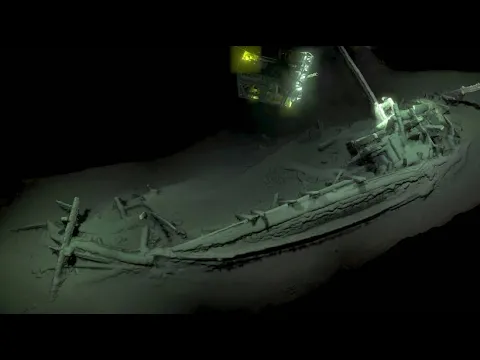
To understand the importance of the discovery, archaeologists compare the new find to the famous Uluburun shipwreck. The Uluburun ship, considered one of the most important archaeological finds in the Mediterranean, was located at only 44 meters deep and less than 10 kilometers from the Turkish coast.

Between 1984 and 1994, archaeologists conducted more than 22,000 dives to recover its cargo. Among the objects found were:
- 10 tons of Cypriot copper
- 1 ton of tin
- 150 Canaanite amphorae
- elephant ivory
- African ebony wood
- a gold scarab associated with the Egyptian queen Nefertiti
The new shipwreck found off the coast of Israel belongs to the same Bronze Age trade tradition, but in a completely different context. The vessel was sailing in open sea, at a distance from the coast that requires advanced navigation techniques.
This demonstrates that the Canaanite sailors of the 13th century BC were capable of undertaking deliberate open-sea voyages, using only observations of the sky and accumulated knowledge from generations of seafarers.
Shipwreck remains preserved at the bottom of the Mediterranean
Despite the scientific importance of the discovery, the Israel Antiquities Authority does not intend to immediately recover the rest of the ship. The depth of 1.8 kilometers makes any archaeological excavation extremely complex and expensive.
For now, the site remains preserved at the bottom of the Mediterranean. The oldest ship ever found in deep waters remains where it sank 3,300 years ago — protected by darkness, ocean pressure, and the distance from the coast that kept it hidden for more than three millennia.


Be the first to react!