Portuguese
  Spanish


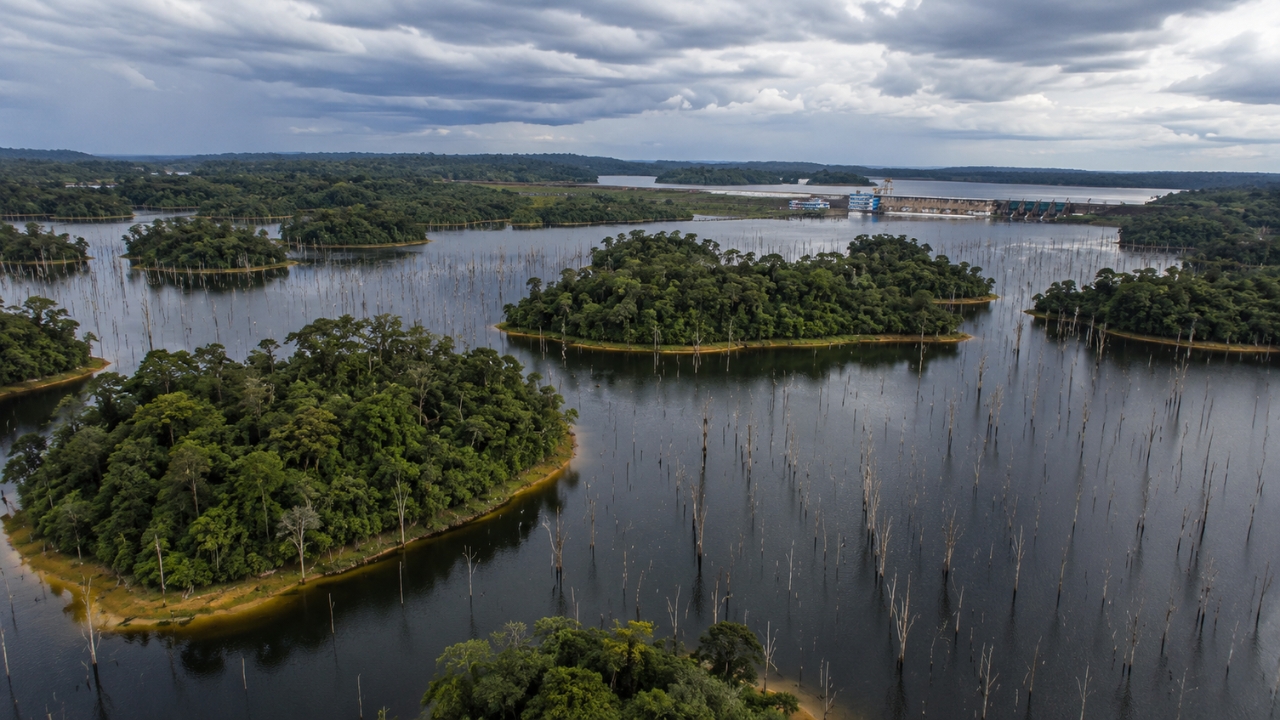

Built on the Uatumã River, the Balbina HPP became a symbol of one of the most controversial decisions in Brazilian energy, with effects on forest, communities, and emissions
It was sold as a symbol of progress, clean energy, and development for the Amazon. But, decades later, the Balbina Hydroelectric Plant, in Amazonas, is remembered by many researchers as one of the most controversial projects in Brazilian energy history.
Built on the Uatumã River, in the municipality of Presidente Figueiredo, the plant came into operation in the late 1980s with only 250 MW of installed capacity, but left behind a gigantic reservoir. According to Memória da Eletricidade, Balbina flooded about 2,360 km² and affected almost 2,928.5 km² of lands previously occupied by the Waimiri-Atroari.
The contrast is shocking: a relatively small plant in generation, but enormous in territorial impact. In the middle of the forest, the artificial lake transformed trees, rivers, communities, and indigenous areas into a landscape marked by stagnant water, isolated islands, and dead trunks.
-
Cape Verde’s World Cup Surprise: Betting on Electric Cars, a 5 MW Solar Plant, and an Ambitious Plan to Transform Energy for 600,000 Residents

-
Man Finds 1,469 Ancient Roman Silver Coins While Metal Detecting in Romania
-
Young Brazilian Siblings Go Viral for Catching Giant Fish, Launch Sport Fishing Project
-
72-Year-Old Retired Professor from Rural Brazil Recites 247 Digits of Pi in One Minute, Setting National Memory Record


The plant that created thousands of islands in the middle of the forest

With the damming of the Uatumã River, an immense area of the Amazon was covered by water. The result was not just a reservoir: it was a new geography, fragmented and difficult to recover.
Recent reports from the Public Defender’s Office of Amazonas indicate that the region now has more than 3,500 isolated islands, in addition to millions of dead trees, popularly known as “paliteiros” (toothpick-like structures). The image is powerful: a forest that was once continuous turned into an artificial archipelago.
This transformation directly affected the environment and the lives of local populations. The project is said to have affected about three thousand families, both above and below the dam, in addition to causing disputes and revisions involving the area of the Waimiri-Atroari.
The paradox: clean energy that can pollute more than coal

The most explosive point in Balbina’s history lies in the comparison with a coal-fired thermal power plant. Research cited by Agência FAPESP indicated that the plant could emit about 10 times more greenhouse gases than a mineral coal thermal power plant of the same capacity.
The explanation lies in what remained submerged. When the forest was flooded, an enormous amount of organic matter began to decompose underwater. In hot, tropical environments with little oxygen, this decomposition releases carbon dioxide and methane, a gas with a strong climatic impact.
In other words: the hydroelectric plant that was supposed to represent a renewable alternative ended up becoming an extreme case of low environmental efficiency. A lot of flooded area, little energy generated, and a worrying amount of emissions.
Only 250 MW for a gigantic lake

Balbina has 250 MW of installed capacity, a modest number when compared to the size of the flooded area. This imbalance is precisely one of the reasons why the plant became so criticized.
In other words, the problem is not just having built a dam. The problem is the relationship between what was sacrificed and what was delivered in energy.
While large hydroelectric plants are usually defended by the volume of electricity generated, Balbina became the opposite example: a project that flooded an immense area of the forest to produce a limited amount of energy.
The forest continues to feel the effects decades later
Balbina’s impacts were not confined to the past. A study released by INPA analyzed over 35 years of environmental effects on the igapó forests affected by the dam.
According to researchers, the alteration of the natural water regime created a kind of “sandwich effect”. Low, medium, and high areas of the forest began to suffer from changes in the flooding pulse, affecting trees, fish, habitats, and entire food chains.
The survey also indicated that approximately 12% of the igapó forests have already died, while other areas remain threatened by the artificial alteration of the water cycle. This shows that the dam did not just cause an initial impact: it continues to modify the ecosystem every year.


Balbina became a symbol of energy error in the Amazon
Balbina’s story is uncomfortable because it dismantles a simple idea: that every hydroelectric plant is automatically clean. On paper, energy comes from water. In practice, the cost can be gigantic when the project floods tropical forest, alters rivers, and affects communities.
Today, the plant is often remembered as a warning for new projects in the Amazon. It shows that poorly planned renewable energy can also generate destruction, especially when it ignores the territory, biodiversity, and the peoples living in the region.
The case also gained new relevance with recent initiatives to rescue the memory of the plant’s construction and investigate its social impacts. The creation of the Balbina Truth Commission, involving institutions such as UFAM, USP, and the Public Defender’s Office, reinforces that this story has not yet been fully told.
A project that promised progress and left an open wound
More than three decades later, Balbina continues to produce energy. But it also continues to produce difficult questions.
Was it worth flooding such a large area of the Amazon to generate only 250 MW? How do we measure the cost of thousands of artificial islands, dead trees, affected families, and greenhouse gas emissions? And how many similar projects can still be avoided with the lessons left by this plant?