Portuguese
  Spanish




Projects approved in the Senate include rural refinancing, new minimum wage for doctors and dentists, and special retirement for health agents, with an estimated impact of up to R$ 263.7 billion on public coffers
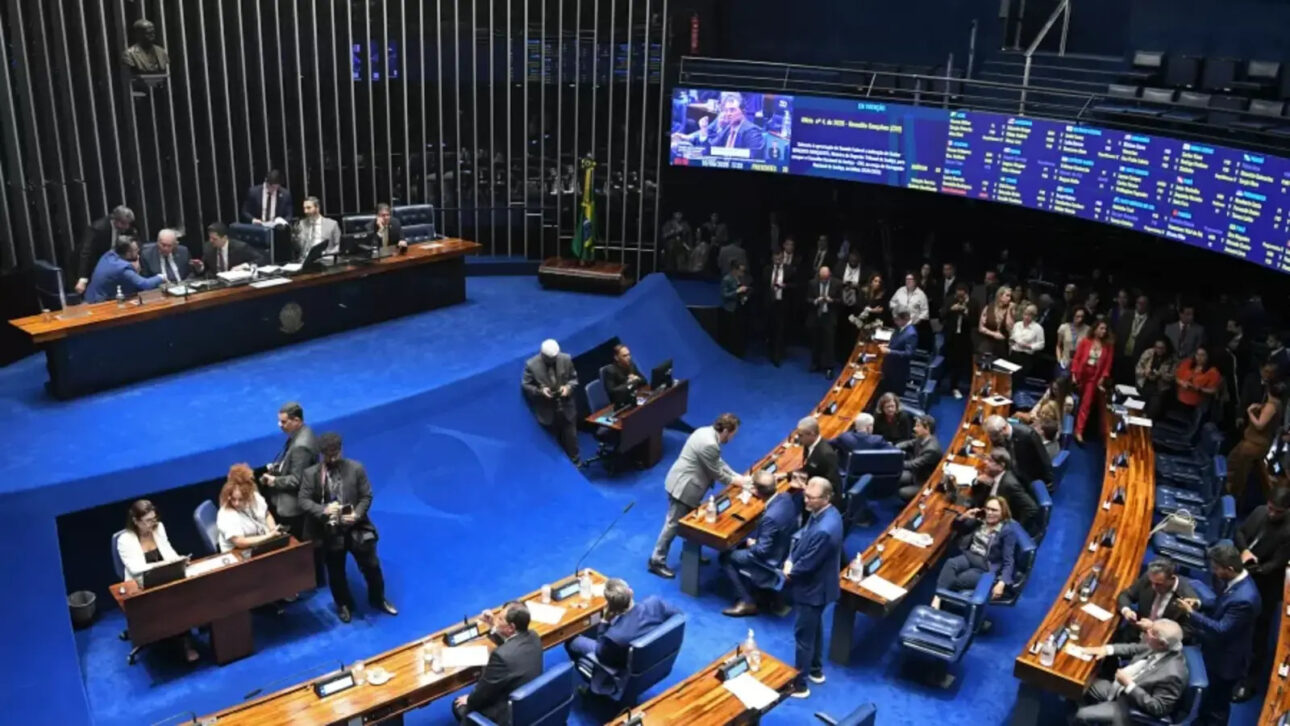
The Federal Senate approved yesterday bombshell agendas that could cost up to R$ 263.7 billion to public coffers in the coming years, including refinancing of rural debts, a new minimum wage for doctors and dental surgeons, and special retirement for community health agents and endemic disease combat agents.


Bombshell agendas advance in a few hours in the Senate
The bombshell agendas were approved in sequence in the Senate and in House committees. In a few hours, the parliamentarians validated changes in the refinancing of debts of rural producers and returned to the Chamber of Deputies the project that creates a minimum wage of R$ 13,662 for doctors and dental surgeons.
Shortly before, the Constitution and Justice Commission approved the creation of a special retirement for community health agents and endemic disease combat agents. The proposal will still go to the plenary for analysis.
-
Brazil to Issue “Panda Bonds” in China, Aiming to Raise Up to 5 Billion Yuan at Lower Interest Rates Than Dollar Debt
-
NATO Faces Internal Tensions as U.S. Pushes for Increased Defense Spending, Targeting 5% of GDP by 2035, with Warnings for Countries Near 2% Level

-
Brazil to Introduce B16 Diesel with Increased Soybean Oil Content for Trucks by 2026
-
Brazil’s July Bolsa Família Payments May Include Extra $150 and $50 for Families with Children, Pregnant Women, and Updated CadÚnico Registration


Combined, the three measures have an estimated fiscal impact of up to R$ 263.7 billion, considering calculations presented by the Ministry of Management, the Ministry of Finance, the National Confederation of Municipalities, and the Ministry of Social Security.
The Minister of Finance, Dario Durigan, stated that proposals with a large fiscal impact could compromise the country’s management capacity in the coming years. According to him, “all these measures that are in progress and would have an impact could make the country ungovernable from the next mandate.”
Bombshell agendas: Rural refinancing could cost R$ 140 billion in ten years
The largest estimated impact is on the refinancing of rural sector debts. According to Dario Durigan, the project could cover R$ 200 billion in operations, with a cost of 70% to the National Treasury.
With this, the potential impact of the measure would reach R$ 140 billion over ten years. The text approved in the Senate amends Bill 5.122/2023 and, having been modified, will return to the Chamber of Deputies.
In practice, the proposal creates a special refinancing line for rural producers, with a grace period, lower interest rates, and a longer repayment term.
Initially, the measure was aimed at groups affected by climatic events, such as the floods in Rio Grande do Sul in 2024.
The text was expanded to include producers affected by impacts resulting from international geopolitical conflicts, such as the wars in Ukraine and Iran.
The proposal allows the use of resources from the Pre-Salt Social Fund to finance rural refinancing. The rapporteur in the Senate, Renan Calheiros, stated that there will be no harm to the amounts allocated to health and education.
The financing will have a limit of R$ 10 million per beneficiary and R$ 50 million per association or cooperative. The repayment term can reach ten years, with an additional three years of grace period, as applicable.
The proposed interest rates are 3.5% per year for those enrolled in Pronaf and small producers, 5.5% per year for those enrolled in Pronamp and medium producers, and 7.5% per year for other rural producers.
Minimum Wage for Doctors and Dentists Returns to the Chamber
Another approved measure raises the minimum wage for doctors and dental surgeons from R$ 3,636 to R$ 13,662, considering 20-hour weekly shifts. The text was approved in the Social Affairs Committee and returns to the Chamber.
According to the Ministry of Management, the creation of the new minimum wage is expected to cost R$ 25 billion by 2029. For doctors in the federal public network, the estimated impact is R$ 7.7 billion in 2027, not including night shift and overtime pay.
The proposal applies to both public and private sectors. In addition to the new minimum wage, the text increases the night shift and overtime pay from 20% to 50%.
The project also ensures a ten-minute rest interval every 90 minutes of work. Another point establishes that heads of medical and dental services must be exclusively exercised by doctors and dental surgeons.
According to the approved text, states and municipalities will not need to fund the salary increase with their own resources. The amounts will be financed by the National Health Fund. The minimum wage will be adjusted annually based on the IPCA.
Special Retirement Has Estimated Impact of Up to R$ 98.7 Billion
The third measure addresses special retirement for community health agents and endemic disease combat agents.
The proposal approved in the CCJ sets permanent and transitional rules and determines the regularization of the functional bond of the categories.
According to the text, these professionals will be entitled to retirement with a minimum age of 57 for women and 60 for men, provided they prove 25 years of contribution and effective exercise in the activity.
The National Confederation of Municipalities calculates an impact of R$ 69 billion for the municipalities’ pension schemes.
The Ministry of Social Security projects an even greater effect, of R$ 98.7 billion, accounted for until the extinction of the impact on the last beneficiary.
The proposal also allows counting periods of leave and time in functional readaptation, when the change of function occurred due to a work accident, occupational disease, or work-related illness.
For those already in activity and linked to the own regime, the text creates transition rules. The minimum ages vary from 50 years for women and 52 for men until 2030, reaching 57 and 60 years from 2041.
This article was prepared based on information from UOL, with data, numbers, and statements preserved as per the consulted material.