Portuguese
  Spanish


The data was presented by Chinese authorities at the 12th China-CELAC Infrastructure Forum in Macau this Thursday. China proposed a new stage of cooperation in green and digital infrastructure with Latin America. It is worth noting that the numbers and positive assessment come from the Chinese government itself, the host of the meeting.
China reaffirmed its long-term commitment to Latin America and the Caribbean during a forum in Macau, and proposed a new stage of cooperation in green and digital infrastructure. According to the portal Brasil 247, the announcement took place at the 12th China-CELAC Infrastructure Forum, held this Thursday, June 11, 2026, with government authorities, international organizations, and executives from large companies. The messages came from representatives of the Chinese government.
Among the highlights presented by China are record trade with Latin America and the promise of more investments in the region. According to diplomat Zhang Run, trade exchange between the two sides reached US$ 549 billion, about R$ 3 trillion, in 2025, with Chinese imports on the rise and nearly one million jobs linked to Chinese projects. However, the numbers were presented by the Chinese government itself, the host of the meeting.
China reaffirms commitment to Latin America
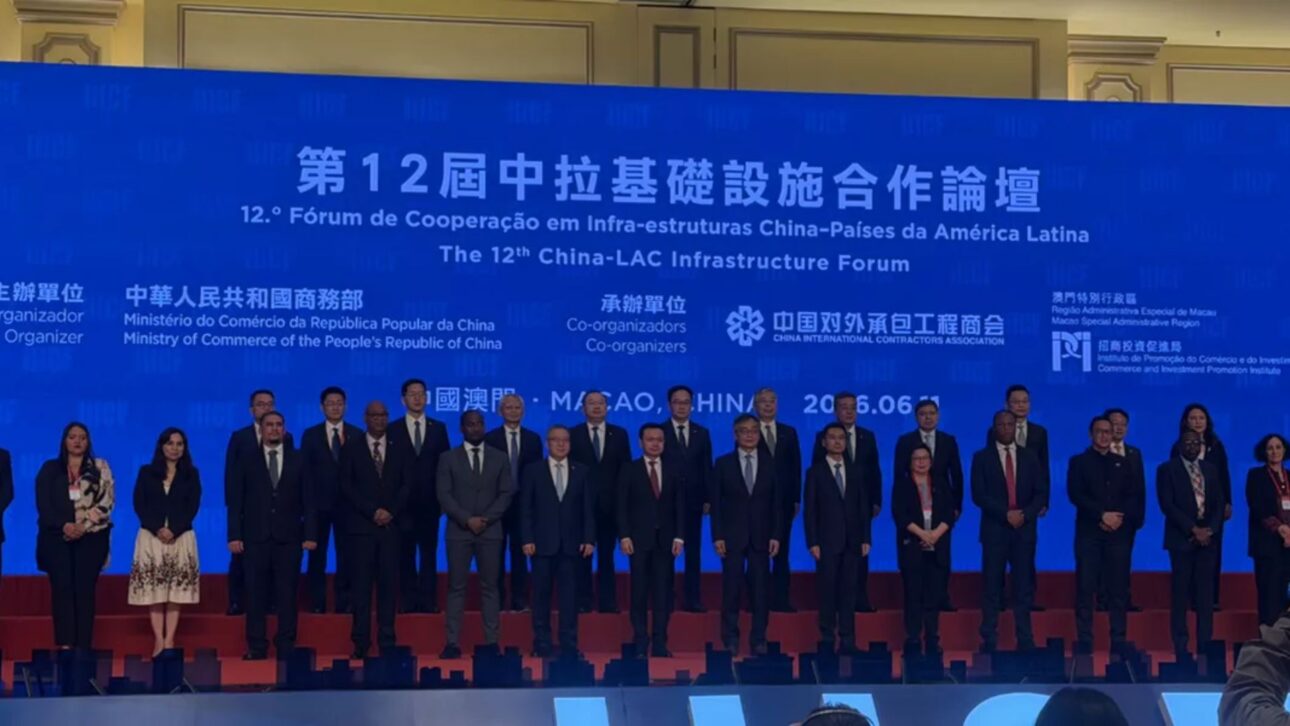
photo: brasil247
The central political message of the forum was delivered by Zhang Run, director of the Latin America and Caribbean Department of the Ministry of Foreign Affairs of China. According to the material, he cited a message from President Xi Jinping to the 10th CELAC Summit and stated that the country will maintain its historical commitment to the region. In his words, China would be “always a good friend and a good partner” of the countries of Latin America and the Caribbean.
-
Controversial Amazon Highway BR-319 to Receive $1.3 Billion for Road Upgrades and $570 Million for Territorial Governance in Brazil

-
Four Sanitation PPPs to Inject $4 Billion into 477 Brazilian Municipalities, Setting 2026 as a Record Year for the Sector

-
Brazil’s BNDES Approves $2.4 Billion for Major Urban Project Aiming to Serve 600,000 Passengers Daily and Reduce CO₂ Emissions by Over 200,000 Tons Annually
-
Brazilian Government Invests $140 Billion in Strategic Sectors like Fertilizers, Biopharmaceuticals, Sustainable Mobility, and Artificial Intelligence with BNDES Support


According to Zhang Run, even in a world marked by conflicts, relations between China and Latin America continue to advance steadily. The diplomat highlighted that, just in the last year, Xi Jinping had more than ten conversations with leaders from the region, including representatives from Brazil, Colombia, Chile, Cuba, and Uruguay. He also stated that the 10th CELAC Summit in Colombia, for the first time, gave a positive assessment of cooperation with China in its final document.
Record Trade and the Numbers Presented by China
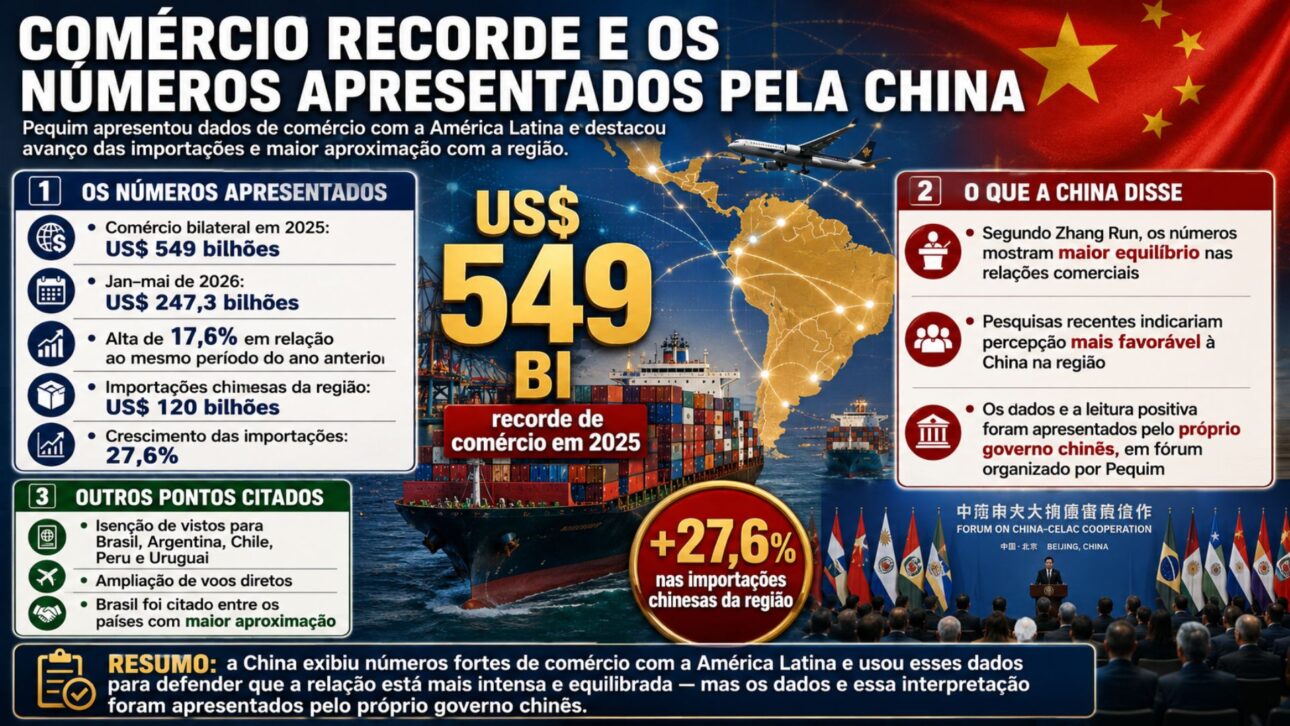
To support the discourse, China presented trade numbers with Latin America. According to Zhang Run, bilateral trade reached a record of US$ 549 billion in 2025 and, in the first five months of 2026, reached US$ 247.3 billion, an increase of 17.6% compared to the same period of the previous year. The most highlighted data by him was the 27.6% growth in Chinese imports from the region, which totaled US$ 120 billion.
It is important to remember that these numbers and the positive reading come from the Chinese government itself, in the forum it organized. According to Zhang, the result would show a greater balance in trade relations, and recent surveys would indicate an increasingly favorable perception of China in the region. The diplomat also mentioned the visa exemption for citizens of Brazil, Argentina, Chile, Peru, and Uruguay and the expansion of direct flights, including with Brazil.
Chancay, Bogotá Metro, and the Three Pillars of the New Phase
The infrastructure part was handled by Wang Qi, head of the Department of Foreign Investment and Economic Cooperation of the Ministry of Commerce of China. According to the material, he stated that projects of the Belt and Road Initiative created a cooperation network in transport, energy, telecommunications, and urban development in Latin America.
Among the examples, he mentioned the Port of Chancay in Peru, which would have reduced maritime transport between the country and Asia from 35 to 23 days, and Line 1 of the Bogotá Metro in Colombia, which is expected to shorten commutes of more than two hours to 27 minutes.
According to Wang Qi, projects by Chinese companies have already helped create nearly one million jobs in the region, in addition to hospitals, schools, bridges, airports, roads, and ports. He advocated for a new phase supported by three pillars, according to the material: the integration between infrastructure and industry, the ecological transition, with clean energy and green finance, and digitalization, with the shift from physical connectivity to digital connectivity. All this, it is worth noting, within the vision presented by China itself.
Chinese giants advance, and the partnership divides opinions
The forum took place amid the growing presence of large Chinese infrastructure groups in Latin America. According to the material, representatives from PowerChina, China Energy Engineering, China Railway Construction Corporation, China Harbour Engineering, and Huawei participated, in a strategy that combines traditional works with clean energy, smart grids, and digitalization.
At the opening, Li Chenggang, China’s Trade representative, advocated for more multilateralism, trade liberalization, and cooperation in areas such as 5G networks, data centers, and smart cities.
Representing CELAC, Guyana’s Minister of Public Works, Juan Anthony Edghill, praised the advancement of the partnership since the forum’s creation in 2014 in Brasília. He stated that the region has witnessed “exponential growth” in the cooperation agenda.
Still, it is important to remember that this account comes from an event organized by China, and the rapprochement occurs amid a global geopolitical dispute, watched with enthusiasm by some and with caution by others, especially regarding dependency and indebtedness.
In the end, the 12th China-CELAC Infrastructure Forum in Macau made clear the size of China’s bet on Latin America, with record numbers and the promise of a new phase of cooperation. However, the scenario was drawn from the Chinese perspective, and the real reach of this partnership will depend on the execution of the projects and how each country in the region manages the relationship. Between enthusiasm and caution, what is at stake is China’s weight in the economic future of Latin America.
And you, how do you see China’s increasing presence in Latin America, an opportunity for development or a reason for caution? Share your opinion and exchange ideas with other readers, with respect for different views.