Portuguese
  Spanish


Eduardo Giannetti, PhD from Cambridge and immortal of the Brazilian Academy of Letters, revealed on Papo Amado the secret method he named microscopic reading. The technique, built notebook by notebook since 1979, transforms ordinary reading into permanent memory.
Eduardo Giannetti was not a satisfied student. During his undergraduate years, he read the assigned books, thought he had done his part, and moved on. But a month later, the feeling was different. He wondered what had remained from that reading. And the answer was the same every time: almost nothing. The discomfort grew until it became a question he refused to ignore. “Almost nothing remained. I said, but it’s not possible. I read this book two months ago, and I hardly remember anything. Something is wrong,” he recounts.
The problem seemed simple, but the implication was serious. If a dedicated reader, studying attentively, retained so little, what was failing? The answer Giannetti found was not in reading faster, highlighting more, or rereading the same text. It was in completely changing the relationship with the page. The solution came not as a sudden revelation, but as a decision made by someone tired of losing what had been gained.
Microscopic reading: the secret method that was born in a notebook
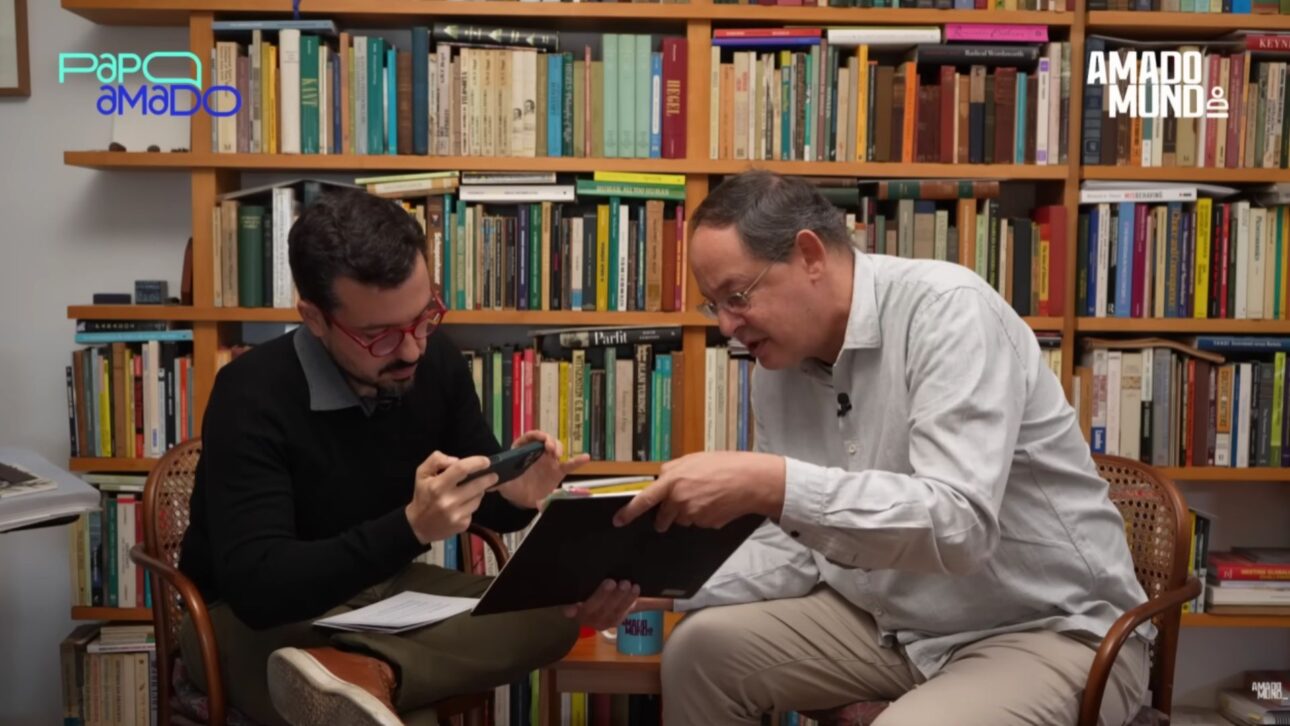
Giannetti took a recommended book, opened a notebook, and began to note down paragraph by paragraph what he was reading. Sometimes he paraphrased, putting the text in his own words. Other times he copied exactly what the author wrote, when the expression seemed so precise that it couldn’t be summarized. The exercise took time. It was slow, deliberate, almost obstinate. Three months later, he tested what had remained. He remembered almost everything. He was able to reconstruct entire passages because he had, in fact, memorized them.
-
13-Year-Old Raises Funds to Build Well, Transforming Lives in Cambodian Community Lacking Clean Water

-
Man with Metal Detector Finds Medieval Silver Seal in England, Uncovers 2,000-Year-Old Roman Gem with ‘Richard’s Secret’

-
Thailand Converts 8 Tons of PET Bottles into 3,500 School Backpacks, Showcasing Circular Economy with Over 40 Factories Involved

-
Mysterious Bats Spotted in Paris’s Père Lachaise Cemetery, Drawing Tourists to the “Vampire Cemetery”




This is how the secret method got its name. Giannetti called it microscopic reading. The central idea is simple: do not move forward in the text until you have processed what you have just read deeply enough to put it into other words. Microscopic reading is not re-reading. It is a different speed, a different quality of attention. And it works precisely because it forces the reader to move from the role of passive spectator to someone who needs to reorganize what they understood before continuing.
Why the computer doesn’t solve what the notebook solves
Giannetti adopts this practice to this day, always by hand, always on paper. He explains that manual writing offers a flexibility that no app reproduces. It’s possible to jot between lines, move up, move down, create connections in the space of the page in ways that the keyboard simply does not allow with the same agility. It’s not nostalgia for the analog. It’s precision about what works for memory consolidation.
Over time, the practice evolved into a system of cross-references between the notebooks. Each occurrence of an idea receives two numbers: the notebook number and the page number where it appears. Thus, when an idea arises in Plato, reappears in Rousseau, and returns in Nietzsche, he records all three with two digits per entry and creates a network of connections that spans centuries of philosophy. The secret method became, in practice, a personal database built by hand over nearly five decades.
60 notebooks and proof that memory is trainable
Today, Giannetti has 60 accumulated notebooks. They are not diaries. They are not agendas. They are reading records with dominant themes, even if they are not monothematic, cross-referenced by that two-number system. A notebook that goes from January 2003 to May 2004 fits in the hand, but contains connections that extend over decades. Every time he wants to develop a new argument or deepen a theme, he takes the notebooks and does, in his words, “a sweep.” The big question is what question he wants to ask. Once the question is asked, the 60 notebooks respond.
The conclusion that emerges from this collection is not about erudition. It’s about a much more accessible mechanism: memory is not a talent that you have or don’t have. It’s a direct consequence of how you process what you read. Giannetti was devastated in college because he read without taking notes, without reconstructing, without demanding of himself to reorganize the content before turning the page. When he changed the process, he changed the result. The secret method of microscopic reading does not depend on exceptional intelligence. It depends on a discipline that anyone can adopt, with any notebook and a pen.
The economist who went beyond economics


Eduardo Giannetti was born in Belo Horizonte in 1957, graduated in economics and social sciences from the University of São Paulo, and obtained his doctorate at Cambridge. He is a professor at Insper and an immortal of the Brazilian Academy of Letters. Throughout his career, he won the Jabuti Prize twice and published titles such as Self-Deception, The Value of Tomorrow, and, more recently, Immortalities. The revelation of the secret method was made during the Papo Amado, a conversation conducted by the Amado Mundo channel, in which he discussed his intellectual journey, memory, and reading with the same clarity he applies to his notebooks. Companhia das LetrasEstado de Minas
Giannetti’s journey is marked by a rare coherence: a man who studies how the human mind works, how beliefs are formed, and how time affects choices, and who has built over decades a concrete practice to prevent time from erasing what he learns. Microscopic reading is not a productivity trick. It is an attitude towards knowledge. And the 60 notebooks are the physical proof that this attitude, maintained for decades, produces something that no note-taking app will replace anytime soon.
You reached the end of this article with 60 notebooks in mind. Now the question is yours: do you jot down what you read or forget it in two months like Giannetti used to forget in college? Do you have any technique that works for you? Leave it in the comments.