





 Portuguese
  English
  Spanish
  5 min of reading
  0 comments


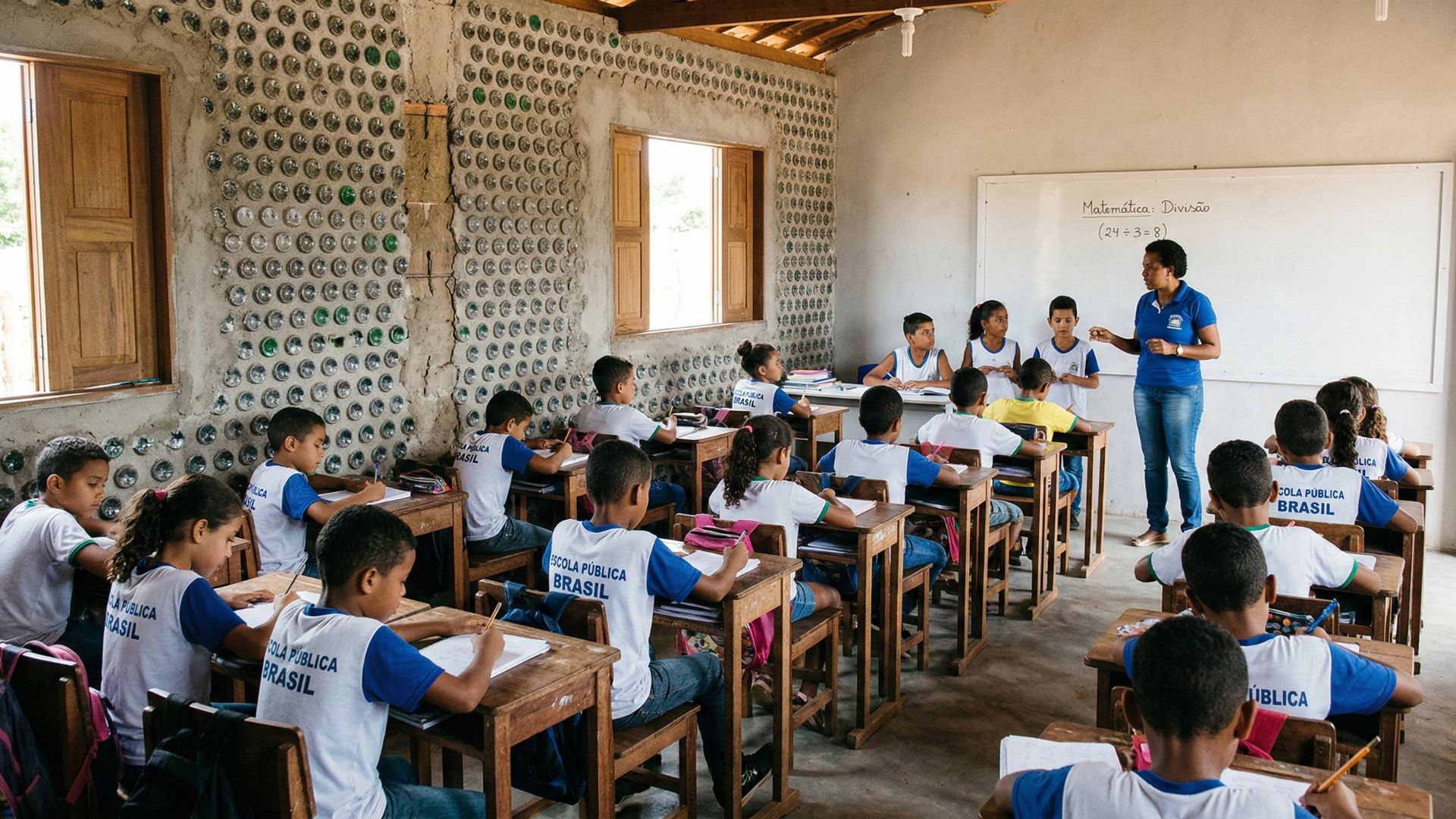
Organization Transforms Thousands Of Plastic Bottles Into Classroom Walls, Mobilizing Entire Communities To Build Schools With Eco-Bricks And Average Cost Of US$ 8,500 Per Room, Uniting Education, Recycling And Sustainable Construction On A Large Scale.
In rural communities of Guatemala, a school construction model has been gaining attention for transforming plastic bottles into structural parts of the walls.
The organization Hug It Forward claims to have enabled 392 classrooms of this type, built from “eco-bricks” — PET bottles filled with inorganic waste — and announces an average cost of US$ 8,500 per room, a value associated with the proposal to expand educational spaces while encouraging local waste management practices.
How “Bottle Classrooms” Made With Eco-Bricks Work
The technique is based on a simple principle: instead of treating the bottle merely as recycling material, it becomes an improvised “brick” when compacted with flexible plastics and other non-organic waste.
-
Amid the United States’ economic blockade, China delivers 15,000 tons of rice to Cuba as part of a 60,000-ton donation personally approved by Xi Jinping. The package includes 80 million dollars and solar panels for hospitals.

-
For around 200 reais, anyone can buy a kit and have a chip implanted between their fingers to replace cards, keys, badges, and even medical information in case of a hospital emergency.
-
A 600-meter hill in the interior of Santa Catarina hides a volcanic past of almost 600 million years. The Morro do Garrafão in Corupá may have been an ancient extinct volcano, and science now confirms what the residents have always suspected.
-
Family has lived for over 50 years without electricity and running water at home in the South of Minas, 10 minutes from the city, improvising light, bath, and water while facing a lack of basic resources and awaiting property regularization.



These containers, already filled, become part of the walls as filling material, usually attached to a conventional structure of columns and beams and covered with cement, forming a closure that, externally, resembles a common wall.

Hug It Forward describes classrooms built this way as “bottle classrooms,” a term that has become popular precisely because it makes visible the logic of the project: walls erected with thousands of bottles, gathered by the community itself.
The model is presented by the organization as a collective effort, in which local residents and authorities participate from collecting the material to construction site stages, while the NGO directs resources toward items that require purchase, such as construction components, specific tools, and some technical services.
How Many Bottles Are Needed To Build A School
For a classroom to exist, work begins before the concrete.
The organization guides communities to collect bottles and, especially, the type of waste that tends to have an uncertain destination: flexible packaging, mixed plastics, and materials that are difficult to recycle in regions with limited infrastructure.
Inside each bottle, this content is compacted until it forms a block rigid enough to be handled and fixed to the wall, reducing the volume of waste and creating a standardized element for the construction.
A report by Theirworld, which followed the phenomenon of “bottle schools” in Guatemala, states that a school with two classrooms may require about 6,500 eco-bricks.
The number helps to gauge the scale of the proposal: it is not about reusing a few dozen containers, but mobilizing a community chain capable of gathering and preparing thousands of units, which turns construction into a continuous process of collection, organization, and community effort.
Steps In The Construction Of Classrooms With Bottles
In the construction stage, Hug It Forward outlines a step-by-step process that combines traditional methods and adaptations for using bottles.
After creating the eco-bricks, foundations and structures are put in place, with columns and beams mounted to support the whole.

Next, pins and metal mesh of the type “chicken wire” are fixed to receive the bottles, which are tied and aligned, functioning as filling material before the application of cement that gives finish and rigidity to the closure.
The method has an immediate visual effect: the wall “births” filled with bottles, and the subsequent coating conceals the content, leaving the appearance similar to that of a conventional masonry classroom.
In practice, this means that the differential is not in the finish, but in what happens inside the wall and in the path that the material takes until it becomes a construction component.
Environmental Education And Community Impact
The proposal is also presented as a tool for environmental education.
The organization itself claims to work to raise awareness about waste disposal and consumption practices, using construction as a concrete pretext to discuss the destination of waste in daily life.
By linking the result — a new classroom — to the effort to collect and compact waste, the initiative creates a direct relationship between domestic behavior and collective benefit, especially in places where the school is a central meeting point for the community.
The numbers reported by Hug It Forward seek to reinforce this scale.
In addition to the 392 classrooms, the organization reports 154 projects completed and 16 years of operation, data used to contextualize the accumulated experience and continuity of the program.
The average cost of US$ 8,500 per room appears as a central reference of the model, presented as a more affordable alternative than traditional school constructions in certain contexts, precisely because it combines local partnerships, community work, and the reuse of materials that are already available in the territory.
Replicable Model And International Impact
The subject gained international attention at different times, fueled by images of walls filled with bottles and the narrative of “schools made of garbage.”
Although the technique uses common materials in engineering, such as concrete and supporting structures, what piques curiosity is the reversal of the bottle’s destination: instead of waste, it becomes a standardized unit of filling, and what was scattered in streets and land is concentrated and encapsulated in a construction element.

Another aspect that attracts attention is the organization of work.
The construction does not rely solely on specialized labor on site; it begins in the routine of families and involves the participation of students, teachers, and neighbors, who help collect bottles and prepare eco-bricks.
The dynamic also involves coordination to standardize containers, store material, separate waste, and maintain proper compression inside the bottles, as the quality of the handmade “brick” affects handling and wall assembly.
By making the process replicable and documented, the initiative positions itself as a model that could inspire similar projects outside Guatemala, especially in places where plastic waste accumulates and the demand for school infrastructure is high.
The very idea of “eco-brick” circulates in other contexts as a way to give destination to plastics that are difficult to recycle, and the Guatemalan example appears as an emblematic case for associating this material with a public equipment of high social value: the classroom.
With the global discussion about plastic excess and the pressure for low-cost solutions in public works, stories like this gain strength by crossing three themes that tend to mobilize readers from any region: education, waste, and construction.
If a community can gather thousands of bottles and transform that volume into walls, what other public spaces could be made possible with the same logic of collective effort and waste reuse?






Be the first to react!