Portuguese
  Spanish


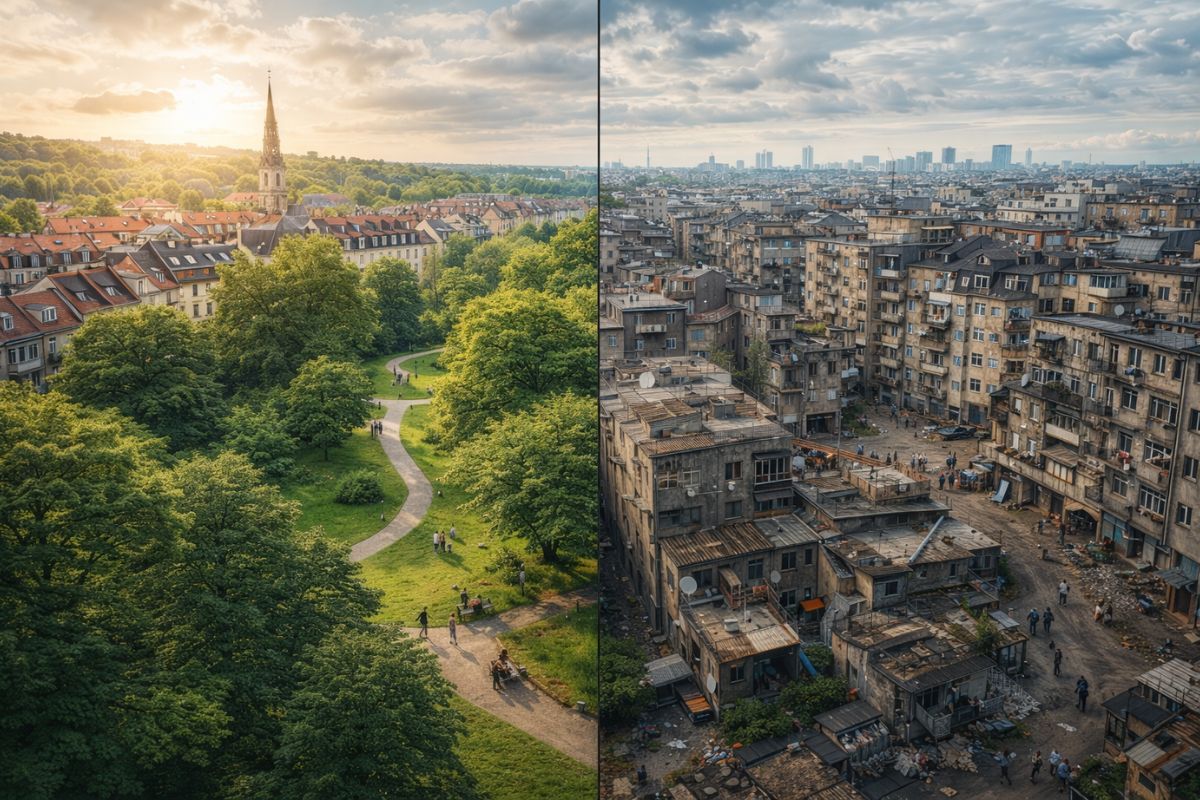

A study published in Nature Communications analyzed 862 cities and found that only 13.5% of Europeans live in compliance with the 3-30-300 urban tree planting rule. The research reveals a “green divide” where wealthy neighborhoods have double the access to trees and parks than low-income areas.
Only 13.5% of Europeans living in cities have adequate access to trees and green spaces near their homes. This figure comes from a study conducted by the European Commission in partnership with the University of Copenhagen, published in the journal Nature Communications, which analyzed 862 cities across the continent using high-resolution satellite images and socioeconomic data. The criterion used was the 3-30-300 rule, a guideline for urban tree planting that establishes that every resident should see 3 trees from their home window, live in a neighborhood with 30% tree cover, and be less than 300 meters from a quality green space. Conversely, 21% of the Europeans studied live in areas that do not meet any of the three parameters.
The most concerning data from the research is not the overall average, but the inequality it conceals. The study reveals a clear “green divide” where wealthier neighborhoods enjoy significantly higher levels of tree cover and proximity to nature than low-income areas. Residents of cities with higher disposable income tend to live in places with significantly better access to nature, while Europeans in cities with lower GDP per capita rarely exceed 10% compliance with the rule. Trees and parks, which should be a right for all, are becoming a privilege for those who can afford to live near them.
What is the 3-30-300 rule that measures Europeans’ access to green space
The 3-30-300 rule, proposed by the Nature Based Solutions Institute, is a practical guideline that quantifies the minimum amount of nature an urban resident should have within reach. The first number requires that at least 3 trees be visible from the window of each residence. The second asks that 30% of the area of each neighborhood be covered by trees. The third stipulates that every resident be less than 300 meters from a high-quality green space, such as a park, a tree-lined square, or an accessible natural area.
-
She spent 73 years breathing inside an iron lung, survived the aftereffects of polio, and became the last woman in the United States dependent on the equipment before dying at 78 years old.

-
Brazilian students created a $1 filter using pine bark, cotton, and 3D-printed parts to clean cassava wastewater, reduce the toxicity of a hazardous waste, and transform contaminated water into biofertilizer.

-
Astronaut from Artemis II steps down after mission to the Moon and decision surprises after a record of 406,771 km, a historic 10-day journey, and an unprecedented achievement for Canada.

-
A fossil kept for years in a small museum in Montreal concealed 450-million-year-old soft tissue, a discovery that has only happened once before in history.


These are not arbitrary numbers. Urban green spaces mitigate environmental stress factors such as high temperatures, heat islands, noise pollution, and poor air quality. For Europeans living in increasingly dense and hot cities, the presence of trees and parks is not just an aesthetic issue: it is a public health matter. The 3-30-300 rule provides governments with a clear and measurable framework to assess whether their cities are delivering the minimum necessary. Data shows that most are not.
Why so few Europeans have adequate access to trees and parks
The problem has roots in how European cities have grown over the past decades. The urban population increased by an average of 16% between 2010 and 2020, while the physical expansion of cities was only 2.3%. More people in less space means that green areas have been sacrificed to make way for buildings, parking lots, and road infrastructure. During the same period, urban green areas and tree cover density decreased by 0.3% and 1.6%, respectively.
The result is that Europeans are living in increasingly dense cities with less greenery. The historical layout of many European cities, with narrow streets and compact blocks, makes it even more difficult to create new green spaces without demolishing existing structures. The competition for urban land between housing, commerce, transportation, and green areas is a zero-sum game where nature almost always loses, especially in low-income neighborhoods where the value of square meters is already maximized.
The divide between north and south that affects Europeans unequally
Compliance with the 3-30-300 rule varies greatly among European cities, and the map reveals a clear geographic pattern. The highest compliance rates are in Scandinavia, Germany, and Poland: Helsinki leads with 57% of the population meeting the criteria, followed by Hamburg with 55% and Krakow with 47%. At the opposite end, southern European cities present figures that expose the severity of the problem: Athens has 3.3%, Palermo 1.9%, and Córdoba only 1%.
This North-South divide reflects a climatic gradient that complicates tree planting in the Mediterranean. The moist environments of northern Europe naturally support vegetation, while the arid climates of the south make the goals of the 3-30-300 rule substantially harder to achieve without irrigation and intensive management. But climate does not explain everything: the difference is also economic. Cities with higher GDP per capita offer more green spaces, and Europeans in wealthy cities in the central-north are approximately twice as likely to meet forest standards compared to their counterparts in the south and east.
The “green divide” that separates rich and poor Europeans within the same city
Inequality in access to green space does not exist only between countries. Within the same city, high-income neighborhoods tend to have more trees, more parks, and more vegetation cover than poor neighborhoods, creating a “green gap” that reproduces and deepens existing socioeconomic disparities. A detailed analysis with income data at a resolution of 200 meters to 1 kilometer confirmed that Europeans with higher disposable income reside in areas with significantly better access to nature.
The consequences of this inequality are concrete and measurable. Neighborhoods with fewer trees suffer more from urban heat islands, higher temperatures, poorer air quality, and greater noise pollution, factors that directly affect the health of residents. The Europeans who most need the benefits that trees and parks offer are, ironically, the ones with the least access to them. This green divide turns urban nature into a marker of social class, contradicting the principle that clean air and the shade of a tree should be available to all.
What European cities can do to reverse the green divide
The study not only diagnoses the problem but also points to solutions. Peri-urban forests should be prioritized for their ability to mitigate heat islands and improve air quality. Tree planting programs need to be expanded to private lands and residential areas, which represent a vast underutilized surface for vegetation growth. Sustainable transportation can free up urban space currently occupied by streets and parking lots, creating opportunities for new parks and green corridors.
In dense areas where land is scarce, greening buildings, including green roofs, living walls, and vegetation on balconies, should become a primary focus. The European Union’s Nature Restoration Regulation already requires cities to prevent the loss of green spaces by 2030 and demonstrate continuous increase thereafter. For Europeans living in increasingly hot and dense cities, the 3-30-300 rule offers a clear metric to demand action from policymakers. The compliance maps produced by the study are available for policymakers to assess the current state and plan socially just solutions.
Only 13% of Europeans live in cities with sufficient trees and parks, and the poorest are the most affected. Do you think Brazilian cities face the same green divide? How many trees can you see from your home window? Share in the comments.