






 Portuguese
  Spanish
  4 min of reading
  11 comments


Born of an Agricultural Subsidy Policy, the Program Led the US Government to Accumulate Millions of Pounds of Stored Cheese That Had to Be Stockpiled in Underground Mines and Then Distributed to the Population
In the underground of Missouri, in the United States, within giant limestone mines, a bizarre story of the American economy has been stored for decades. It is the saga of “Government Cheese,” a program that led the government to accumulate millions of pounds of stored cheese to try to stabilize the dairy market. At its peak, the stockpile was so large that there was the equivalent of more than two pounds of cheese for every citizen in the country.
What started as a well-intentioned policy to help farmers turned into a logistical nightmare of monumental proportions. The government found itself with a colossal surplus, a million-dollar storage cost, and a public relations problem. The solution found was to distribute the cheese to the population, turning a block of processed cheese into one of the greatest cultural icons of American history.
The Origin of the Cheese Mountain, the 1977 Law That Encouraged Overproduction
The foundation for the cheese mountain was laid with a law in 1949, but it was the Food and Agriculture Act of 1977 that opened the floodgates. True to his campaign promise, President Jimmy Carter signed the law. He had promised dairy farmers that the government would guarantee prices “at least equal to the cost of production,” which effectively removed all risk from the market. To stabilize the sector, the government injected about US$ 2 billion in subsidies and committed to buying all excess milk from producers at a guaranteed minimum price.
-
A 10-year-old girl in Manaus created a styrofoam buoy with a sensor to detect trash in streams, became the sole representative from Latin America in an international challenge in London, and turned the pollution she saw near her home into a sustainable invention.

-
It was neither a crash nor abandonment; this retired plane left the airport in parts, crossed Costa Rica on trucks, and ended up becoming a suite in the heights with daily rates exceeding R$ 2,000.

-
She panicked when she saw her daughter fall from the crib; years later, she turned the experience into a factory generating R$ 9 million per year.

-
At 75 years old, João José de Carvalho, known as Mr. Janjão, was accepted for the second time by Sisu after overcoming distance, physical limitations, and years away from school, to fulfill his dream of studying Biological Sciences at UFPI.




The signal to farmers was clear: produce as much as they could. With no production controls, the industry responded with a massive increase in milk supply. As fresh milk is a perishable product, the only solution the government found was to turn the dairy deluge into more durable products, mainly processed cheese.
The Peak of the Crisis, 544 Million Pounds of Cheese in 1984
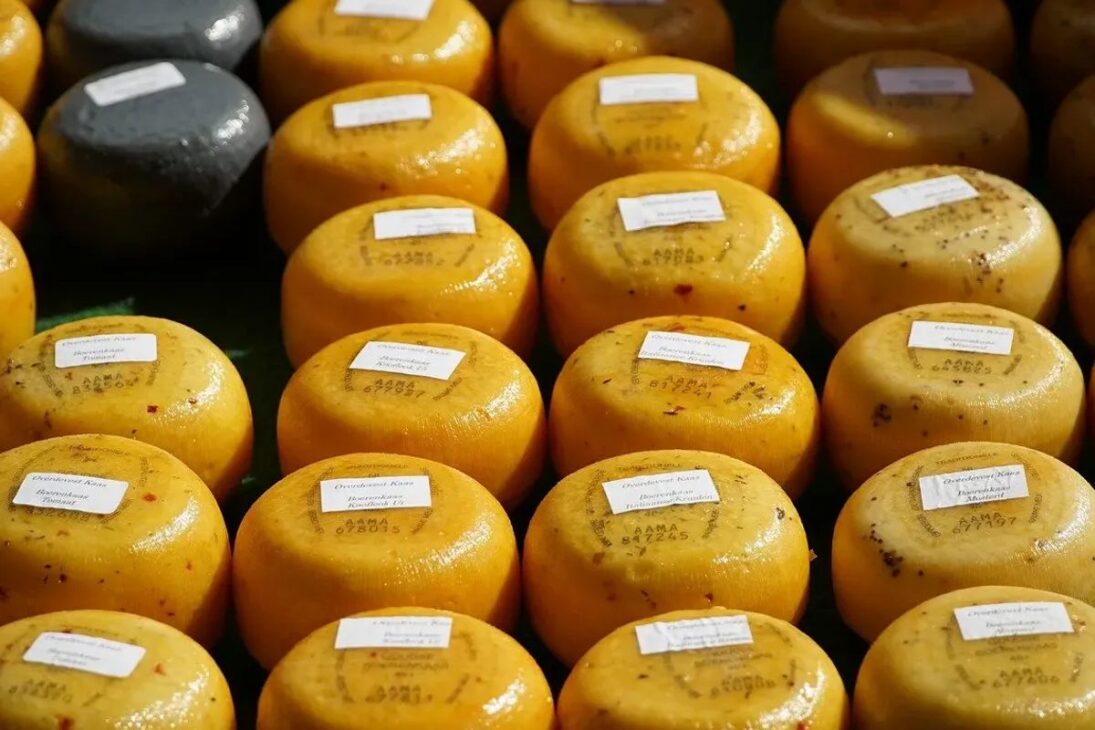
The result of the subsidy policy was a surplus that grew exponentially. By 1981, the stockpile was already over 250 million pounds. The peak of the crisis was reached in 1984, when the US government found itself with a stockpile of over 1.2 billion pounds of cheese, equivalent to 544 million pounds.
This mountain of cheese generated a logistical and financial nightmare. The cost for the government to buy and store the product reached US$ 1 million per day. Ironically, the president elected with the promise to cut government waste became the owner of the world’s largest cheese stockpile, a perfect symbol of the excess he promised to combat.
The Underground Solution
With conventional warehouses overflowing, the government needed a creative solution and found it underground. The main storage site became a series of old limestone mines in Springfield, Missouri.
These mines, hundreds of feet below ground, offered millions of square feet of naturally cooled space, ideal for cheese preservation. Although Missouri was the epicenter, this was a national operation. The millions of pounds of stored cheese were spread across more than 150 warehouses in 35 states.
How “Government Cheese” Reached Americans’ Tables
The turning point came in 1981, when Secretary of Agriculture John R. Block, at a famous press conference, held up a block of cheese that was already moldy, exposing the urgency of the problem to the entire nation and forcing action. Faced with public pressure, President Ronald Reagan authorized the release of the stockpile. Thus, the Temporary Emergency Food Assistance Program** (TEFAP)** was born, a program to distribute the cheese for free.
The product was delivered in five-pound blocks (about 2.3 kg), with a generic and unmistakable packaging. For millions of low-income families, “Government Cheese” became a vital source of food during the recession of the 80s. At the same time, for many, receiving the block of cheese was a symbol of shame and poverty.
The Legacy in 2025, the Policy That Continues and the Pop Culture Icon
The cheese caves are no longer as crowded as they were in the 80s, but the story is not over. The government’s practice of purchasing dairy products to stabilize the market continues, and programs like TEFAP still distribute cheese to vulnerable populations in 2025.
The most surprising legacy, however, is cultural. “Government Cheese” transcended its origin to become a powerful icon of American pop culture. It is frequently referenced in hip-hop music by artists like Jay-Z and Kendrick Lamar, as a symbol of overcoming poverty. In 2025, as it became the title of an Apple TV series, ‘Government Cheese’ completed its journey: from a necessity item and stigma to a ‘cool’ reference in pop culture, cementing its place in American memory.








SE FOSSE NO BRASIL, ESSE QUEIJO TODO SERIA VENDIDO PELO DOBRO DO PREÇO. NÃO CONSEGUIRIAM VENDER É CLARO. LÁ, FORAM DOADOS. TEM COMO MANDAR UM AÍ PRÁ MIM?
Nada foi doado, foi pago pelo contribuinte americano. Aí sim, esse pagou por queijo supervalorizado, mesmo sem querer comer queijo.
Ainda terei tempo de ver os brasileiros terem orgulho da nação. Sem complexo de inferioridade, complexo de virá lata. Somos o melhor país do mundo, somente temos que mudar nosso pensamento errado e começar a pensar em ganhar, ganhar, ganhar e abrir vantagem.
Olha só o “livre mercado” atuando. O consenso de Washington fala que temos que privatizarar estatais. Os EUA tem mais de 7.000 empresas estatais. Por isso a China deu certo: fez exatamente o contrário do que os EUA falaram pra fazer!!!