






 Portuguese
  Spanish


U.S. Company Transforms Wind Turbine Blades into Concrete and Mortar Without Thermal or Chemical Processes, Revolutionizing Construction Worldwide!
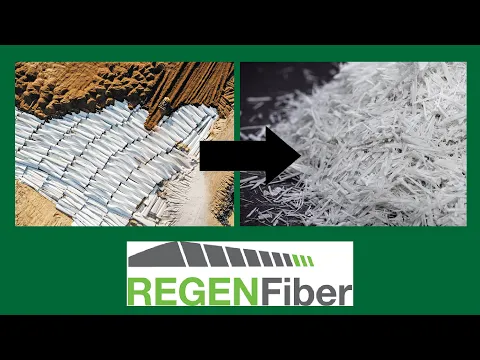
To prevent wind turbine blades from ending up in industrial landfills and to contribute to reducing the ecological footprint of wind farms, Regen Fiber, owned by the logistics solutions company Travero, based in the state of Iowa, USA, is the first and only company in the world to present a recycling process that allows for the conversion of decommissioned blades into materials for the construction industry, without using a thermal or chemical process.
The main final product is a high-performance reinforcement fiber made from wind turbine blade components for use in a variety of applications that can enhance the strength and overall durability of concrete and mortar applications, such as pavements, high-quality slabs, and precast products, in construction works, without ending up in landfills or releasing combustion byproducts, such as carbon, into the atmosphere if burned.
Construction Revolution: Wind Turbine Blades are Turning into Concrete and Mortar

According to the American Clean Power Association (Washington, D.C., USA), wind energy is the largest source of renewable energy in the U.S. and “nearly 70,000 wind turbines across the country are generating clean and reliable energy, revolutionizing construction works.”
-
$134.7 Million Project in São Paulo Installs Over 5 Kilometers of Pipes, Creates New Underwater Crossing to Boost Water Supply for Over 450,000 People

-
At 61, Former Homeless Wheelchair User Receives Key to Container Home in Brazil, Declares Independence
-
São Paulo Highway to Receive Over $260 Million in Upgrades, Including 90 Kilometers of Service Roads and New Infrastructure, by 2027
-
Couple Transforms Abandoned Seaside Public Restroom Bought for £33,000 into £295,000 Beach House After a Decade of Renovations




“With tremendous growth projected in the wind industry and an increasing number of turbines already reaching the end of their approximately 20-year lifespan, REGEN Fiber is entering the market at the perfect time,” says Jeff Woods, business development director at Travero.
REGEN Fiber Expects to Recycle Over 30,000 Tons of Wind Turbine Blade Materials Per Year.
In 2021, REGEN Fiber began piloting the process at a facility in Des Moines, Iowa. Working with clients in the construction industry, in concrete and mortar, REGEN Fiber was able to validate the performance of the products and ensure they meet customer requirements.
Large-scale commercial operations for recycling decommissioned turbine blades began in the second half of 2023. To meet high demand, a new manufacturing facility for REGEN Fiber has been built in Fairfax to recycle these blades.
Once commercial operations in Fairfax reach full production levels, REGEN Fiber expects to recycle over 30,000 tons of materials from decommissioned wind turbine blades per year.
Travero, along with its subsidiary Travero Logistics, supports REGEN Fiber and its customers with all aspects related to the transportation of turbine blades and finished products across North America.
“Travero’s vast experience in supply chain and logistics, production operations, and materials handling is bringing REGEN Fiber’s new recycling process to life,” adds Woods. “We are proud to provide manufacturers with high-quality products made in the USA, helping to protect the environment for future generations.”
According to a press release from Regen Fiber, several dismantling and subsequent recycling operations for some turbine blades that promise to revolutionize construction works are already planned for the entire year of 2024.
I would love to hear what you think about this new recycling technology. Let us know in the comments section if you are a construction professional and your experience in the field. Don’t forget to leave 5 stars and turn on CPG notifications to keep up with all the news from the automotive world. See you next time!


O assunto é interessante, pela inovação e benefícios diretos.
Mas faltou informar ao menos uma parte disto:
1) o tipo de processo físico que transforma as pás em fibras utilizáveis para produção de concreto e argamassa;
2) o tamanho e aparência dessas fibras;
3) o percentual de aproveitamento e de rejeitos das pás;
4) tipos de fibras produzidas (só um tipo?).