Portuguese
  Spanish


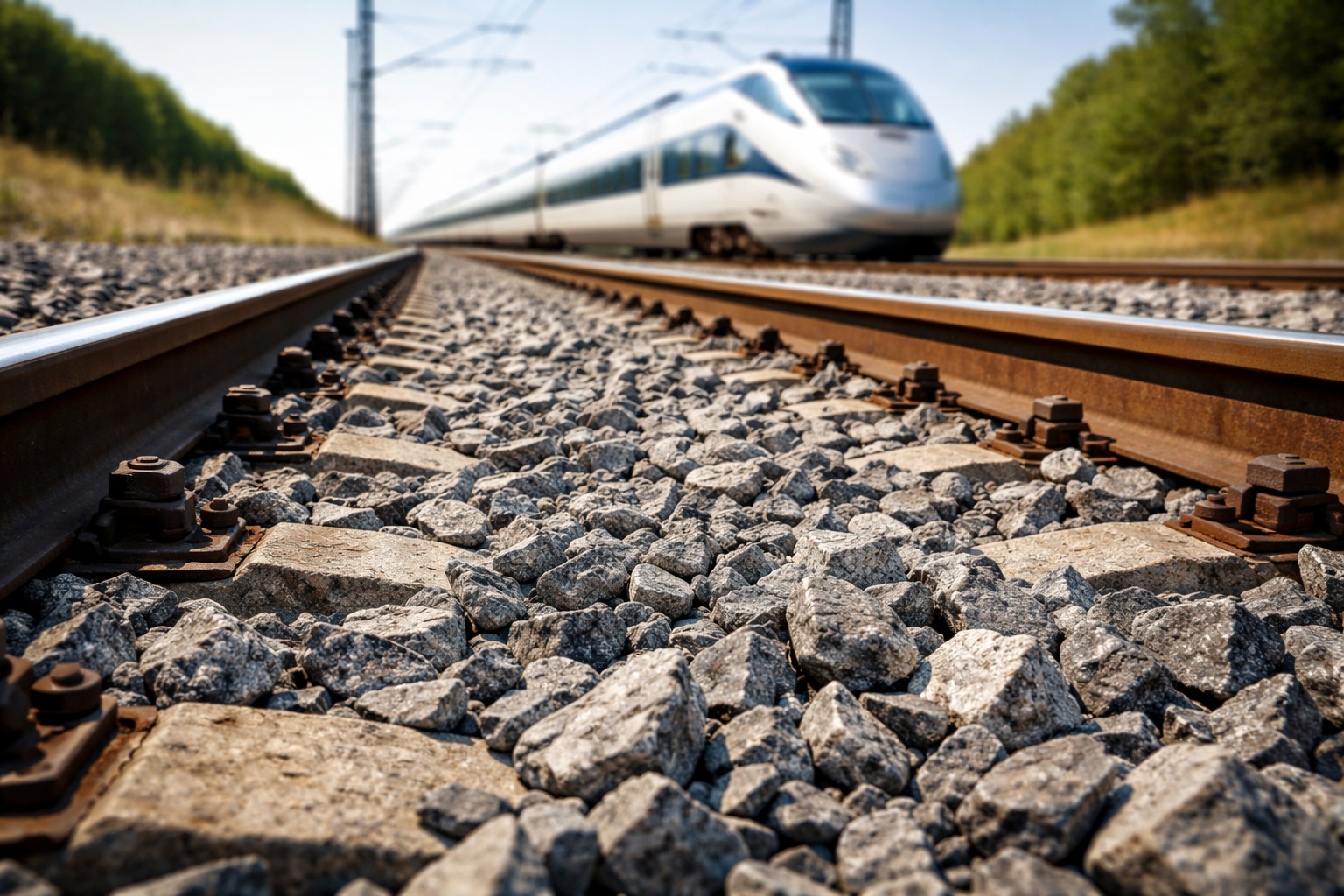


Crushed Stone Ballast Supports Millions of Kilograms of Steel and Provides Stability, Drainage, and Alignment Over Thousands of Kilometers of High-Speed Rails for Over 200 Years
A high-speed locomotive rests on rail ballast, a structure made of loose stones that supports millions of kilograms of steel, distributes loads over thousands of kilometers, and prevents daily disasters, keeping global logistics running for over 200 years.
Rail Ballast Is the Foundation That Absorbs Millions of Kilograms and Prevents Soil Collapse
Underneath modern tracks lies a pile of loose rocks that represents not improvisation, but rather an essential solution in civil engineering.
The rail ballast acts as a large-scale shock absorber, absorbing the concentrated weight of metal wheels.
-
Tourist Discovers Forgotten Joaquín Sorolla Painting Worth Up to 60,000 Euros While Strolling in Seville

-
Brazil’s Fernando de Noronha Boasts World’s Most Beautiful Beach, Accessible Only by Descending 208 Cliffside Steps and With No Food Vendors Allowed

-
Wave Rock: Australia’s Giant Granite Wave Stands 15 Meters Tall, Spans 110 Meters, and Showcases 2.7 Billion Years of Erosion in the Australian Desert
-
How to Unclog Showerhead Holes Blocked by Limescale and Hard Water Without Replacing or Hiring a Technician



These stones, technically called ballast, create a floating base. The structure dissipates the energy accumulated over thousands of kilometers, allowing the track to support millions of kilograms of steel without the ground giving way violently.
The system relies exclusively on friction and the gross weight of the minerals. There are no fixed bolts or rigid foundations anchored to the center of the earth, ensuring organic flexibility in the face of momentary stress.
If the track were laid on a continuous concrete slab, excessive rigidity would cause fatal cracks. The adaptability of the rail ballast prevents this daily structural risk.
Crushed and Sharp Stones Ensure Interlocking and Prevent Slippage
Builders only use extremely hard and angular materials, such as granite or quartzite. The irregular shape creates the physical phenomenon of interlocking, preventing displacements under intense pressure.
When compacted by heavy machinery, the edges penetrate neighboring crevices. A locked and immovable mass forms, capable of withstanding massive vibrations without compromising the stability of the track.
If smooth and rounded river stones were used, vibrations would cause the pebbles to roll like metal bearings. The result would be the immediate derailment of the locomotive.
Sharp gravel ensures extreme grip on the horizontal sleepers, keeps the gauge aligned, and blocks lateral displacements on sharp curves, counteracting centrifugal force.
It also allows for quick millimeter adjustments in response to minor natural settling of the geological terrain, maintaining alignment even under continuous load.
Drainage System and Vegetation Barrier
The thick layer of stones functions as a highly porous drainage system. During heavy storms, water drains through the gaps almost instantly, keeping the soil dry.
Without the rail ballast, rain would turn the base into mud, washing away support and sinking heavy machinery in a matter of minutes.
In addition to draining, the structure prevents the growth of aggressive weeds. The total absence of fertile soil blocks deep roots that could break the physical compaction of the bed.
Vegetation would retain excessive moisture and compromise stability. The mineral barrier eliminates this silent structural risk.
To detail these points, the channel Coisas Simples e Curiosas produced explanatory content about the railway structure and its fundamentals.
Naval Origin of the Term and Use for Over 200 Years
The term ballast comes from classical navigation. Sailors filled empty cargo holds with heavy stones to submerge the hull and ensure stability against strong winds.
This deadweight prevented large ships from capsizing in rough seas. Upon reaching the ports of England, vessels unloaded tons of rocks to carry coal.
The mountains of maritime debris became available material for the first railway designers. The technique was incorporated into land infrastructure over 200 years ago.
Since then, rail ballast has remained a central element in the safety of trains, supporting millions of passengers daily.
Primitive Engineering That Supports High Speed
The crushed stone foundation demonstrates that lasting solutions do not depend on advanced electronics. Pure concepts of mechanical physics ensure uninterrupted safety with low periodic maintenance costs.
This invisible engineering connected entire continents during the industrial revolution and remains essential today.
By positioning basic elements of nature correctly, the system defies weight, weather, and time. The exact stone in the right place supports the railway structure and ensures high-speed operations without systemic failures.
Even in the face of immense forces, rail ballast maintains adaptable and functional stability, proving that a solution created over 200 years ago remains indispensable in modern transportation and global logistics.
With information from BMC News.