






 Portuguese
  Spanish
  4 min of reading
  0 comments


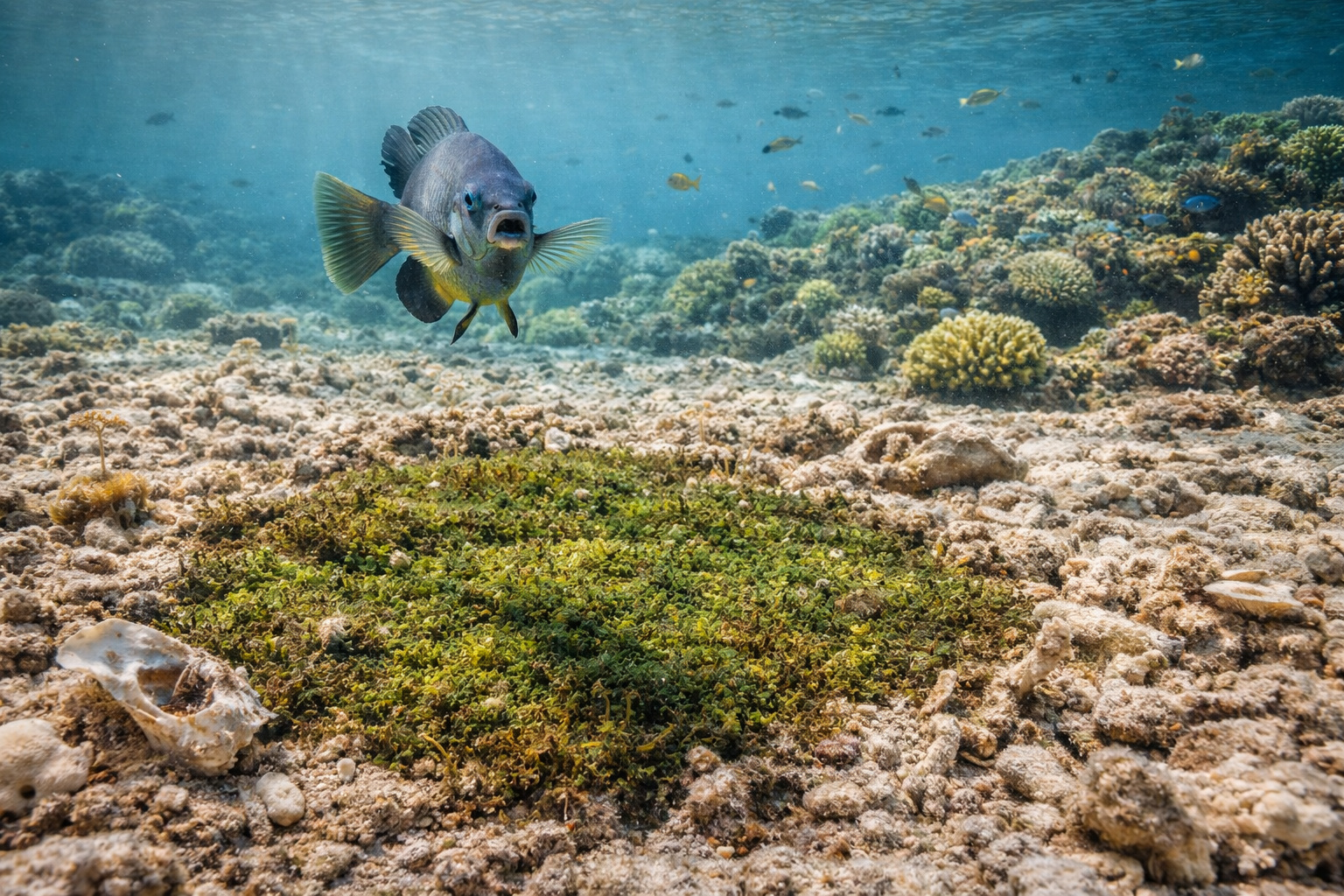
The Small Stegastes Cultivates Algae, Kills Corals and Remodels Tropical Reefs with Its Territorial Behavior, Quietly Altering Marine Ecology.
At first glance, it doesn’t attract attention. With just a few centimeters, discreet colors, and fast fins, the Stegastes, a tropical fish found in Atlantic and Indo-Pacific reefs, appears to be just another piece in the vast underwater landscape. But what makes this species fascinating is something that isn’t immediately visible: its habit of cultivating and defending “gardens” of algae, a territorial behavior that kills corals, expels larger fish, alters ecological competition, and redesigns entire reef communities.
This phenomenon, documented by ecologists and reported in scientific articles from NOAA, PNAS, and Nature Ecology & Evolution, reveals a remarkable example of ecological engineering on a small scale — a process in which an animal modifies its surrounding environment, generating effects that go far beyond its size.
How the Stegastes’ Subaqueous “Garden” Works
The behavior begins with a simple strategy: securing food. While many fish scrape algae indiscriminately, Stegastes do the opposite. They clean an area, remove unwanted species, protect the territory, and allow specific algae to grow. These nutrient-rich algae become their main food source.
-
Two Brazilian students created a hospital bed with voice control to help their sick grandmother and won an award in Portugal: the prototype allows patients to adjust height and inclination just by speaking, without cranks, and promises more autonomy for the elderly and people with reduced mobility.

-
Public school students from Sertão de Pernambuco create a $5 filter using sugar-apple peel, transform toxic cassava waste into drinking water, and win 1st place nationally in Samsung’s innovation contest.

-
8-year-old boy found small balls in the yard, thought they were seeds, and helped U.S. universities reveal a hidden natural strategy in oak galls, showing how small domestic observations can change scientific research on discrete natural processes.
-
The owner of Facebook, Mark Zuckerberg, opened his wallet and paid the equivalent of R$ 72.9 billion, or US$ 14.3 billion, to hire a 28-year-old and put him in charge of Meta’s new superintelligence.


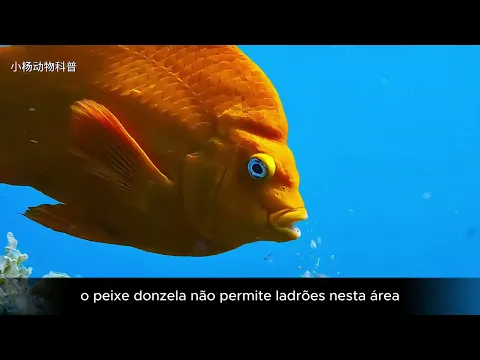

The territory is defended with aggression disproportionate to the size of the fish. Divers and researchers report direct attacks on equipment, on much larger fish, and even on turtles that accidentally approach the “gardens.”
By preventing larger herbivores — such as surgeonfish and parrotfish — from eating the algae, the Stegastes ensures a continuous and exclusive production. This territorial behavior creates an interesting cycle:
- area cleaning
- selective algae growth
- active defense against herbivores
- development of a monoculture
- substrate alteration
Over time, these gardens become clearly visible in healthy reefs: dense, green patches surrounded by corals and sponges, like small farms amid the underwater city.
Dead Corals, Living Algae: The Unexpected Ecological Effect
But there is an important consequence: by allowing algae to grow, the Stegastes promotes an increase in coral-algae competition. Corals need light and space to survive. If a surface is dominated by algae, the coral cannot settle, does not grow, or slowly dies.

Thus, the behavior of the little fish can kill corals through indirect suffocation, something documented especially in the Caribbean, Brazilian coast, and tropical Pacific.
When this occurs on a large scale, the result is a deep change in the landscape, reefs that were dominated by corals become dominated by algae.
This is particularly concerning because coral reefs are one of the most biodiverse habitats on the planet, often compared to underwater tropical forests.
An Effect Amplified by Human Action
It’s important to note, however, that the most severe effects of this process tend to manifest primarily in reefs already degraded by human actions, such as global warming, coastal pollution, eutrophication, and overfishing of large herbivores. In healthy reefs, competition between corals and algae is usually balanced, and the territorial impact of Stegastes remains localized.
However, when the system is already under stress, the cultivation of algae by these fish can accelerate the replacement of coral reefs by algae-dominated reefs, making the natural recovery of the ecosystem more difficult.
A Miniature Ecological Engineer
The term “ecological engineer” is used for species that physically modify the environment — such as beavers, moles, or certain boring mollusks. The Stegastes fits this definition perfectly. Its impact falls across at least five ecological layers:
- submarine vegetation — favors specific algae
- reef substrate — prevents coral settlement
- food chain — excludes larger herbivores
- microhabitats — creates ecological mosaics
- ecological succession — alters who comes next
These transformations are localized, but can spread if there is high population density and fishing pressure, especially because reefs with few herbivores are more vulnerable to algal domination.
A Sophisticated Evolutionary Strategy
From an evolutionary standpoint, “gardening” is an efficient solution. Instead of directly competing for food — something risky and unpredictable — the Stegastes creates an exclusive resource, protected, and continuously renews it.
This resembles behaviors seen in social insects, like ants that cultivate fungi, but here it occurs in a solitary, territorial fish situated on top of tropical corals.
It’s an example of how behavior, ecology, and evolution can converge to generate unique strategies.
Impacts in a Changing Ocean
This phenomenon gains even more importance in light of the climate crisis. Corals already suffer from thermal bleaching, acidification, pollution, and overfishing.
When reefs are weakened, opportunistic algae grow faster, and the Stegastes finds easy substrates to expand its gardens. This creates a domino effect:
- warming kills corals,
- algae proliferate,
- Stegastes defends algae,
- herbivores decrease,
- corals fail to recover.
For marine ecologists, the presence of this fish in degraded areas is a warning sign, not an isolated cause of degradation.
What the Stegastes Teaches Us About the Future of Reefs
The small fish that creates subaqueous gardens reveals something larger: reefs are not static, but ecological powerhouses, where tiny disputes shape enormous landscapes.
A tiny animal, silently cultivating algae, can help or hinder coral recovery depending on the context.
This perception changes the way we think about marine conservation.
It’s not enough to protect corals: we must understand relationships, control herbivory, reduce overfishing, and recognize that the health of a reef depends on both small fish and large predators.
In the end, the Stegastes reminds us that the ocean is a living mosaic, and that some of the most profound transformations come not from whales or sharks, but from small underwater farmers working silently, garden by garden.


-

-

-

-

9 people reacted to this.