






 Portuguese
  Spanish


Published on June 2, 2026, the story of the voice-controlled hospital bed features João Marcelo and Cauã Da Cal, students from ETEHL/Faetec in Niterói, awarded at the 2026 Science Fair in Portugal with a project inspired by their sick grandmother and aimed at patients with reduced mobility autonomy.
A voice-controlled hospital bed created by two Brazilian students won the award for best international project at the 2026 Science Fair in Portugal. The prototype was developed by João Marcelo and Cauã Da Cal, Electronics students at the Henrique Lage State Technical School, a unit of the Faetec Network in Niterói, Rio de Janeiro.
The story was published by Só Notícia Boa on June 2, 2026, and shows how a family need turned into a technological solution. The idea was born from the experience of João Marcelo, 18, who sought a way to improve the routine of his grandmother, who faces heart problems.
Prototype was born from a family need
The initial motivation did not come from a commercial demand, but from a domestic situation. João Marcelo wanted to find a way to offer more comfort and quality of life to his grandmother, who needed care due to heart problems.
-
What is a red flashlight used for, after all? See why it is so commonly used at night.

-
He has never read a line of code, but he already knows how to work: the French company UMA presented in Paris the Northstar, its first AI-powered humanoid robot designed for factories and warehouses, capable of copying tasks just by observing an employee in action.

-
A young Kenyan engineer collects plastic waste from the streets and transforms it into robots that translate physics lessons into sign language in real-time, a machine made with old bottles that teaches what was missing to deaf children left out of science.
-
What is the dark substance found in the sand of Ipanema Beach? Civil Police conduct an examination, collect samples of the material, and initiate an investigation to identify the composition, clarify the origin, and verify if there was an environmental crime.



From this concern, he and Cauã Da Cal began to develop a hospital bed that could be controlled by voice. The goal was to allow people with reduced mobility to have more autonomy to adjust their own bed, without always depending on someone else.
Students are from the Faetec network in Niterói
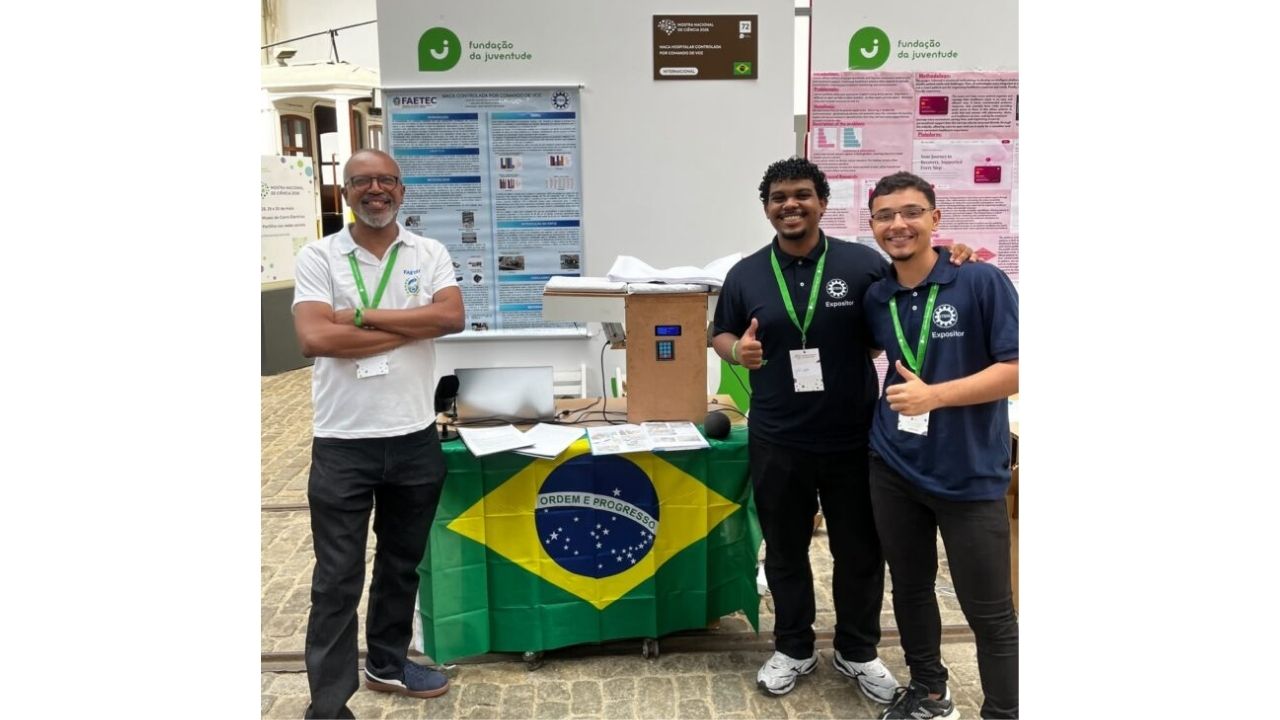
João Marcelo and Cauã Da Cal study Electronics at the Henrique Lage State Technical School, known as ETEHL. The unit belongs to the Faetec Network and is located in Niterói, Rio de Janeiro.
The two were the only representatives from Brazil at the awards in Portugal, according to the report. This detail highlights the reach of the project, which started from a public technical school in Rio de Janeiro and reached an international science exhibition.
Technical guidance helped turn idea into project
The development was guided by Professor Altair Martins. The report states that the project took shape after a year of research, tests, and technical visits to Antônio Pedro Hospital.
This stage was important because it brought the idea closer to the hospital reality. Instead of remaining just a concept, the hospital stretcher went through a process of technical maturation, with observation of practical needs and adjustments to the prototype’s functioning.
Voice command replaces cranks and touch keyboard
The technology used in the so-called stretcher 3.0 involves voice recognition modules. With this, the patient themselves can adjust the height and inclination of the bed just by speaking commands, without using cranks or a touch keyboard.
The proposal has a direct impact on the elderly, people with reduced mobility, and even quadriplegic patients, as explained by the students. Autonomy is at the center of the innovation: the patient no longer depends entirely on physical strength or external help for simple position changes.
Award in Portugal gave international recognition
The most recent achievement mentioned in the report was the award for the best international project at the Science Exhibition 2026 in Portugal. The recognition occurred the weekend before the publication of the article, released on June 2, 2026.
For the students, the award put the hospital stretcher in the spotlight outside Brazil. The case shows how school projects can cross borders when they combine a real problem, applied research, and a functional solution.
Project had already accumulated other awards in Brazil
Before reaching Portugal, the prototype had already received other recognitions. The report mentions the first place at the CRT-RJ fair, the Regional Council of Industrial Technicians of the State of Rio de Janeiro.
The stretcher was also awarded at Mostratec, in the Electronic Engineering category, won second place at FECTI, Science, Technology and Innovation Fair of the State of Rio de Janeiro, and came in third place at Febrace, Brazilian Science and Engineering Fair.
Idea targets patients who need more independence
The focus of the prototype is to facilitate the routine of those who depend on an adjustable bed or stretcher. For many patients, movements like raising the torso, changing the inclination, or adjusting the bed height require constant assistance from caregivers or professionals.
By responding to voice commands, the hospital stretcher reduces part of this dependency. The technology does not replace human care, but it can enhance autonomy in simple and repetitive daily tasks.
Student innovation shows the strength of technical school
The story also highlights the role of technical education. João Marcelo and Cauã Da Cal applied Electronics knowledge to solve a concrete problem, with the support of a guiding teacher and contact with a hospital environment.
This type of project shows how technical schools can generate solutions with social impact. When students have guidance, a laboratory, a real challenge, and space to test ideas, innovation can emerge even before university or the market.
Simple technology can change the routine in care
The strength of the project lies in transforming an already known function, the adjustment of a stretcher, into something more accessible for those with physical limitations. Voice command makes interaction more direct, especially for patients who cannot operate cranks or touch panels.
The hospital stretcher created by the Brazilian students is still presented as a prototype, but its logic points to a real demand: more responsive, accessible health equipment designed for the autonomy of its users.
When the classroom meets a real need
The story of João Marcelo and Cauã Da Cal shows that great ideas can arise from nearby situations. A problem experienced by a student’s grandmother motivated a solution that received awards in Brazil and international recognition in Portugal.
The case also raises an important question: how many solutions for the elderly, patients, and people with reduced mobility could emerge within Brazilian technical schools if more projects had support, guidance, and visibility? Leave your opinion in the comments.


