Portuguese
  Spanish



Groundbreaking Discovery Reveals Isolated Black Hole, Without Surrounding Stellar System, Silently Crossing the Galaxy
The existence of a lonely black hole has finally been confirmed by an international team of astronomers. This is the first time such an object has been identified without the presence of a companion star, marking an important advance in modern astronomy.
Discovery Began in 2022
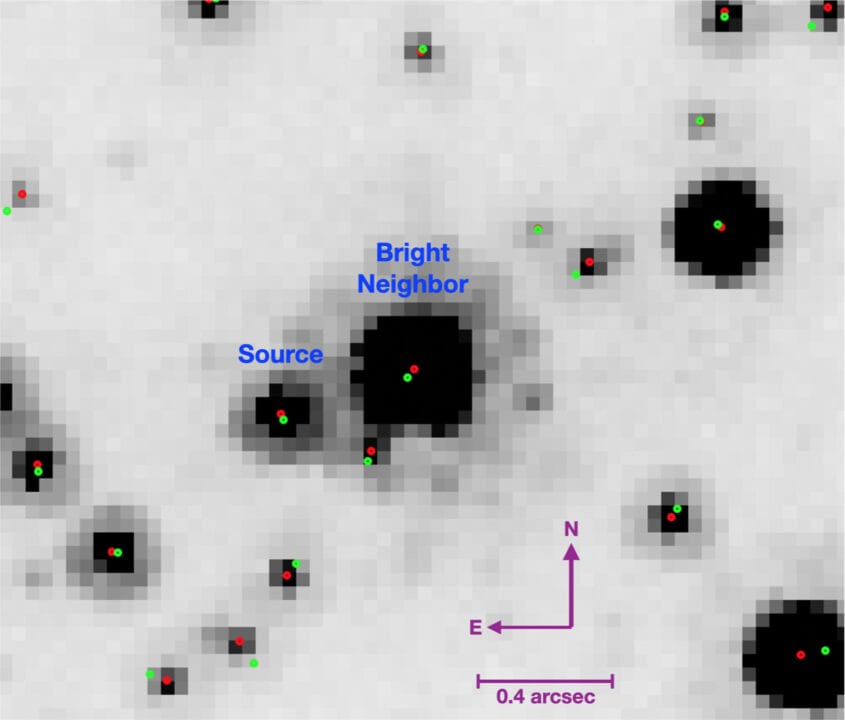
In 2022, researchers affiliated with the Space Telescope Science Institute observed a dark object in motion in the constellation Sagittarius.
They suspected it was a lonely black hole, that is, a black hole without a companion star.
-
DNA Analysis Reveals How Five Cattle Survived Over 130 Years on a Deserted Brazilian Island

-
Private Spacecraft Intercepts Another for First Time in History During U.S. Space Force Mission Completed 11 Hours Early with Rocket Launched in Record 16 Hours

-
Scientists Predict Earth’s Habitable Lifespan: 1.8 Billion Years Before Oceans Evaporate and Sun Forces Planet Out of Life Zone
-
LG Unveils XBOOM Stage 501 Portable Speaker with 25-Hour Battery, AI Karaoke, and Sound by will.i.am in Brazil


However, another scientific team contested this hypothesis, suggesting that the observed object could be a neutron star.
New Analysis Confirms the Original Hypothesis
The original team did not stop there. Based on more recent data, they deepened the study. Records from the Hubble Telescope from 2021 to 2022 were used, in addition to information collected by the Gaia space probe.
The new analysis indicated that the object has about seven times the mass of the Sun. This data was decisive: a neutron star could not have this mass. Therefore, the most plausible explanation was that the object was indeed a black hole.
Confirmation Also Came from the Rival Team
Interestingly, the second team of researchers, which had previously suggested an alternative interpretation, reviewed their data in 2023. They also concluded that the observed object is indeed a black hole.
The measurement made by this second group indicated a mass close to six times that of the Sun.
Even with slight differences, the data aligned and reinforced the conclusion that the object is a lonely black hole.
A Rare and Difficult Type to Observe
The distinguishing factor of this discovery is the fact that, until now, all identified black holes had a companion star.
This made their detection easier, as scientists could observe them based on the effects caused on the light of the neighboring star.
In the case of the lonely black hole, there is no such help. The object was only identified because it passed in front of a distant star, temporarily distorting its light and position in the sky.
Expectation for New Discoveries in the Future
With the official confirmation published in The Astrophysical Journal, the team hopes that other lonely black holes may be found in the coming years.
The bet is on the Nancy Grace Roman Space Telescope, expected to be launched in 2027. The new equipment is expected to significantly enhance the capacity to detect these rare and silent objects in the universe.