





 Portuguese
  English
  Spanish
  3 min of reading
  0 comments



DARPA Hires RTX BBN to Develop X-Ray Algorithms Capable of Inferring Internal Composition Up to 1 Kilometer with Low-Quality Data in the XENA Program
The long-range X-ray image is the focus of a new contract between DARPA and RTX BBN Technologies to create algorithms capable of inferring the internal composition of objects up to 1 kilometer away, even with incomplete or inaccurate data.
The United States government already invests billions of dollars in X-ray imaging technology aimed at security, according to the National Institute of Standards and Technology, NIST.
The new project expands this effort by proposing tools capable of “seeing” a little over half a mile.
-
The sea has stopped just warming and has started pushing storms towards the continent: marine heatwaves are already entering the path of up to 25% of extreme coastal rains and can increase storms by 30%, worsening floods on the coast.

-
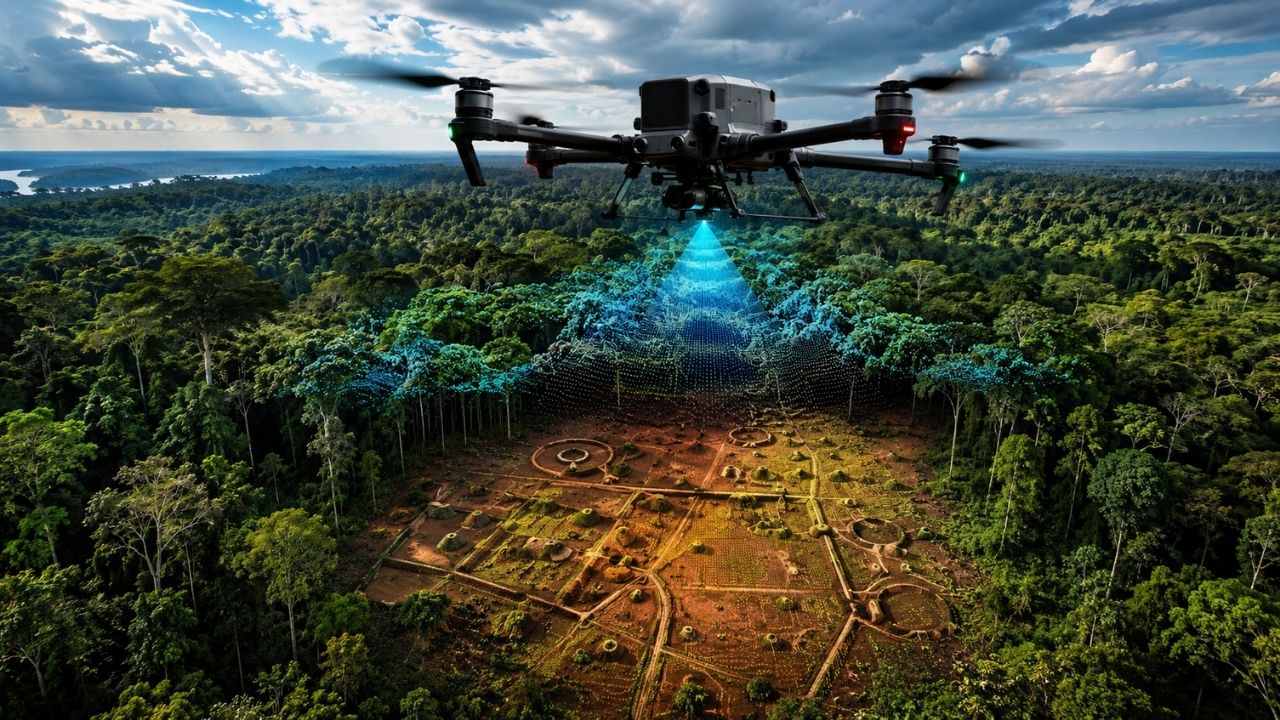
Drone flies over indigenous area in Xingu and creates a point cloud capable of penetrating the tree canopy, revealing the forest floor, and mapping archaeological sites, ancient villages, roads, and ditches used to understand the historical occupation of the Kuikuro territory.
-
New technology may retire the common electric shower: Xiaomi introduces an intelligent model with tempered glass, a giant 305 mm spreader, antibacterial function, four water modes, and controls inspired by piano keys for around R$ 640 in China.

-
Japan surprises the world by launching a wooden satellite only 10 cm in size into space: the LignoSat project spent 240 days exposed on the ISS, withstood radiation, and could reduce space debris generated by metal structures.



In a statement released on Wednesday, RTX BBN Technologies announced that it was selected by the Defense Advanced Research Projects Agency, DARPA, to develop long-range X-ray imaging algorithms based on a distinct approach.
Unlike traditional methods, which rely on a few high-resolution images, BBN’s proposal utilizes a large volume of low-quality samples.
The company bets on extensive simulations to build a robust mathematical model.
The XENA Program and the Focus on Long-Range X-Ray Imaging
The initiative is part of the XENA program, which stands for Extreme Range X-Ray Analysis Without Images, from DARPA.
The goal is to develop algorithmic toolsets capable of inferring the internal composition of objects located at great distances.
The program aims to tackle a recurring problem in military contexts: motion blur, which reduces the quality of intelligence data.
As the device moves away from the target, noise and image instability compromise the transmission of information.
With long-range X-ray imaging, the expectation is to overcome this historical limitation. Traditionally, X-ray technologies applied to surveillance have restricted ranges precisely because of the progressive degradation of data.
Historical Limitations and Data Collection
According to NIST, law enforcement and military authorities have used X-rays for decades to locate hidden objects, including threats and smuggling. However, these systems often operate at short distances.
The main challenge in advancing these technologies has been the need for large volumes of high-quality data to train systems applicable to the real world. Collecting this material in the field is complex and costly.
BBN’s proposal changes this logic by prioritizing low-quality data, which is simpler to obtain in large quantities.
From this volume, the algorithm is trained to solve practical problems even with unstable or fragmented images.
Remote Recognition Up to 1 Kilometer
According to the company, the approach will remain valid at distances of up to about 1 kilometer, equivalent to 0.6 miles.
The focus is to transform a reduced number of granular snapshots into usable information for decision-making.
Joshua Fasching, the project’s principal investigator at BBN, stated in a statement that the algorithms are being developed to convert imperfect images into sufficient details for assessing threats or supporting emergency response operations.
The long-range X-ray image, if implemented as planned, could provide the military with access to practical information about hidden threats, potential weapons, or structural vulnerabilities from previously inaccessible ranges.
BBN’s History and Link with DARPA
BBN Technologies, based in Massachusetts, is a subsidiary of RTX, a Virginia-based aerospace and defense manufacturer. Since 1948, the company has participated in advancements in networking technologies, many of which have been supported by DARPA itself.
Now, with the XENA program, the company focuses its efforts on algorithms capable of operating in scenarios that closely resemble those found on the battlefield.
The goal is to enable commanders to detect dangers proactively at extended distances.
If development proceeds as planned, the new class of long-range X-ray imaging tools could redefine how fragmented data is processed in security and defense contexts, maintaining an emphasis on decisions based on practical information.
With information from Gizmodo.






-

2 people reacted to this.