






 Portuguese
  Spanish


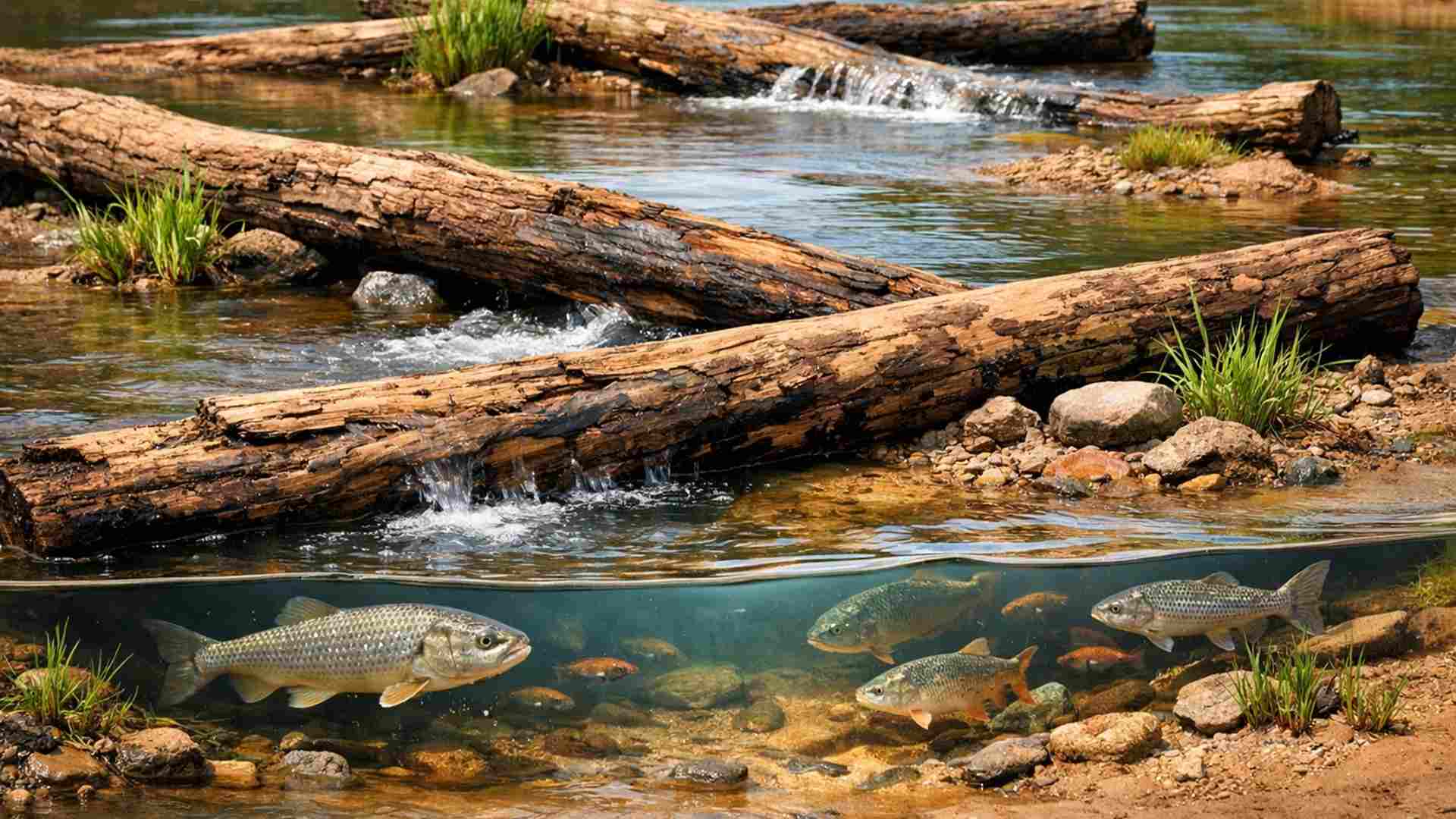


The Technique Applied to the River Most Affected by the Disaster in Mariana Showed That the Planned Reintroduction of Logs and Branches Reduced Water Speed, Increased Sediment Retention, and Recreated Essential Habitats, Allowing for the Recovery of Aquatic Biodiversity Based on Scientific Evidence and Continuous Monitoring
More than ten years after the collapse of the Fundão dam in Mariana (MG), the Gualaxo do Norte river has become Brazil’s main laboratory for an environmental recovery technique based on natural solutions, low cost, and continuous scientific evidence, now internationally recognized as one of the world’s most successful river restoration projects.
The project, named ReNaturalize, started as a pilot experiment in 2016 and scaled up from 2018, with the systematic implementation of renaturalization structures in severely degraded sections of the river.
Developed in partnership with the Renova Foundation, the project uses natural resources to accelerate the restoration of the aquatic ecosystem.
-
China Develops Custom 140-Ton Electric Mining Truck with 770 kWh Swappable Battery, Deploys 290 Units in Xinjiang’s Largest Zinc Mine

-
Meta to Launch Arena, a New Prediction App Targeting 3.56 Billion Users, Competing with Polymarket and Kalshi

-
Scientist Challenges Famous Human Evolution Theory, Argues Homo Sapiens Evolved Gradually Over Thousands of Years
-
15-Year-Old American Builds Ocean Generator with PVC Pipe and 3D-Printed Propeller for $12, Wins National Prize, Presents at White House, and Makes Forbes 30 Under 30 List




In 2022, the results of the first five monitoring campaigns were consolidated into an extensive technical report, which indicated measurable physical, hydrological, and biological improvements in the ecosystem.
Since then, the project has moved on to new stages, accumulated additional field data, and received independent external evaluations that reinforced the method’s effectiveness.
International Evaluation Ranks Brazilian Project as “Exceptional”
One of the most significant milestones following the publication of the technical report occurred when a team of scientists from the Society of Environmental Toxicology and Chemistry (SETAC World) assessed the Brazilian project as “exceptional,” the highest rating awarded by the organization.
SETAC World is a global nonprofit scientific organization with over 20,000 members and 85 partner organizations across more than 90 countries, dedicated to advancing environmental science and sustainable ecosystem management.
The evaluation involved over 60 projects from various countries, all focused on the environmental recovery of degraded areas.
In the Brazilian case, scientists analyzed monitoring data, methodology, replicability, and concrete ecological results obtained in the Gualaxo do Norte river. The report highlighted the proven recovery of water quality, significant increases in aquatic biodiversity, and the scientific consistency of the method adopted over time.

From Pilot Experiment to Applied Scientific Reference
The technique used in the Gualaxo do Norte was developed by Aplysia Environmental Solutions after comparative studies conducted in Europe and North America, where similar river restoration strategies had been implemented on a large scale.
According to the project coordination, the first pilot was deployed in 2016, still on a reduced scale, with the aim of testing the viability of the technique in tropical rivers impacted by mining waste.
The initial success led to the adaptation of the method for a pilot stretch of approximately 2 kilometers of the Gualaxo do Norte, considered the most degraded after the Mariana disaster.
The methodology is based on the planned reintroduction of logs, branches, and other natural materials into the riverbed and banks, recreating structural heterogeneity, calm zones, and hydraulic refuges. These structures reduce water speed, favor controlled sediment deposition, and recreate essential habitats for fish, macroinvertebrates, and associated organisms.
Technical Monitoring Confirmed Consistent Ecological Gains
The technical report presented in 2022 indicated significant progress in environmental indicators. The data showed that, in the renaturalized stretches, there was an increase in bed complexity, greater hydraulic retention during low flow periods, and the formation of micro-habitats that did not exist after the passage of mud.
The monitoring campaigns also indicated stability in water quality parameters, remaining within the established standards for class 2 freshwater in Minas Gerais, even in previously more impacted sections.
In the biological field, the most significant results were observed in the response of fish fauna and the community of benthic macroinvertebrates, considered key indicators of aquatic ecosystem health.
Fish Population Showed Accelerated Growth
With the continuation of the project and the expansion of analyses after 2022, the most recent data reinforced the positive trend already observed in the technical report. In the Gualaxo do Norte river, nearly a doubling in the number of fish was recorded, accompanied by significant changes in population structure.
The monitoring indicated that fish not only increased in number but also in average weight, reflecting better feeding, shelter, and breeding conditions. One of the most relevant data was an 81% increase in the population of juvenile fish in just one year, evidencing the recovery of nursery areas along the river.
These results are directly associated with the reduction of water speed at strategic points, which reached up to 63% in certain stretches, creating more stable and energetically favorable environments for the development of species.
Nature-Based Solutions Reduce Hydrological Risks
In addition to ecological gains, the project has also been analyzed from the perspective of environmental risk management. The formation of calm zones and the retention of sediments in the renaturalized stretches help reduce the excessive transport of particulate matter to larger rivers.
This dynamic tends to decrease downstream sedimentation and, consequently, the risk of flooding during high water periods, an indirect benefit highlighted by specialists monitoring the project.
The use of natural materials, such as logs and branches, combined with the absence of heavy engineering works, makes the technique easily adaptable to different geographical contexts, including small and medium-sized rivers distributed across Brazil.
International Recognition and Unprecedented Award by BRICS
The progress of the project was also recognized in multilateral forums. In 2021, ReNaturalize won an unprecedented award at the BRICS Solutions for SDGs Awards, aimed at technological and scientific solutions aligned with the United Nations Sustainable Development Goals.
Registered in the Potable Water and Sanitation category, the project was the only representative from Brazil among the awarded initiatives. A total of 290 initiatives from different countries were evaluated, all focused on innovation, social impact, environmental sustainability, and economic viability.
The recognition reinforced the potential of the method as a replicable public policy, especially in countries with a large number of degraded rivers and budgetary constraints for high-cost environmental recovery works.
Local Participation and Continuous Science as Pillars of the Project
Another aspect highlighted in the recent evaluations is the involvement of the local population throughout the different phases of the project. Residents of the Bento Rodrigues region participate in field activities, monitoring interventions, and educational actions related to the sustainable use of the river.
According to the coordination of ReNaturalize, environmental recovery is not treated as an immediate process, but as a gradual construction based on continuous scientific monitoring, methodological adjustments, and direct observation of ecosystem responses.
By 2026, the data accumulated over nearly a decade indicate that the renaturalization of the Gualaxo do Norte river has stopped being merely an emergency response to the Mariana disaster and has come to represent a Brazilian model of river restoration with international recognition.
Project Is Now Cited as a Reference for the Recovery of Degraded Rivers
With consolidated results, independent evaluations, and international awards, ReNaturalize has begun to be cited in technical and scientific forums as a viable alternative for the recovery of hundreds of degraded rivers in Brazil.
The experience in the Gualaxo do Norte demonstrates that the recreation of natural habitats, when based on applied science, rigorous monitoring, and low-impact solutions, can produce measurable results in relatively short timeframes, even in severely impacted environments.
In a country marked by historical environmental liabilities related to mining, urbanization, and deforestation, the case of the Gualaxo do Norte river consolidates, in 2026, as one of the most documented and successful ongoing river recovery experiences in the national territory.







Parabéns a todos os envolvidos nesse projeto de recuperação fluvial de rios degradados. Prêmio mais que merecido à ReNaturalize, em razão do empenho e dedicação em benefício dos nossos ecossistemas, contribuindo, assim, para uma melhor qualidade de vida no Planeta. Emocionada e imensamente grata, presto a todos minha reverência!🙏💓👏👏👏
A mesma coisa que varrer a casa e jogar a sujeira para debaixo do tapete, aí quando der uma enchente os sedimentos continuam no fluxo.
E a pergunta que não quer calar:
Em que condições estão os peixes que proliferaram, porque no rio doce em regência, os peixes estão cheios de tumores.
Projeto Maravilhoso desenvolvido pela CAROLINA ORLANDI !👏🏻👏🏻👏🏻