Portuguese
  Spanish



Pearls Inspire New Revolution in Engineering! Ultra-Resistant Cement Imitating Nature Developed by Researchers.
Researchers at Princeton University found a delicate element of nature to be a powerful source of inspiration to revolutionize civil engineering. Nacre — the substance that forms pearls, also known as mother-of-pearl — led to the development of a new type of cement with surprising strength, promising to transform the way we build.
Despite being associated with beauty and fragility, pearls possess a structure in their composition that combines flexibility and hardness, ideal characteristics to face structural challenges. This discovery reinforces how nature is still a valuable source of solutions for materials science.
How Pearls Shaped the New Cement?
The study, led by Shashank Gupta from the Department of Civil and Environmental Engineering at Princeton, focused on reproducing the impressive structure of nacre in the lab.
-
Brazilian Airport to Receive $2.8 Million Investment, Completion Expected Within a Year

-
UN Warns of AI’s Environmental Impact and Calls for Greater Corporate Transparency

-
Former Atacadão Employee Turns Online Cake-Baking Lessons into a Confectionery Brand with Factory, Store, Delivery, and Nearly $400,000 in Revenue
-
Brazilian Startup Sells Nearly 9 Million Surprise Bags of Near-Expiry Food, Prevents Thousands of Tons of Waste, Aiming for $42 Million Revenue by 2026




The natural material, produced by mollusks to coat their shells, is known for its ability to deform without breaking — a highly desirable characteristic in construction.
Using this inspiration, scientists created hexagonal structures with cement paste sheets, separated by layers of polydimethylsiloxane (PDMS), a hyper-elastic polymer.

The result was a new type of cement with superior mechanical properties compared to traditional cement.
Tests Reveal 17 Times Greater Strength
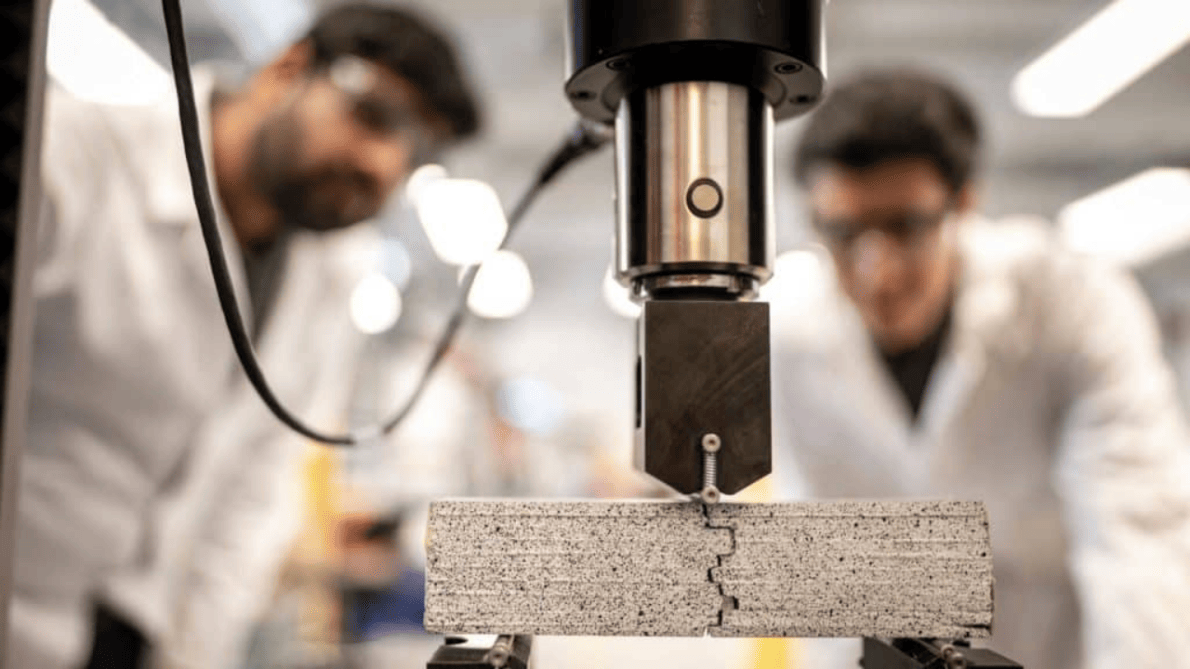
To prove the effectiveness of the new cement, researchers manufactured beams using both traditional material and pearl-inspired cement.
Both were subjected to flexural testing, a standard procedure in engineering that evaluates the breaking point of structures.
The results were surprising: while conventional beams exhibited brittle behavior, nacre-type beams demonstrated 19 times more ductility and 17.1 times more toughness, supporting much greater pressure without yielding.
Path to Safer and More Durable Constructions
This innovation can signify a true revolution in building materials. The new cement, inspired by pearls, promises greater resistance to cracking, increased durability, and consequently, greater safety in civil structures.
According to the publication New Atlas, researchers will still conduct tests in real environments before commercial application, but the potential of the composite is already generating great interest in the sector.
This union between nature and technology reaffirms that, even in times of artificial intelligence and digital advances, engineering has much to learn from the ancient processes of nature.