





 Portuguese
  English
  Spanish
  4 min of reading
  1 comment


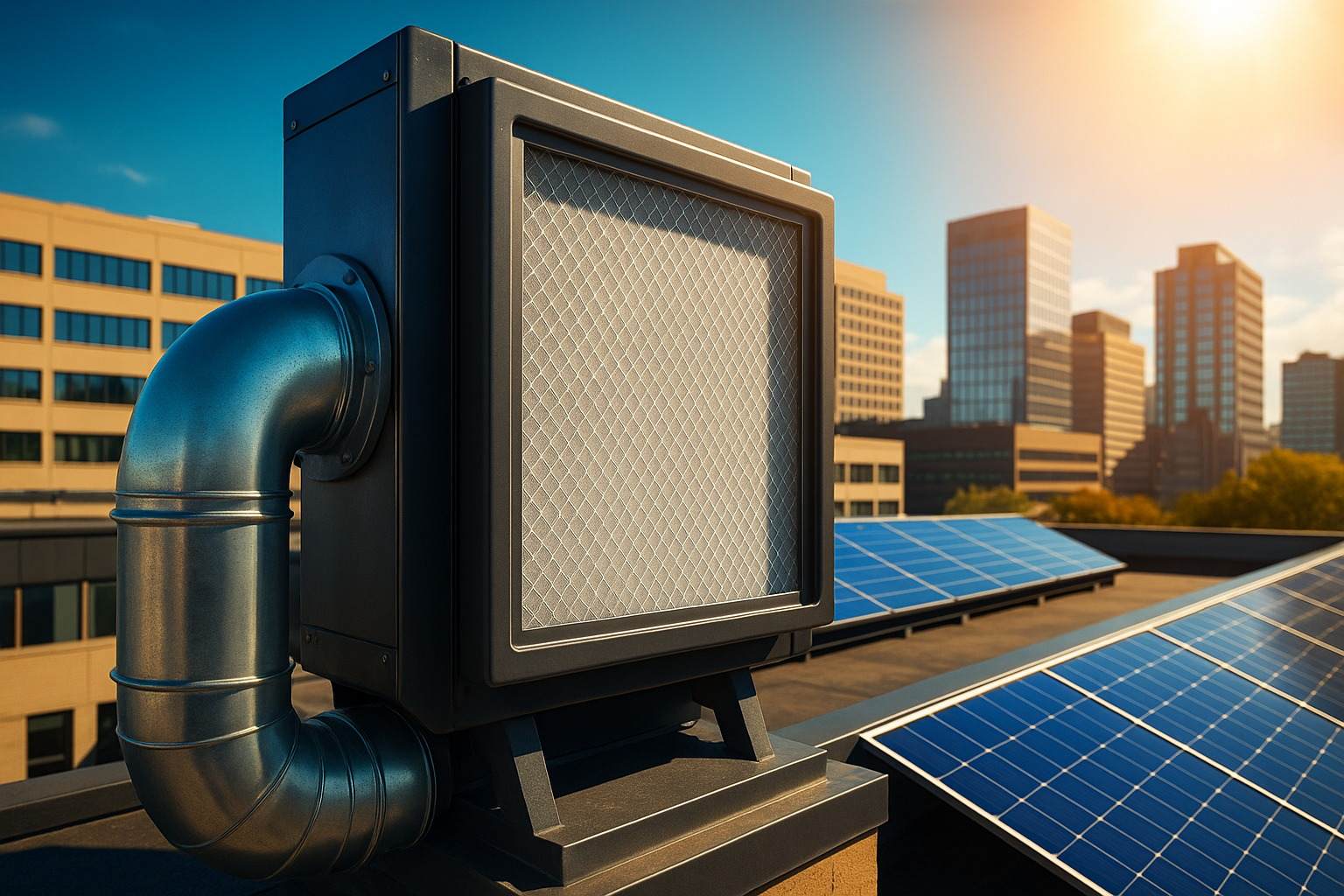


A New Technology Promises to Transform Common Ventilation Systems into Weapons Against Global Warming, Capturing CO₂ Directly from the Air and Removing Up to 596 Million Tons Per Year at Low Cost and Minimal Energy.
As carbon emissions continue to rise worldwide, scientists reinforce a consensus: reducing is no longer enough — reversal is required. In this scenario, a promising innovation emerges as an efficient and accessible alternative: filters installed directly in ventilation systems that capture CO₂ from the air with very low energy consumption and the potential to remove up to 596 million tons annually on a global scale.
Passive Capture and Simple Installation
The technology relies on something already present in nearly every modern building: HVAC systems — short for heating, ventilation, and air conditioning.
The team of researchers responsible for the project developed an air filter made of carbon nanofibers coated with a polymer called PEI, capable of capturing carbon dioxide passively without compromising airflow.
-
China surrounds the country’s largest desert with a gigantic green belt of 3,046 km, transforming the “sea of death” into an “ecological scarf” and uses vegetation, straw, and solar energy to hold back the sand, protect oases, save cities, and create billion-dollar income for families in the desert.

-
The “freshwater lid” that worries scientists: Greenland melts, could weaken Atlantic currents and is already being monitored by robots, satellites, and artificial intelligence before altering the climate in the coming decades.
-
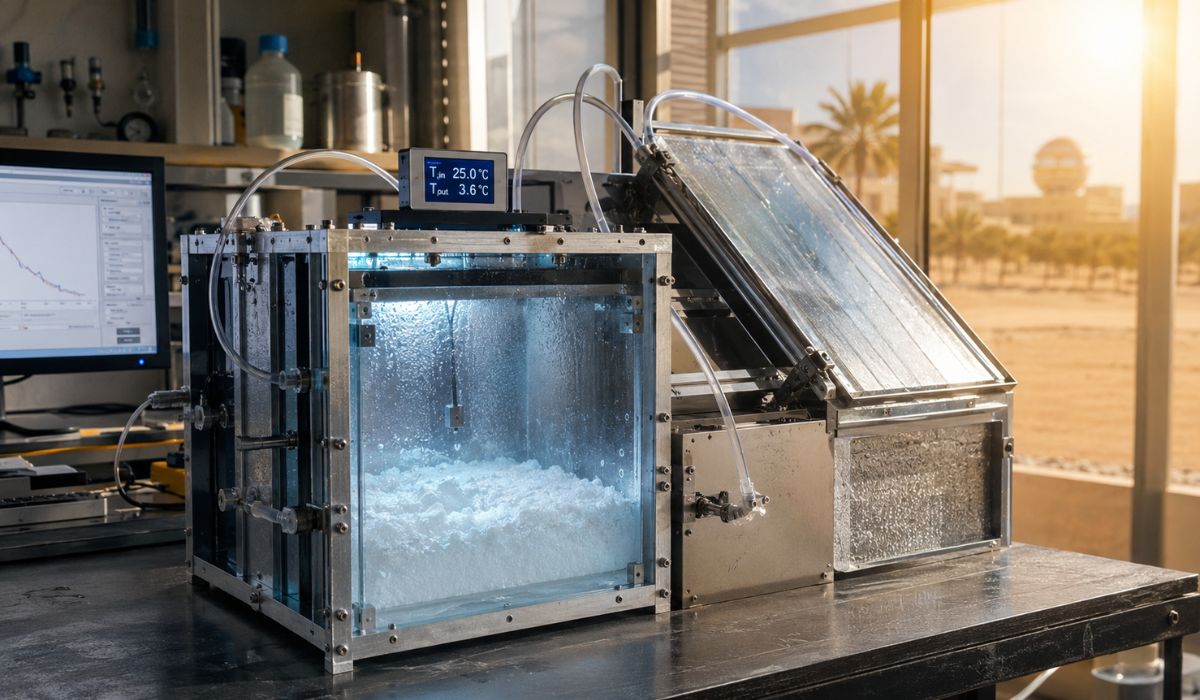
Scientists in Saudi Arabia create an “electricity-free refrigerator” that uses a chemical reaction to lower the temperature from 25°C to 3.6°C in 20 minutes and then uses the sun itself to restart the system without a compressor, outlet, or generator.
-
MIT study creates method to search for dark matter in gravitational waves and finds possible evidence in black hole signal




The main advantage of this approach is simplicity. Instead of building large industrial direct air capture (DAC) plants, which are costly and energy-intensive, the solution distributes the task across billions of smaller points. Thus, offices, homes, and factories can directly contribute to CO₂ removal from the atmosphere without the need for complex renovations.
Solar Regeneration and Impressive Efficiency
One of the biggest challenges of current carbon capture technologies lies in regeneration — the process of releasing captured CO₂ for storage or reuse. In traditional systems, this step requires high temperatures and large amounts of energy.
The new technology overcomes this obstacle by allowing the filters to be regenerated with direct solar heat at around 80 °C, or with short electric pulses lasting one to two seconds.
This feature drastically reduces energy consumption and facilitates adoption in urban areas, where efficiency is crucial. When regenerated with solar energy, the system achieves 92% net efficiency in carbon capture, virtually without impacting the energy consumption of the building.
Competitive Costs Compared to DAC Plants
In addition to efficiency, the cost of operation makes the technology attractive. Researchers estimate that removing one ton of CO₂ would cost around US$ 362 using solar heat. If regeneration is done with electricity, the cost would rise to US$ 821 per ton.
Nevertheless, these numbers remain within the current range of DAC plants, which vary from US$ 100 to US$ 1,000 per ton, depending on access to cheap energy sources.
With tax incentives and carbon credits, as implemented in the United States by the Inflation Reduction Act, the cost could drop even further.
This range makes investment feasible for companies, municipalities, and buildings committed to climate neutrality goals.
Global Impact and Logistical Challenges
Widespread adoption could generate a significant impact. Estimates suggest that, just in the United States, implementing the filters in ventilation systems could eliminate around 25 million tons of CO₂ per year. Globally, the number could reach 596 million tons — a volume comparable to the annual emissions of countries like Australia or South Korea.
The main obstacle to achieving this potential lies not in science but in logistics. Producing and distributing filters at scale and organizing their maintenance and periodic regeneration require planning and infrastructure.
Still, the challenges appear more manageable than erecting large industrial direct capture facilities.
Startups like Heirloom and CarbonBuilt are already exploring this path, testing decentralized solutions in residential buildings. Cities like Copenhagen and San Francisco are also considering including passive capture technologies in their sustainable building codes.
Turning Buildings into Climate Allies
Although the new technology alone won’t solve the climate crisis, it represents an important step towards more accessible, distributed, and effective solutions. Incorporating CO₂ capture filters into existing ventilation systems would bring several advantages:
- Decarbonizing buildings without deep structural renovations.
- Turning homes, factories, and offices into allies in combating climate change.
- Complementing public policies with everyday actions.
- Reducing reliance on large industrial mega-infrastructures.
- Facilitating public adoption without requiring drastic lifestyle changes.
When combined with strategies such as electrification, energy efficiency, and expanding renewable sources, the technology can accelerate the creation of cities that not only reduce their emissions but also remove carbon from the atmosphere.
A Real Possibility for Change
The idea of transforming every building into an active agent in carbon capture seems, at first glance, utopian. However, recent advances show that this vision is already technically possible.
The next step involves political decisions, strategic investments, and adequate incentives to scale production and make filters an integral part of urban environments.
If implemented on a large scale, the technology could redefine the role of human constructions in the global climate balance — from mere energy consumers to protagonists in atmospheric restoration. And, given the urgency of the environmental crisis, solutions like this are not just desirable: they are essential.
Study available at Science.








Where does the CO2 go when the filter is regenerated?