





 Portuguese
  English
  Spanish
  5 min of reading
  0 comments


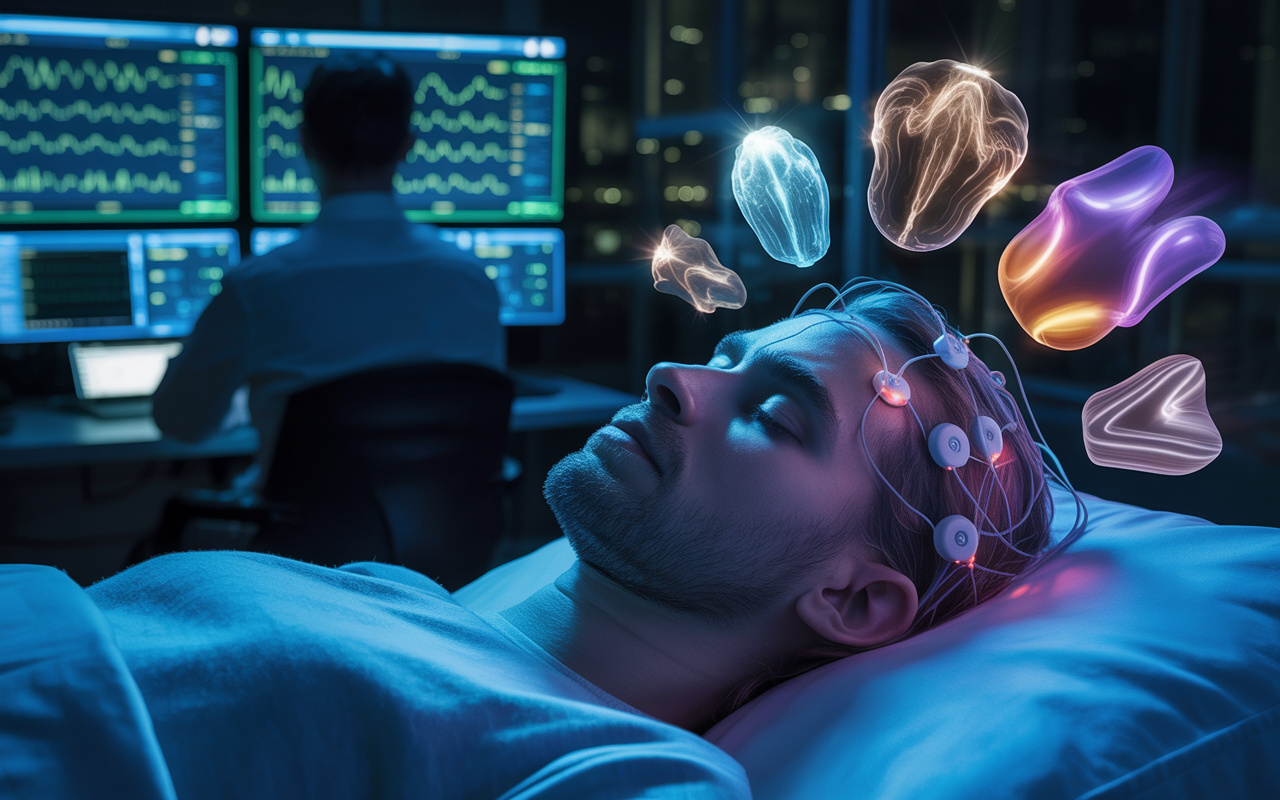
Surveys Show Communication During REM Sleep in People with Lucid Dreaming, Challenging Theories About Consciousness and Sensory Processing.
Few people imagine that the human brain, while dreaming, can not only construct internal narratives but also interact with the external world. For decades, REM sleep was described as a state of sensory disconnection, dominated by intense brain activity and muscular paralysis. However, recent experiments conducted by teams in the United States, Germany, France, and the Netherlands showed something surprising: people in a lucid dreaming state can perceive questions posed from outside, interpret simple commands, and even respond in real-time using eye movements and facial muscle contractions.
Although it sounds like science fiction, this phenomenon has been documented with controlled protocols, electroencephalogram (EEG), and cross-validation methods. The result challenges the traditional consensus about the sensory impermeability of REM and opens the door to new hypotheses about consciousness in altered states, as well as scientific and clinical applications.
What is REM Sleep and Why Has It Always Been Considered “Disconnected”?

To understand the impact of the discovery, it is necessary to place REM sleep in the neurophysiological map. The human sleep cycle is divided into NREM phases (N1, N2, N3) and REM. During REM (Rapid Eye Movement) sleep:
-
Russia saw sanctions close doors on orbital cooperation, but the most unlikely detail came from the Gulf: the United Arab Emirates had no space program in 2014, created the Hope mission from scratch in six years, reached Mars’ orbit, and became the first Arab interplanetary probe.

-
Venezuela has 303 billion barrels of oil, but its production is five times lower than Brazil’s due to technical obstacles.

-
Glasses with artificial intelligence win a £1 million prize for recognizing objects, remembering daily tasks, and helping people with dementia remain independent at home for longer.
-
Hidden hundreds of kilometers deep, two rivers of molten rock are devouring the ancient base of the North American continent towards the Black Hills, overturning the old certainty that this core was an untouchable and immovable anchor of the Earth.




- more vivid and narrative dreams occur,
- there is an increase in cortical activity,
- breathing becomes irregular,
- the body enters muscle atonia,
- the eyes make rapid movements under the eyelids.
Since the 1960s, research has shown that during REM the brain responds to some sounds, but without conscious integration. The prevailing view was that REM functioned as a “closed world,” where internal sensory experience predominated and external perception was minimized.
The exception would be lucid dreaming, a state in which part of the waking consciousness mixes with the dream narrative. Until very recently, however, data on bidirectional interaction was rare and controversial.
International Experiments Show Real-Time Communication
The turning point came when research groups in four countries coordinated experiments using lucid dreamers as a bridge for communication. The trained volunteers in lucidity were connected to EEG, electromyography (EMG), and eye movement monitoring.

The task was simple: upon realizing they were dreaming, they should confirm lucidity with pre-agreed sequences of eye movements, such as “look twice to the left and twice to the right.”
After that, the researchers presented auditory stimuli, such as simple questions or math commands. Real examples include:
- “2 + 1?”
- “6 – 2?”
- “Yes or no?”
- “Look to the left if yes”
The unexpected result was that, during REM, some participants correctly responded using eye movements or facial muscle contractions detected by the devices. These responses were consistent and significantly above chance.
The most important outcome was not the mathematical performance, but the fact that there was communication, indicating that the brain in REM:
- receives external stimuli,
- cognitively interprets, and
- executes a voluntary response,
all this without waking up.
What Does This Change in the Neuroscientific View of Sleep?
Traditional neuroscience described dreaming as an internal phenomenological state, isolated from sensory perception. Real-time communication challenges this boundary. Based on these findings, several points come into debate:
- the sensory permeability of REM may be greater than previously believed,
- part of the networks responsible for attention and calculation remain functional,
- consciousness may exist in a continuum between wakefulness and dreaming,
- the brain may rapidly switch between “internal” and “external” modes.
The discovery also strengthens the hypothesis that the lucid state is a neurophysiological hybrid, coexisting with muscle atonia and dream narrative. This does not mean that all REM is lucid nor that every dream allows communication. The experiment relied on specific training and protocols.
How Does the Brain Receive Stimuli During Dreaming?
One of the most complex aspects of the research involves the sensory pathway. Even in deep sleep, the ear continues to capture vibrations. The difference lies in the level of central processing. In the experiments, it seems that auditory stimuli can reach sufficient cortical areas to activate basic cognitive circuits.
There is still no consensus on how this happens, but hypotheses include:
- partial reactivation of attentional networks,
- preservation of thalamic sensory channels,
- modulation of dopamine and acetylcholine during REM.
Sleep neuroscience already knew that external sounds could influence the content of dreams (an alarm may turn into a siren within the dream), but there was no robust evidence of direct conscious response.
Now there is.
Possible Scientific and Clinical Applications
The interest is not only philosophical. If consolidated, communication with lucid dreamers could lead to applications in three major areas:
Research on Consciousness
Studying how the mind constructs internal and external realities in parallel.
Therapy for Recurring Nightmares
Lucid dreaming is already being experimentally used to modulate dream plots and reduce suffering in patients with sleep disorders.
Neurorehabilitation and Brain–Machine Interface
In the future, it may be possible to access cognitive states without waking the patient, something potentially useful in neurological conditions.
All of this is still speculative, and the researchers themselves emphasize that more studies are needed.
Limits, Controversies, and What We Still Don’t Know
Despite the excitement, there are important caveats:
- The correct response rate was low — there was no fluid communication.
- The technique requires lucid dreamers, who are a minority.
- We do not know if the phenomenon occurs without lucidity.
- We do not know if more complex tasks are possible.
- The replication is still ongoing in other laboratories.
In other words: no one is “talking to sleeping people” continuously. The advancement lies in the proof of concept.
Furthermore, there is no consensus on how to train lucidity, and some of the population cannot easily reach the state. The research is recent and is undergoing constant review.
What Does It Mean to Be Conscious?
The discovery opens up a philosophical and scientific debate: is consciousness binary or graded?
If the brain sleeps, dreams, and responds to the world at the same time, it may be necessary to abandon the rigid idea that wakefulness and dreaming are opposing states. In practice, they can be different positions on a spectrum.
The question that remains is simple yet profound: if we can access someone during a dream and receive a response, where does the dream end and consciousness begin?
This debate is just beginning, and sleep, which seemed like a closed territory, has just gained unexpected windows.





-

-

2 people reacted to this.