






 Portuguese
  Spanish
  4 min of reading


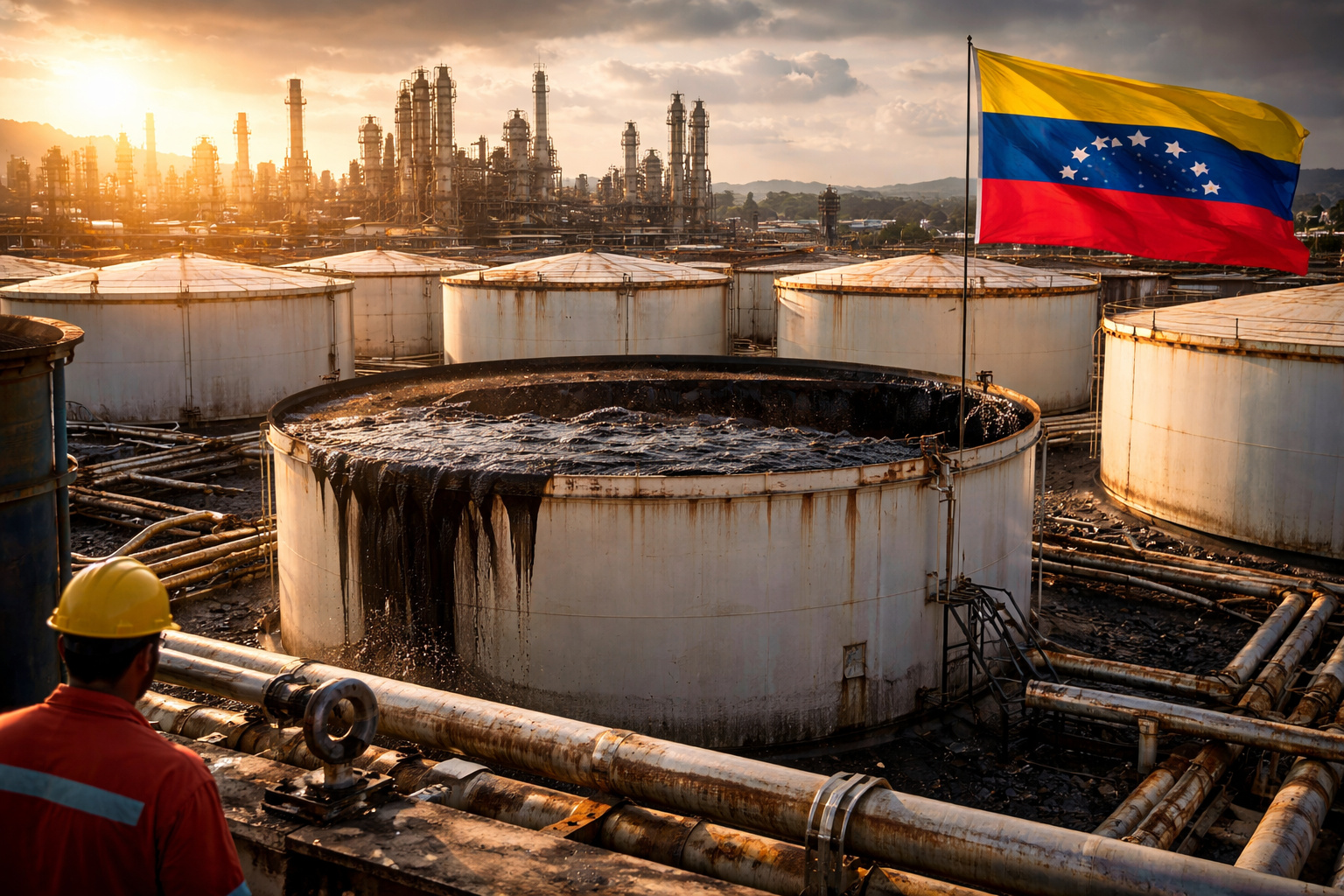
Oil Has Always Been at The Center of The Venezuelan Economy.
Since The Early 20th Century, when large reserves were discovered, the country structured its revenue, public policies, and international relations around this activity. Over The Decades, this dependency ensured significant revenue. However, it also created profound vulnerabilities.
Now, according to information released by Bloomberg News, following actions and blockades related to the U.S. government, Venezuela has begun to face a critical issue regarding oil. The ability to store oil may run out within ten days, which will force a slowdown in production. This scenario thus highlights the combination of external restrictions and internal limitations accumulated over time.
Historically, storage capacity has always played a strategic role in the oil sector. Producing countries rely on tanks, terminals, and ships to balance production, exportation, and demand. When this system becomes inefficient, production becomes unfeasible, even with large reserves still available underground.
-
Petrobras is expected to complete the drilling of the Morpho well in the Foz do Amazonas in August 2026, the first well in the Equatorial Margin, an oil frontier that the ANP estimates at more than 30 billion barrels and could redraw the map of Brazil.

-
Oil returns to the center of concerns with tension between the US and Iran

-
IEA reduces forecast for global oil demand in 2026 after impacts of the Middle East crisis

-
Bank of Japan raises interest rates to 1%, reaching the highest level in over three decades


In the Venezuelan case, this limitation arises at a particularly sensitive time. In addition to sanctions, the country faces operational difficulties, investment shortages, and deteriorating infrastructure.
Oil, Sanctions, and Structural Bottlenecks
The relationship between oil in Venezuela and international sanctions intensified from the 2010s onward. According to the U.S. Department of the Treasury website, economic measures began to directly pressure the Venezuelan oil sector. As a result, the country lost access to traditional markets, financial services, and logistical contracts.
Consequently, the export flow began to face frequent delays. Ships fail to dock, contracts are suspended, and routes need to be reorganized. Meanwhile, production continues to generate significant volumes of oil in Venezuela, which require immediate storage.
According to the International Energy Agency, reports published in recent years show that countries under sanctions often face logistical bottlenecks before even experiencing a sharp decline in production. Venezuela follows exactly this pattern. Even with lower production levels than in the past, the country struggles to offload the available oil.
Moreover, the storage infrastructure operates under significant wear. According to analyses from international institutions, many tanks and terminals function below their ideal capacity. This further reduces the margin for maneuver, increasing the risk of operational collapse.
The Risk of Forced Production Slowdown
As tanks approach their limit, the oil industry faces difficult decisions. Either reduce production or assume high operational risks. In the Venezuelan case, according to Bloomberg News, the proximity of capacity exhaustion may force PDVSA to slow extraction in the short term.
Historically, such disruptions create a chain reaction. Reducing production does not occur easily or immediately. Heavy oil wells, like those in Venezuela, suffer technical damage when abruptly shut down. According to the International Energy Agency, restarts after forced shutdowns tend to be slow and costly.
Additionally, reducing production directly affects the country’s revenues. In an already fragile economy, any further decline in the flow of dollars amplifies fiscal constraints, limits imports, and intensifies social tensions.
Thus, oil, while representing potential wealth, also becomes a factor of vulnerability when economic alternatives and logistical resilience are lacking.
Oil, Geopolitics, and External Dependency
The current situation in Venezuela clearly illustrates the role of geopolitics in the oil sector. Decisions made outside the country have direct impacts on its ability to operate. According to the Organization of the Petroleum Exporting Countries, OPEC, oil has always been at the center of global political and strategic disputes.
In the Venezuelan case, the almost exclusive dependency on this commodity reduces alternatives. Without full access to the international market, the country faces difficulties in renegotiating deadlines, prices, and contracts. Furthermore, the shortage of partners willing to take legal and financial risks limits offloading options.
According to the International Monetary Fund, economies excessively dependent on a single commodity suffer more intensely when facing external shocks. The storage crisis confirms this diagnosis.
While other producing countries can redirect exports or use strategic stocks with greater flexibility, Venezuela operates with extremely limited margin.
A Structural Alert for The Venezuelan Oil Sector
Analyzing this episode from a broader perspective reveals that the problem extends beyond a specific blockade. The lack of space to store oil exposes structural fragilities accumulated over decades. Outdated infrastructure, external dependence, and low adaptability make the system highly vulnerable.
According to the International Energy Agency, logistical resilience weighs as much as productive capacity. Countries that invest in storage, transportation, and market diversification manage to better absorb geopolitical impacts. Venezuela, however, has invested little in these pillars over time.
Thus, the possibility of a forced slowdown in oil production does not merely represent an immediate operational problem. It signals a profound structural challenge, where external political decisions combine with internal limitations, restricting the management of the country’s main economic asset.
In a world that still depends on oil, the Venezuelan case serves as a warning. Logistics, governance, and geopolitics have become as determinant as the existence of the reserves themselves.





Be the first to react!