Portuguese
  Spanish





Located 40 Light-Years Away, 55 Cancri e May Have Up to One-Third of Its Mass Composed of Diamond, Making It One of the Most Valuable Planets Ever Estimated by Science.
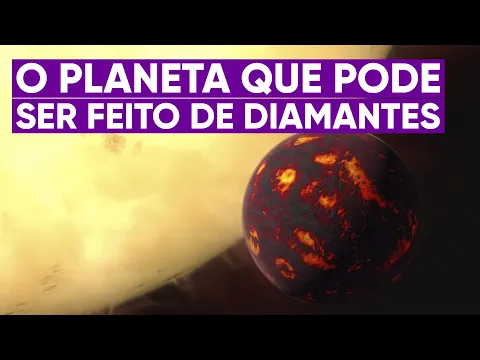
Imagine a planet where at least one-third of its entire mass is pure diamond. Not microscopic fragments or underground deposits that need to be mined, but an entire world with a graphite crust covering a thick layer of solid diamond, which in turn surrounds a mantle of silicon carbide and a molten iron core. This planet exists. It’s called 55 Cancri e (officially named Janssen), located 40 light-years from Earth in the constellation Cancer, and according to calculations published in the program “The Filthy Rich Guide”, it’s worth approximately US$ 26.9 nonillion, a number so absurdly large it needs to be written like this: US$ 26,881,200,920,800,000,000,000,000,000,000.00.
To put it into perspective: this value is 384 quadrillion times greater than the global GDP (around US$ 70 trillion). It’s more wealth than all of humanity has produced, is producing, and will produce over the next millions of years, all concentrated in a single planet at such a high temperature that iron melts like butter.
But there’s a small problem: 55 Cancri e is 40 light-years away (384 trillion kilometers), has a surface temperature between 2,400°C and 3,500°C, completes an orbit around its star in just 18 hours, and any attempt to land there would result in instant vaporization.
-
In Brazil’s backyard: Tesla, by Elon Musk, announces official operations in Uruguay, where electric vehicles already make up 20% of new cars but still leaves out the largest market in the region.

-
This Mars rover may finally reveal if life ever existed on Mars.
-
A nearly 70-year-old Chinese inventor has registered 90 patents and created a device that stores water in the roots, helping seedlings survive drought while trying to transform the arid slopes of the Loess Plateau into green areas without relying on heavy irrigation.

-
Researchers want to change the way of producing rare earth magnets, reducing purification steps and making better use of the elements found in Swedish deposits.


The Planet That Made the Diamond Industry Seem Like a Joke

Let’s start with Earthly numbers to understand the scale of the absurd.
Worldwide Diamond Reserves (2024):
- Russia: 990 million carats (52% of global reserves)
- Democratic Republic of the Congo: 150 million carats (13%)
- Botswana: 250 million carats
- Canada: significant reserves
- Australia: declining
- Total global: approximately 1.1 billion carats
Global Annual Production:
- Russia: 42 million carats/year (25% of global production)
- Botswana: 24.8 million carats/year
- Canada: 16.2 million carats/year
- Total global: about 140 million carats/year
Now, 55 Cancri e:
The planet has 8 times the mass of Earth. If at least one-third of that mass is pure diamond (as suggested by the 2012 study from Yale University led by Nikku Madhusudhan), we are talking about approximately 3 whole Earth masses of diamond.
Doing the math:
- Mass of Earth: 5.97 × 10²⁴ kg
- 3 Earth masses: 1.79 × 10²⁵ kg of diamond
- Density of diamond: 3.5 g/cm³
- Volume: about 5.1 × 10²⁴ cm³
Converting to carats (1 carat = 0.2 grams): 55 Cancri e contains approximately 90 sextillion carats of diamond (90,000,000,000,000,000,000,000 carats). That is 81 trillion times more than all existing Earth reserves combined.
To visualize: if the entire annual production of diamonds from Russia, Botswana, and Canada (about 83 million carats) were multiplied by 1 trillion, you still wouldn’t come close to the amount of diamonds in 55 Cancri e.
An Alien World of Crystallized Carbon
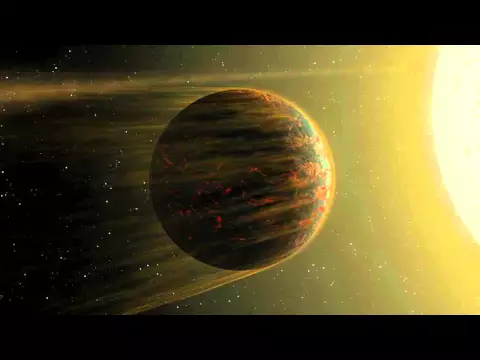
55 Cancri e isn’t just any planet; it is a super-Earth, a type of rocky exoplanet larger than Earth but smaller than gas giants like Neptune.
Physical Characteristics:
- Diameter: 2 times that of Earth (~25,500 km)
- Mass: 8 times that of Earth
- Surface Gravity: Approximately 2.3 times that of Earth
- Distance from Star: 0.01544 AU (2.3 million km)
- Orbital Period: 17.7 hours (less than a day on Earth!)
- Orbital Speed: About 463 km/s
For comparison, Earth is 150 million km from the Sun and takes 365 days to complete an orbit. 55 Cancri e is 65 times closer to its star than Mercury is to the Sun.
Proposed Composition (Yale Model 2012):
- Outer Crust: Graphite (carbon in non-crystalline form)
- Intermediate Layer: Solid diamond (at least 1/3 of total mass)
- Mantle: Silicon carbide (SiC) and possibly silicates
- Core: Molten iron
Unlike Earth, which has a core of iron, a mantle of silicates, and a crust of oxygen-rich rocks — 55 Cancri e is extremely poor in oxygen and extremely rich in carbon.
“This is our first glimpse of a rocky world with fundamentally different chemistry than Earth,” declared Nikku Madhusudhan when announcing the discovery in 2012. “In contrast, Earth’s interior is rich in oxygen but extremely poor in carbon — less than one part per thousand by mass.”
Fire Hell: Temperatures That Melt Iron
The extreme proximity to its host star turns 55 Cancri e into one of the most hostile places known in the universe. Surface Temperatures:
Day Side (always facing the star):
- Initial estimate (Spitzer 2011): 2,700 K (2,430°C)
- Reanalysis 2022: 3,770 K (3,500°C / 6,330°F)
- Iron melts at 1,538°C — the surface is 2x hotter than iron’s melting point
Night Side (always in darkness):
- Initial estimate: 1,380 K (1,110°C)
- Upper limit (2022): 1,650 K (1,380°C)
- Even hotter than terrestrial volcanic lava (700-1,200°C)
Tidal Locking:
Like the Moon always shows the same face to Earth, 55 Cancri e is gravitationally locked — one hemisphere endures eternal day under brutal radiation, while the other experiences perpetual night but remains scorching.
Observations from the Spitzer Space Telescope revealed extreme temperature variations over time, suggesting possible massive volcanic activity releasing giant clouds of dust, temporarily blocking thermal emissions.
“We observed significant variations in the depth of the planetary transit, which may be attributed to large-scale volcanism or the presence of a variable gas torus co-orbiting with the planet,” scientists reported in 2022.
In summary: 55 Cancri e is not just hot — it is an active volcanic hell with global oceans of molten lava.
The Discovery and Controversy: Is It Really a Diamond Planet?
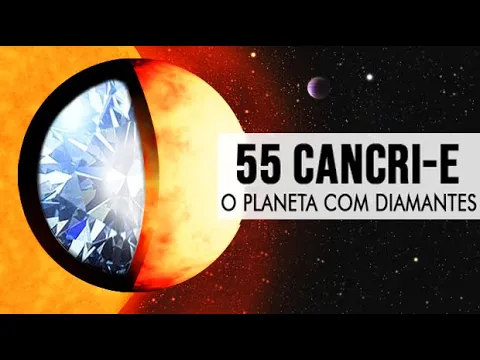
55 Cancri e was discovered on August 30, 2004 using the radial velocity method — measuring the “wobble” gravitational pull that the planet exerts on its host star, 55 Cancri A, a G-type star (similar to the Sun) located about 40 light-years from Earth in the constellation Cancer.
It was one of the first super-Earths discovered orbiting a main-sequence star, preceding Gliese 876 d by a year.
The Diamond Planet Theory:
In 2011, the planet’s transit was confirmed — meaning it passes in front of its star as seen from Earth, allowing precise calculations of its radius. Combining this with the estimated mass, scientists were able to calculate its density.
The density was too low for a planet with a silicate interior like Earth. Two hypotheses emerged:
- Water Planet: Covered by a deep ocean in a “supercritical” state (fluid under high pressure between liquid and gas)
- Carbon Planet: Rich in carbon instead of oxygen
In October 2012, Nikku Madhusudhan’s team from Yale University published a groundbreaking study in the Astrophysical Journal Letters proposing that 55 Cancri e is a carbon planet — the first ever identified.
The Logic:
- Spectroscopy showed that the host star 55 Cancri A is rich in carbon
- Planets tend to have similar compositions to the gas and dust cloud that formed them
- The planet’s density fits perfectly if it is made of carbon, iron, and silicon carbide
- Hubble observations did not detect hydrogen in the Lyman-alpha signature during transit — no water
“Science fiction has dreamed of diamond planets for many years, so it’s amazing that we finally have evidence of their existence in the real universe,” said Madhusudhan. “This is the first time we know of a planet so exotic that we think it formed primarily from carbon — which really makes this a fundamental game-changer.”
The Controversy:
In 2013, Johanna Teske, an astronomy graduate student at the University of Arizona, disputed the theory.
Her Objection: More detailed analysis of the host star showed that 55 Cancri A is cooler than the Sun and has more metals, but its carbon/oxygen ratio isn’t as high as initially thought.
“In theory, 55 Cancri e could still have a high carbon/oxygen ratio and be a diamond planet, but the host star doesn’t have that high ratio,” said Teske. “So, in terms of the two blocks of information used to propose the initial ‘diamond planet’ — the exoplanet measurements and the star measurements, the star measurements no longer validate that.”
The Current Consensus (2024-2026)
Recent observations from the James Webb Space Telescope (JWST) in 2024 brought a new twist:
- The planet is not a lava world without atmosphere as previously thought
- It has a substantial atmosphere rich in CO₂ or CO
- This atmosphere is likely being fed by outgassing from the internal magma ocean
- The atmosphere is “secondary”, having lost its original one due to stellar radiation, but “grew” another from the volcanic interior
“We measured the thermal emissions of this rocky planet, and the measurement indicates that the planet has a substantial atmosphere,” explained Renyu Hu from Caltech. “This atmosphere is likely sustained by outgassing from the rocky interior of 55 Cancri e, and we think this is the first measurement of a secondary atmosphere in a rocky exoplanet.”
The question of diamond remains open, but most scientists agree that even if it is not 100% carbon, the planet has much higher carbon proportions than Earth — making it the best candidate for a “diamond planet” that we know of.
Why We Won’t Go Looking for Diamonds
The short answer: it’s physically impossible with current technology and will likely remain so for centuries.
Obstacle 1: Absurd Distance
40 light-years seem small on a cosmic scale, but it’s 378 trillion kilometers. For comparison:
- Voyager 1 (most distant human-made object): travels at 61,000 km/h and would take 70,000 years to arrive
- New Horizons (fastest spacecraft ever launched): at 58,000 km/h, would take about 74,000 years
- Hypothetical nuclear propulsion at 1% the speed of light: 4,000 years
- Hypothetical antimatter propulsion at 10% the speed of light: 400 years
Even if we developed technology to travel at 10% the speed of light (completely out of reach today), a one-way trip would take 4 centuries. Round trip: 8 centuries.
Obstacle 2: Infernal Temperature
At 2,400°C-3,500°C:
- Aluminum melts at 660°C
- Iron melts at 1,538°C
- Stainless steel melts at 1,510°C
- Titanium melts at 1,668°C
- Tungsten (metal with the highest melting point) melts at 3,422°C
In other words, even tungsten would be on the verge. Any spacecraft would need:
- Extraordinary thermal shields
- Massive active cooling
- Materials yet to be invented
Obstacle 3: Extreme Stellar Proximity
At just 2.3 million km from its star, 55 Cancri e is immersed in:
- Brutal ultraviolet radiation
- Intense stellar wind
- Constant bombardment of high-energy particles
- Violent magnetic fields
For comparison, NASA’s Parker Solar Probe (2018) reached 6.5 million km from the Sun — three times farther away — and required a thermal shield of 11.5 cm of high-tech carbon composite. And that was just a quick flyby, not a landing.
Obstacle 4: High Gravity
With 2.3 times Earth’s gravity, any landing and takeoff operation would require:
- Much more fuel
- Stronger structures
- Astronauts under extreme physical stress
Obstacle 5: Extreme Orbital Speed
The planet orbits at 463 km/s (1.6 million km/h). To reach it, a spacecraft would need to match this orbital speed — requiring extremely complex maneuvers and massive fuel expenditure.
Obstacle 6: Impossible Energy Equation
Even if we overcame all the above obstacles, the energy required to:
- Travel 40 light-years
- Land on the planet
- Mine for diamonds
- Load the spacecraft
- Return to Earth
…would be trillions of times greater than the economic value of the diamonds brought back.
Ironically, we would need to burn energy equivalent to billions of tons of fuel to seek decorative stones that only have value because they are rare on Earth. If we managed to bring diamonds from 55 Cancri e, they would flood the market and become worthless.
Value is Fiction, but Science is Real
The estimate of US$ 26.9 nonillion is clearly an economic fiction.
This number comes from multiplying the estimated mass of diamond (equivalent to 3 Earths) by the market price of high-quality diamonds on Earth (around US$ 4,000 per carat or US$ 20,000 per gram). But it completely ignores:
- Law of Supply and Demand: Bringing an infinitesimal fraction of diamonds from 55 Cancri e would collapse the market instantly
- Extraction Costs: Infinite (literally impossible)
- Intrinsic Value vs Market Value: Diamonds are only expensive because the industry controls the supply
In fact, diamonds are one of the most common minerals in the universe. Scientists estimate that:
- Uranus and Neptune may have liquid diamond oceans under high pressure in their cores
- Jupiter and Saturn may produce 1,000 tons of diamond per year through diamond rain in their atmospheres
- Carbon-rich white dwarf stars may have crystallized diamond cores the size of the Moon
The true value of 55 Cancri e is not in its diamonds — it is in what it teaches us about the diversity of possible worlds in the universe.
The Impossible Mission: Visiting the Diamond Planet
Let us imagine, for a moment, that humanity decided to try to reach 55 Cancri e in the coming centuries.
Optimistic Scenario (Hypothetical Technology):
- Propulsion: Laser sails pushing ships at 20% the speed of light (Breakthrough Starshot project)
- Travel Time: 200 years (one way)
- Problems:
- Minuscule ships (grams, not tons)
- No braking (they pass by the planet at 60,000 km/s)
- No return
- Only remote observation
- Estimated Cost: US$ 10 billion for the complete program
- Outcome: Some high-resolution photos passing through the system at relativistic speed
Realistic Scenario (next 500 years):
- Propulsion: Advanced nuclear fusion or antimatter
- Speed: 1-5% the speed of light
- Travel Time: 800-4,000 years (one way)
- Problems:
- Multiple crew generations
- Maintaining a closed ecosystem for millennia
- Cosmic radiation
- No real-time contact with Earth
- Impossible to mine and return
- Cost: Incacalculable (perhaps 10-100 trillion dollars)
- Outcome: Human colony in an alien system, completely isolated from Earth
In practice: we will never visit 55 Cancri e. At least not in the next several generations.
The Final Numbers That Would Make Any Billionaire Cry
To conclude with the most absurd data about the largest inaccessible fortune in the universe:
Estimated Value:
- US$ 26.9 nonillion = US$ 26,881,200,920,800,000,000,000,000,000,000.00
- 384 quadrillion times the global GDP
- 547 sextillion times the global government debt (US$ 49 trillion)
Earthly Comparisons:
- Annual global GDP: ~US$ 70 trillion
- All wealth ever created in human history: ~US$ 500 trillion
- Market value of all companies in the world: ~US$ 100 trillion
- A measly 0.0182% of the diamonds from 55 Cancri e would pay off all global government debts
Comparisons with Major Producers:
- Russia (largest producer): 42 million carats/year
- Botswana: 24.8 million carats/year
- Canada: 16.2 million carats/year
- Total global: 140 million carats/year
- 55 Cancri e: 90 sextillion carats (640 billion years of global production)
Energy Needed to Mine:
- Round trip at 10% the speed of light: energy equivalent to 10 billion Hiroshima bombs
- Landing and takeoff in 2.3x gravity: impossible to calculate (technology does not exist)
- Working at 2,400°C: impossible to calculate (materials do not exist)
The Definitive Paradox:
55 Cancri e contains enough wealth to:
- Pay off all world debts 547 sextillion times
- Make every human a trillionaire millions of times
- Fund scientific and social projects for billions of years
- Eliminate all poverty, hunger, and disease for millennia
But it is 40 light-years away, has temperatures that melt iron, lacks water, is bathed in lethal stellar radiation, and getting there would take at least 400 years with technology that does not exist.
It is the cosmic equivalent of having the password to a vault with quintillions of dollars… but the vault is at the bottom of the Sun.
The Final Lesson: Take Care of What We Have
The story of 55 Cancri e is a perfect metaphor for the human condition in the universe.
We live in an age where we know there are trillions of planets in our galaxy. Some with oceans of water. Others with oceans of methane. Some with solid diamonds. Others with molten iron rain. Worlds with conditions that challenge imagination.
But we cannot reach any of them. The closest stars are 4 light-years away, a distance that would take 70,000 years to cross with our current technology. 55 Cancri e, at 40 light-years, may well be in another dimension.
Meanwhile, here on Earth, we destroy forests for wood, pollute oceans for short-term profit, deplete soils through unsustainable agriculture, and wage wars for resources that seem scarce, but are only scarce because we do not take proper care of them.
The universe is filled with unimaginable riches. But the only wealth that truly matters is that which is within our reach, and that is the only planet we know for sure can sustain life: Earth.
55 Cancri e is worth US$ 26.9 nonillion in diamonds. But Earth, with its oceans of liquid water, breathable atmosphere, vibrant biosphere, and 8 billion human beings, is worth infinitely more because it is the only home we have.
And unlike the diamonds of a planet 40 light-years away, Earth is still within our reach. For now.