






 Portuguese
  Spanish
  3 min of reading
  1 comment


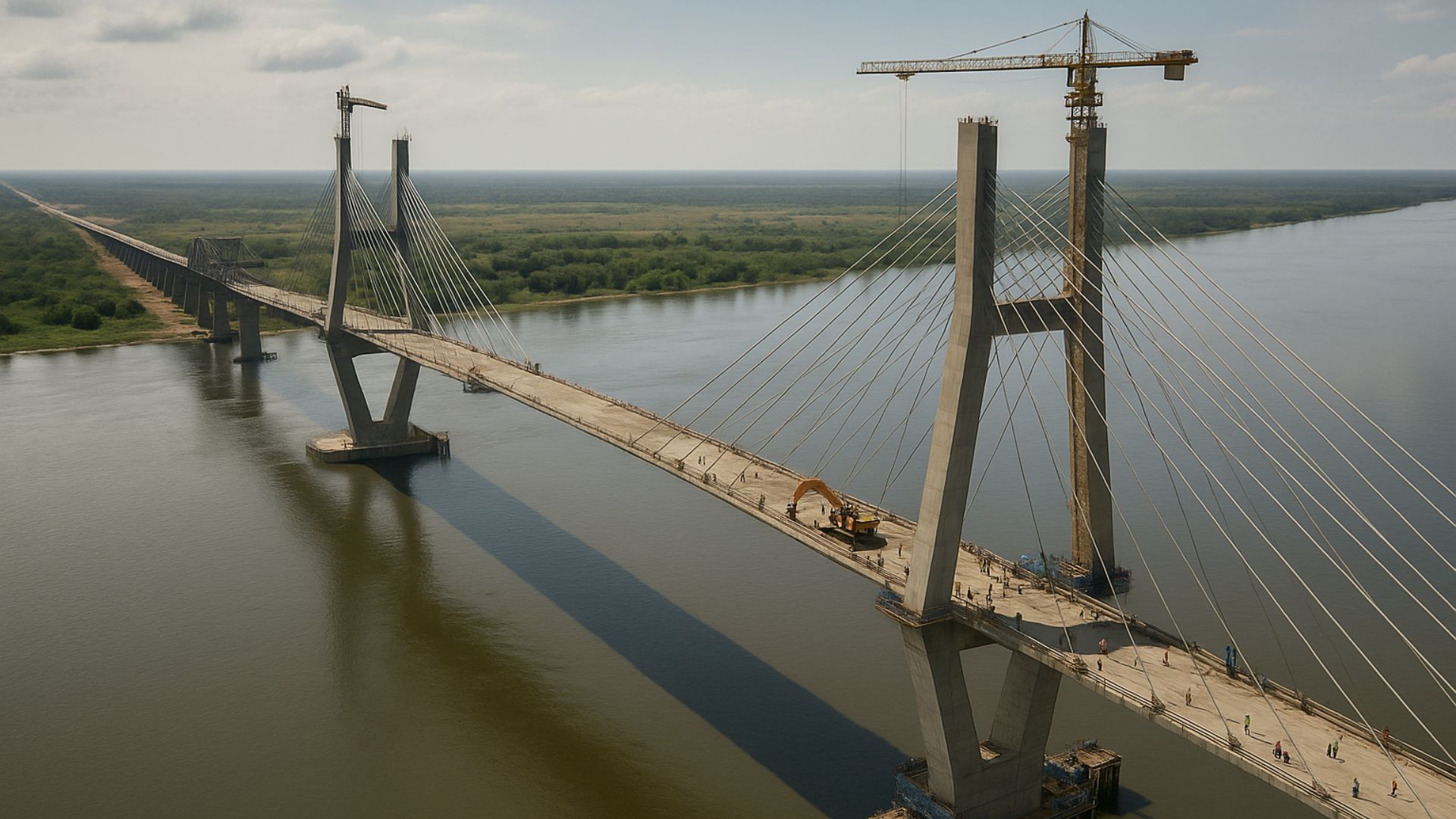


The construction of the Bioceanic Bridge has reached a significant milestone by achieving 84% completion, bringing Brazil, Paraguay, Argentina, and Chile closer together through a structure considered strategic for South American trade and logistics. During a technical inspection conducted on Saturday (22), new images revealed the proximity of the fitting of the immense walkway that advances over the Paraguay River, highlighting the grandeur of the work.
The information was released by Campo Grande News, which closely follows each stage of this megaproject that promises to transform the economic flow between the countries connected by the route.

Billion-Dollar Project Involves Structure of 1,294 Meters and Investments of R$ 574 Million in the Brazilian Section
The international bridge, which will have a 1,294-meter span, is progressing rapidly within the larger project of the Bioceanic Route, considered the main land corridor connecting the Brazilian Midwest to the Pacific ports. This progress has been made possible thanks to a set of work fronts that are operating simultaneously on both sides of the border.
In the Brazilian section, the 13.1 km access that will connect the BR-267 to the bridgehead in Porto Murtinho is receiving an investment of R$ 574 million. The execution is under the responsibility of the PDC Fronteira Consortium, formed by the companies Caiapó, DP Barros, and Paulitec. During the inspection, technicians emphasized that the teams are currently working on the construction of concrete pillars, installation of vertical and horizontal beams, and launching the precast slabs that will form the access viaducts.
-
Bolivian Female Construction Workers Form Association to Combat Discrimination and 38% Pay Gap in the Industry

-
Near Amsterdam, residents buy land and discover they must also build streets, manage drainage, handle waste, and grow food on half their plot.
-
Brazil’s WEG to Open New Factory in China by 2027, Expanding Production of Large Rotating Electric Machines and Low to Medium Voltage Motors in Rugao

-
Chinese Shipyard Secures $1 Billion in Orders for Low-Carbon Container Ships Amid Global Fleet Renewal Efforts


Moreover, the so-called advancing train, equipment responsible for the suspended assembly of the stayed segment, has already completed 188 of the 350 meters of the central span that crosses the Paraguay River. The walkway will have 21 meters in width and will be 35 meters above the channel, allowing safe navigation and integration between the banks even during flood periods.
Megaproject of US$ 1.1 Billion Advances in Paraguay with Paved Sections and New Guaranteed Investments
The bridge is part of an even broader set of works, financed by the Paraguayan government with a total of US$ 1.1 billion allocated for the corridor of 580 km between Carmelo Peralta and Pozo Hondo. According to the published article, part of these resources has already ensured the completion of essential segments of the route.
Of the amount invested so far, US$ 440 million has been applied in the Carmelo – Loma Plata section; US$ 100 million financed the construction of the international bridge; US$ 354 million is earmarked for the paving of the PY-15 (Picada 500) highway; and another US$ 200 million will be applied in the section between Centinela and Mariscal.
Although initially scheduled for November 2025, the total completion of the bridge has been postponed to February 2026, a deadline considered reasonable given the complexity of the engineering involved. Nonetheless, authorities stress that the work is still within acceptable parameters and remains one of the most relevant projects in the recent history of physical integration in South America.
Stressed Structure of 632 Meters and Strategic Role of the Bridge in Continental Integration
The Bioceanic Bridge is divided into three sections, with the central, stayed part summing 632 meters, with a main span of 350 meters. This feature reinforces the project’s status as one of the most imposing in the Southern Cone. Additionally, the entire structure will have approximately 1,300 meters, considering adjustments for ramps and viaducts.
As emphasized by Campo Grande News, the expectation is that the bridge will represent a turning point for Brazilian foreign trade, as it will shorten the path to the Chilean ports in the Pacific and enhance the logistical competitiveness of agricultural and industrial products.
At the end of the inspection, technicians highlighted that the union of the structural platforms marks the symbolic beginning of physical integration between neighboring countries, reinforcing the importance of the corridor as a strategic axis of development for the entire region.





Parabéns ao governo Lula e seu compromisso com o desenvolvimento do Brasil