






 Portuguese
  Spanish
  3 min of reading
  0 comments


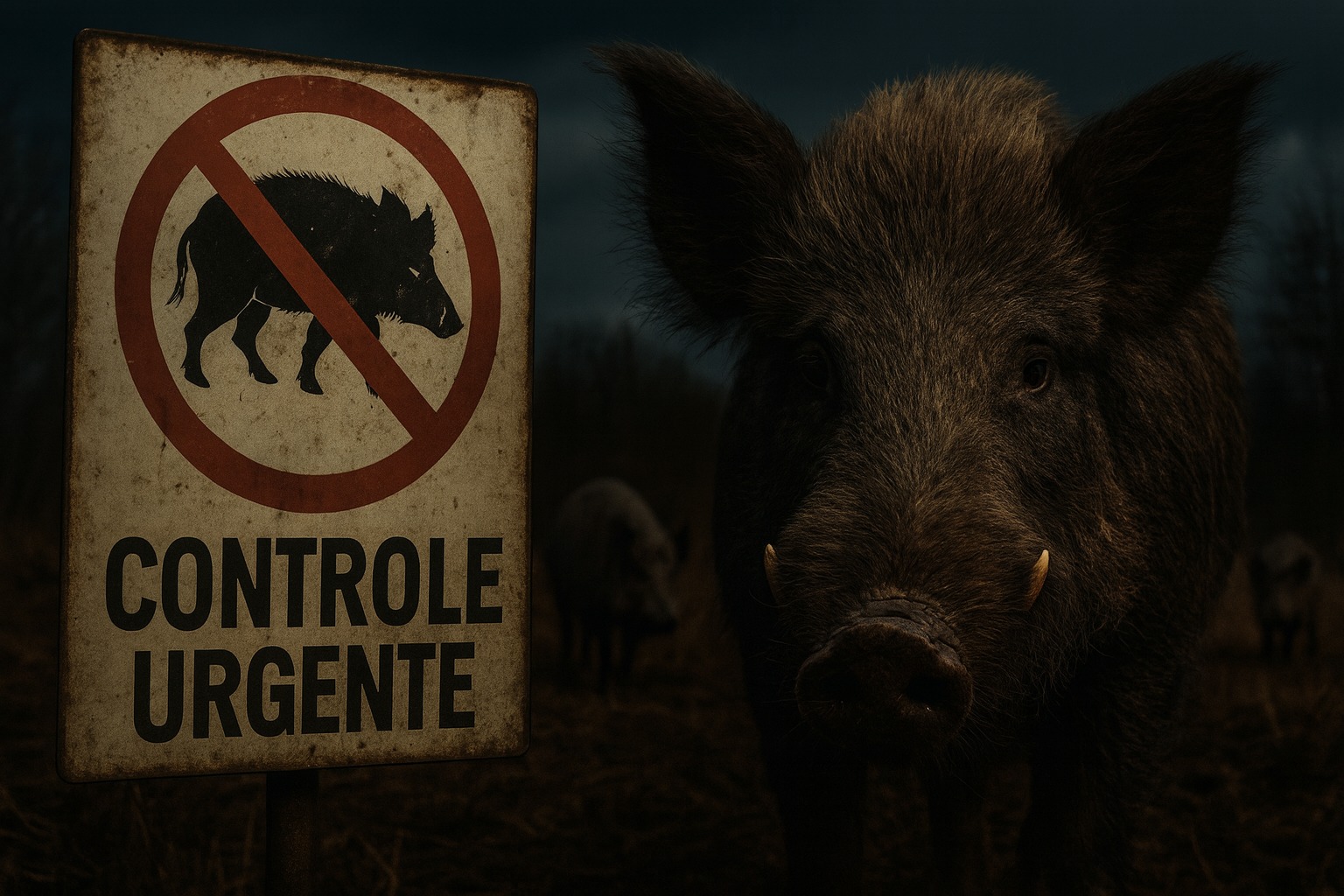
Award-Winning Study From UFSCar Shows That Only Management With Hunting And Planned Slaughter Prevents Wild Boars From Reaching Critical Levels In Brazil
The presence of wild boars in Brazil has ceased to be just a curiosity and has become a concrete threat to crops, ecosystems, and even public health. They reproduce at an accelerated rate due to their high adaptability. Furthermore, they attack crops, disrupt the balance of native fauna, and can transmit diseases.
According to research from the Federal University of São Carlos (UFSCar), without proper control, the species’ expansion results in overpopulation and severe damage.
The study indicates that the only effective way to curb their advance is through management via controlled hunting and slaughter.
-
Low-Demand Brazilian Beef Offal Gains Popularity Abroad: Indonesia Purchases $19.5 Million, Boosting Revenue and Reducing Waste

-
Soy Expansion in Former Brazilian Savanna Sparks Water and Land Conflicts in Major Agricultural Frontier
-
Mexican Pest Threatens U.S. Cattle Herds at Historic Lows, Potentially Boosting Brazilian Beef Exports as Burger Prices Soar

-
Avocado Boom for European and U.S. Markets Fuels Water Crisis in Drought-Stricken Chilean Region




Award-Winning Research Proves The Effectiveness Of Planned Management
The work titled “Modeling The Population Control Of Sus scrofa Through Stochastic Simulations” was developed by researchers Vittoria Façanha Bassani and Giulia Canali Forace, under the guidance of Professor Iuri Ferreira from the Center for Natural Science at UFSCar.
The study received the Best Paper award from the Junior League at the Workshop on Applied Computing (WorCAP) 2025, promoted by the National Institute for Space Research (Inpe). This recognition reinforces the scientific relevance of the topic.
According to the results, regular management authorized by agencies such as Ibama reduces the pace of population growth and prevents wild boars from reaching the environment’s carrying capacity.
Simulations Reveal Two Possible Scenarios
The team applied the Verhulst equation, adapted to simulate periodic captures and slaughters. Thus, it was possible to compare two distinct contexts:
- With Controlled Management: the population remains at safe levels and the environmental impact decreases.
- Without Management: uncontrolled growth occurs, resource depletion, and greater conflict with humans.
The simulations used Bayesian methods and Hamiltonian Monte Carlo algorithms, incorporating real uncertainties, such as variations in reproduction rates.
“The projections show that, without intervention, wild boars grow exponentially and further pressure ecosystems,” the authors explain.
Impacts Of Wild Boars In Brazilian Territory
The invasive species, a hybrid of the European wild boar and domestic pigs, has already been identified in all national biomes.
Their versatility allows them to occupy agricultural areas, forests, and pastures, consuming everything from grains to small animals.
Among the most severe damages are:
- Devastation of crops and economic losses for producers.
- Direct competition with native species.
- Erosion and soil compaction.
- Transmission of diseases such as leptospirosis, brucellosis, and classical swine fever.
- Attacks on domestic animals and, in rare situations, on humans.
Therefore, the continuous expansion of the species represents not only an environmental risk but also a threat to food and sanitary security.
Science Applied To Sustainable Management
The research was conducted at the Center for Ecology Modeling and Environmental Sciences (CeMECA) at UFSCar, with support from CNPq.
The group uses open-source statistical tools and plans to make the simulator available in public repositories, increasing access to the techniques.
According to Professor Iuri Ferreira, hunting and slaughter, when applied in a planned, ethical, and legal manner, should not be seen as arbitrariness, but as indispensable tools for conservation.
National Recognition And Next Steps
The highlight at WorCAP 2025 underscores the importance of integrating ecology, data science, and sustainability.
The research was among the most relevant projects in areas such as Artificial Intelligence and Computational Modeling, demonstrating how mathematics can guide public policies.
The next steps include integrating information from camera traps and land-use maps. The idea is to calibrate the models with real data and produce even more accurate scenarios for managers and producers.
Control Is A Matter Of Productive And Environmental Survival
The study concludes that, without planned control, the advance of wild boars creates ecological imbalance and amplifies losses.
With scientific management, it becomes possible to preserve crops, protect biodiversity, and reduce health risks.
Therefore, science indicates a clear path: only with continuous and regulated actions will it be possible to effectively face this silent threat that has already reached the entire country.
With information from Compre Rural.





-

1 person reacted to this.