Portuguese
  Spanish


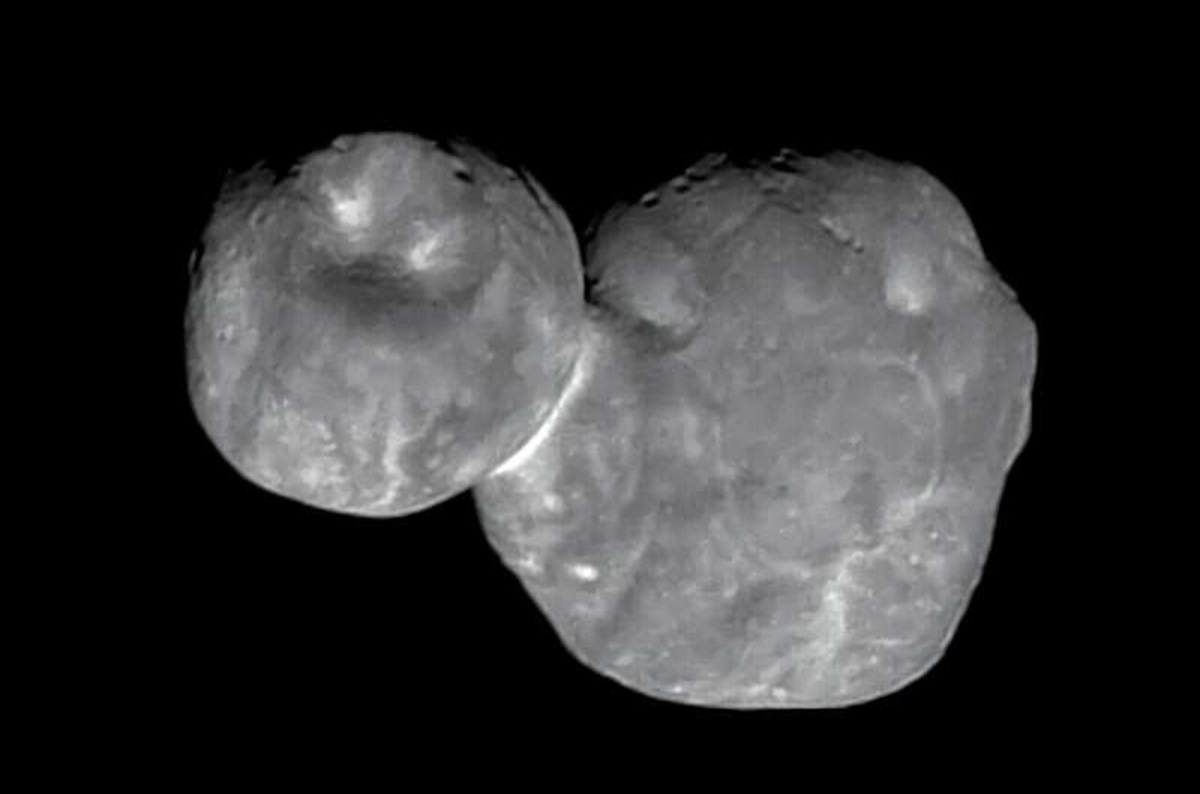

Objects In Space Beyond Neptune Challenge Scientists For Decades, After Images Reveal That About 10% Of The Bodies In The Kuiper Belt Have A Double Shape Similar To Snowmen, Reigniting The Debate About Their Formation
Researchers at Michigan State University reproduced, through computational simulation, the shape of two lobes observed in objects in space in the Kuiper Belt, indicating that gravitational collapse may explain why about 10% of the planetesimals are contact binaries.
Simulation Reproduces Natural Shape Of Objects In Space With Two Lobes
Astronomers have debated for years why so many objects in space, especially in the outer solar system, have a shape similar to that of a snowman.
In the Kuiper Belt, beyond Neptune, are icy blocks preserved since the beginning of the solar system, known as planetesimals.
-
Humanoid Robots Begin Replacing Workers in Repetitive Roles as Companies Accelerate Industrial Automation

-
Humanoid Robots Begin Replacing Factory Workers in China, Working 64-Hour Shifts and Driving Industrial Automation Forward

-
Miniature Nuclear Reactor to Be Installed in South Wales, Powering 20,000 Homes and Reviving UK’s Nuclear Industry After Nearly 50 Years
-
San Andreas Fault Reaches “Highest Tension in 1,000 Years,” Raising Fears of the “Big One,” but New Study Identifies Key Zone Near Los Angeles Influencing Earthquake Impact



About one in ten of these bodies is classified as a contact binary, meaning it is formed by two connected spheres. The origin of this configuration, without resorting to rare events or exotic phenomena, remained an open question.
Jackson Barnes, a graduate student at Michigan State University, created the first simulation capable of naturally reproducing the shape of two lobes through gravitational collapse. The work was published in the Monthly Notices of the Royal Astronomical Society.
Previous computational models treated collisions as mergers of fluid masses resulting in spheres, preventing the formation of these specific geometries. The new simulation uses resources from the Institute for Cyber-Enabled Research and its high-performance computing cluster.
This allows the objects to maintain their structural integrity and rest upon each other, enabling the stable formation of the two characteristic lobes observed in Kuiper Belt objects.
Observational Evidence Supports Gravitational Collapse Hypothesis
Contact binaries were photographed up close by NASA’s New Horizons probe in January 2019. The images led scientists to re-examine other bodies in the Kuiper Belt.
It was found that approximately 10% of all planetesimals belong to this category. These objects in space remain largely untouched, floating in a sparsely populated region relatively protected from collisions.
According to Seth Jacobson, Professor of Earth and Environmental Sciences and senior author of the study, if 10% of planetesimals are contact binaries, the process responsible for their formation cannot be rare. For him, gravitational collapse fits what has been observed.
Alternative theories involve special events or unusual phenomena that, while possible, would not occur frequently enough to explain the identified proportion.
Initial Formation Of Planetesimals And Orbital Dynamics
In the early Milky Way, the galaxy was composed of a disk of dust and gas. Remnants of this period are present in the Kuiper Belt, including dwarf planets like Pluto, comets, and planetesimals.
Planetesimals are the first large bodies formed from the dust and pebble disk. Just as compressed snowflakes form a snowball, these objects originate from the aggregation of pebble-sized particles bound by gravity.
Under certain circumstances, when the rotating cloud collapses upon itself, the object may fragment, creating two planetesimals that begin to orbit each other. Astronomers observe many binary systems in the Kuiper Belt.
In Barnes’ simulation, the orbits of these bodies spiral inward until the two make gentle contact and merge, maintaining their rounded shapes. This process explains the morphology of objects in space with two connected lobes.
Stability Over The History Of The Solar System
A central question is how these two bodies remain bound together over billions of years. Barnes explains that the likelihood of collision with another object in that region is low.
Without significant collisions, there is no force capable of separating them. Most of these binary systems do not even show craters, indicating a limited history of impacts.
Scientists suspected that gravitational collapse was behind the formation of these objects in space, but they had not been able to fully test the hypothesis.
The model developed by Barnes is the first to incorporate the necessary physics to consistently reproduce contact binaries. According to the researcher, it is the first time the hypothesis can be legitimately tested, making the study particularly relevant.
Barnes states that the model can aid in understanding binary systems composed of three or more objects. The team is now working on creating a new simulation that models the collapse process more accurately.
As new NASA missions explore unmapped regions of the solar system, researchers consider it possible that more objects in space with similar shapes will be identified, enhancing understanding of the formation of the first planetary bodies.