






 Portuguese
  Spanish


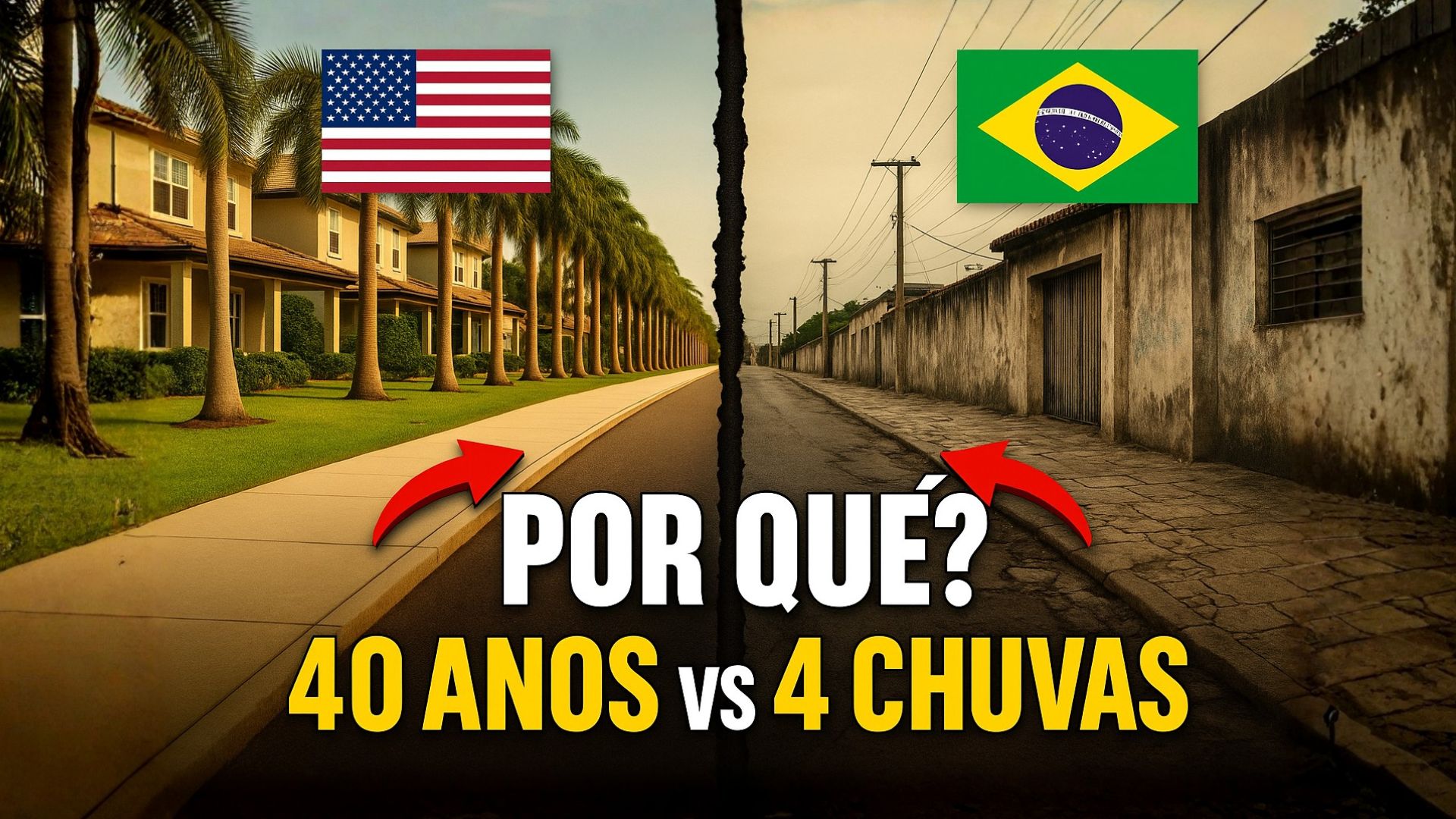


In The United States, Standardized And Durable Sidewalks Are The Result Of Urban Planning And Technical Maintenance. In Brazil, Even With Standards And Qualified Professionals, Improvisation Still Prevails And Compromises Urban Mobility.
Technical concrete sidewalks, standardized and continuous, are common in North America and can achieve lifespans of decades, according to urban engineering experts.
In Brazil, although there are standards and qualified professionals, the predominant practice still results in irregular, fragmented, and unsafe sidewalks, which directly affects mobility and public health.
According to a report published by the Elementar channel, this structural difference is not explained by a lack of technical knowledge, but by a series of historical and administrative decisions that have distanced pedestrians from the center of urban planning.
-
At 17, she hand-painted her first watercolor design for school uniforms; her brand grew without investors, sold 135,000 pieces, and aims for $3 million in revenue by 2026.

-
Shell Discovers Intact Early 19th-Century Wooden Shipwreck in the Gulf of Mexico at Over 1,300 Meters Deep
-
Brazilian Entrepreneur Turns Door-to-Door Jewelry Sales into a Family Business Empire with Over 70 Stores

-
$75 Million Bridge in Brazil Opens to Connect Cities, Create Jobs, and Cut Travel Time from 30 to 2 Minutes; Spanning 1.24 km, It’s Among the Country’s Largest and Ends Decades of Ferry Queues.




The country has standards and qualified professionals, but continues to repeat a model of improvisation and discontinuity.
What Defines A Good Sidewalk
In American and Canadian cities, the model consists of slab poured over a prepared base, with joints and subgrade specified for drainage.
The paving seeks uniform surface, controlled slopes, and accessibility at corners and crossings.
In many municipalities, contractors identify the year of execution within the concrete itself, which facilitates quality control and inspection over time.
In Brazil, the technical base exists.
The ABNT NBR 9050 establishes accessibility parameters, such as clear circulation areas, maximum slopes, and curb cuts.
Other standards guide materials and drainage, including permeable solutions.
In practice, however, the application is uneven: for each lot, the standard changes, with sections made of brittle ceramics, uneven cement, loose stones, or even grass, without continuity or effective oversight, according to engineers specialized in urban infrastructure.
Urban Planning And International Comparison
The discussion is not limited to material durability.
In various European centers, walking is part of urban design.
Wide sidewalks, lined with narrow, tree-lined streets, connected to plazas and public facilities, make walking safer and more comfortable.
Many central areas are pedestrian-only, and cars play a secondary role.
According to the findings of the Elementar channel, cities like Utrecht in the Netherlands demonstrate that it is possible to combine historical urbanism with modern infrastructure geared towards people.
There, walking or cycling is considered an essential part of the urban experience.
The European example reinforces that the longevity of sidewalks is directly linked to continuous planning and the priority given to pedestrians, according to urban planners interviewed by the channel.
In the United States, the rise of the automobile in the 20th century replaced streetcars and narrowed the pedestrian experience in many cities.
Still, when the sidewalk exists and follows technical standards, the constructive quality is often high, according to urban mobility specialists.
In Canada, large cities combine historical areas with modern infrastructure, prioritizing continuous surfaces, furnishings, and accessibility.
The central difference lies less in the country and more in the public management of space and the consistency of standards, according to evaluations by urban planners.
Legislation And Responsibility For Sidewalks
A critical point is the responsibility for construction.
In Brazil, the sidewalk is public space, but the obligation to build and maintain falls on the property owner.
This generates mosaics of materials, garage ramps that occupy the entire width of the sidewalk, and successive differences in elevation.
The absence of territorial standardization and systematic inspections exposes pedestrians to risks and shifts a collective cost onto citizens, according to analyses by researchers in urban law.
In other countries, even though residents participate, there are strict standards, deadlines, and inspections integrated into municipal management.
When the public authorities directly assume strategic sections — like those around hospitals, schools, and transport corridors — continuity improves, and the benefits extend to the network, according to urban planning specialists.
The Elementar channel also pointed out that in countries like Canada, there are sidewalks with manufacturing dates engraved in the concrete, a resource that symbolizes the commitment to maintenance and durability.
In Brazil, the absence of such control contributes to premature degradation and lack of accountability for repairs.
Social And Public Health Impacts
Poorly executed sidewalks increase the risk of falls, particularly among the elderly and people with reduced mobility.
Hospitals frequently report treating victims of falls on public roads, and national mobility studies indicate that walking remains one of the most practiced forms of transportation in Brazilian cities.
Nonetheless, safe and connected infrastructure is an exception, according to a survey by the National Association of Public Transportation (ANTP).
Previous research conducted by civil organizations has recorded low ratings for sidewalk quality in various capitals, with most evaluated sections falling below acceptable levels.
In addition to physical obstacles, “invisible” factors such as noise, pollution, inadequate lighting, and disconnected routes discourage walking habits and increase isolation for those who depend most on sidewalks, according to specialists in active mobility.


Where The Main Challenges Are
Among the main problems are insufficient planning, poor execution, and lack of continuous maintenance, according to engineers and urban planners.
Isolated projects per lot ignore the pedestrian network as a system, the base is often poorly compacted, and drainage is deficient, which reduces lifespan and causes subsidence after the first rains.
The Elementar also highlighted that individual homeowner responsibility for the sidewalk section tends to produce uneven results, with different flooring, heights, and materials.
Without centralized management and active inspection, public space loses continuity and accessibility.
The historical priority given to automobiles reinforces this pattern.
Wide avenues, extensive crossings, and narrow sidewalks are common in many Brazilian metropolises.
When active mobility policies are proposed, they often face institutional disputes over responsibilities and funding sources, according to researchers in the field.
Possible Solutions To Improve Brazilian Sidewalks
One of the solutions pointed out by specialists is to treat the sidewalk as essential urban infrastructure, just like lighting, drainage, and sanitation.
This implies network planning, dedicated budgets, unique standards per neighborhood, and regular inspections.
Municipalities can adopt hybrid models, where the public authority defines projects and technical standards, while residents execute within deadlines and under municipal supervision.
In sensitive areas — such as schools, hospitals, and tourist zones — the city hall can take direct responsibility.
Another alternative is to adopt decentralized management by neighborhoods, with sub-mayors or local consortia responsible for sidewalk maintenance funds and urban furniture.
This organization brings decision-making closer to the problem and speeds up solutions, maintaining the established technical standard.
The Technique Exists, But Continuity Is Lacking
Brazil has engineers, architects, urban planners, and established standards.
The difference between sidewalks that last for decades and those that deteriorate in a few years lies in three main factors, according to specialists: complete project, with adequate base and drainage; qualified execution, with material control; and scheduled maintenance, with quick responses to damage and interference.
Where these elements align, durability increases and the lifecycle cost decreases.




Realmente no Brasil não temos calçadas adequadas para o pedestre. Como pedestre andar em calçadas sem condições é um desafio. Em São Caetano município de São Paulo tem calçadas bem estruturas.
É porque lá, o dinheiro destinado a fazer as calçadas, vai para as calçadas, aqui, vai para o bolso dos políticos ou dos responsáveis pelas obras.
Faltou explicar que lá a calçada é pública e pertence a prefeitura. Aqui a calçada é privada, de serventia pública, ou seja, privatiza que melhora? Então. As calçadas aqui são iniciativa privada e cada dono faz como bem entender fora das normas mínimas. Não tem fiscalização nem punição então quem não faz nem o mínimo economiza… É só a estatização com a devida cobrança. O asfalto você cobra. Senão também é só a buraqueira.