Portuguese
  Spanish


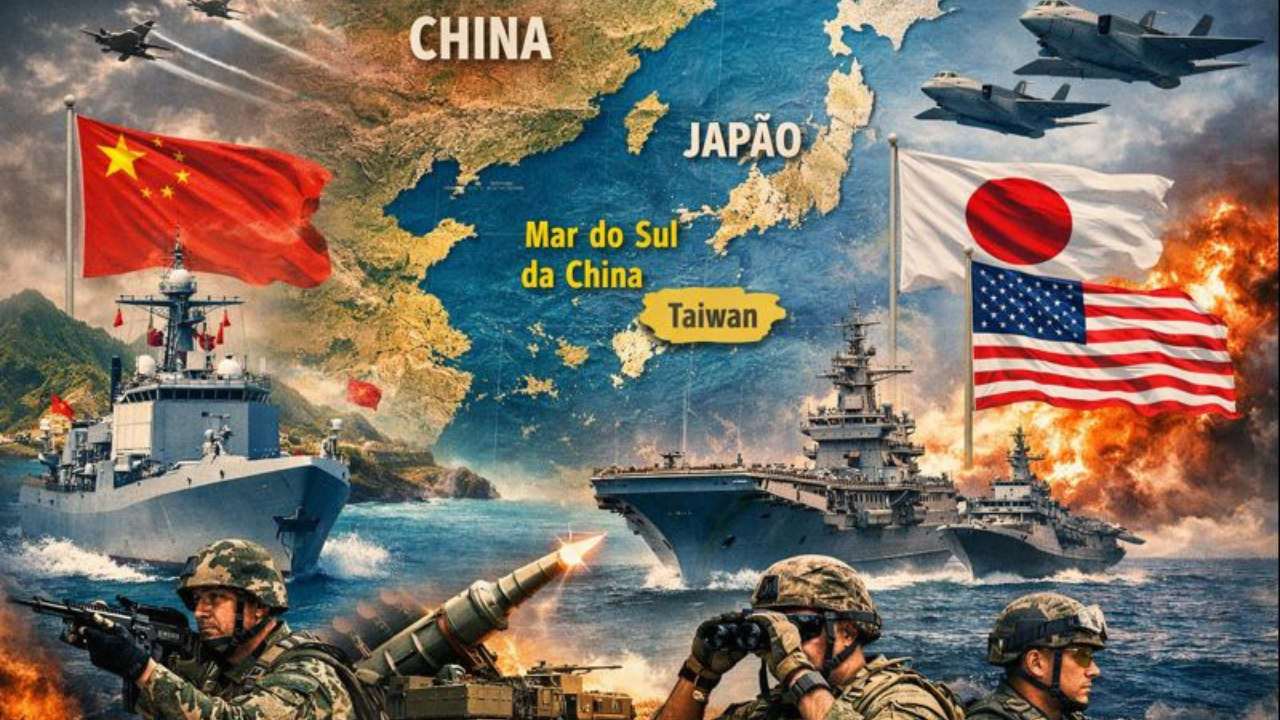


Understand Why the Indo-Pacific Is Strategic and How China, Japan, and the United States Use Military Deterrence to Avoid Open War.
The Indo-Pacific has become, in recent years, one of the main focuses of global geopolitics.
What is happening is an escalation of strategic tensions;
Who is at the center of the dispute are China, Japan, and the United States; When, at a moment marked by prolonged conflicts in various parts of the world;
-
European Parliament Approves Digital Euro, Aiming to Challenge Visa and Mastercard’s Dominance and Transform Payments Across Europe by 2029

-
Israel finds Hezbollah militarized tunnel over 200 meters long under village, with 4 missile launch shafts, 12 chambers, anti-tank missiles, drones, and weapons depots at a depth of 25 meters.

-
Ukraine launches largest drone attack on Moscow since 2022, Russia claims to have intercepted nearly 200 aircraft near the capital, Kapotnya refinery targeted again, and offensive reignites alert about war reaching the Russian energy heart just a few kilometers from the Kremlin.

-
Truck drivers, freight, and fines from 2022 take center stage in politics: Chamber approves MP with amnesty, mandatory tracking by CIOT, million-dollar penalties, and new minimum wage for those who spend more than 24 hours on the road.



Where, especially in the South China Sea and around Taiwan;
How, through military alliances and displays of power;
Why, because the region is considered vital for the economy, security, and global influence of great powers.
Right at the beginning of the analysis, it becomes clear that the cooperation between Japan and the United States did not arise to provoke a direct confrontation, but to prevent the tensions with China from evolving into an open war in Asia.
Nonetheless, the scenario is considered delicate and long-term.
Indo-Pacific: Why the Region Is Strategic
The Indo-Pacific encompasses some of the most important maritime routes on the planet.
A significant portion of global trade, including energy, food, and industrial inputs, passes through these waters.
Therefore, ensuring freedom of navigation is a central point of the foreign policy of the United States and its allies.
Additionally, the growing Chinese presence in the South China Sea and near Taiwan has altered the regional balance.
This expansion includes investments in infrastructure, an increase in naval power, and greater political influence in neighboring countries.
As a result, Japan has come to view regional security as a national priority.
China Expands Presence and Generates Reaction
China has been combining economic, military, and political interests to strengthen its position in the Indo-Pacific.
The country understands that controlling or influencing this area is essential to ensure resource supply, protect trade routes, and consolidate its status as a global power.
Meanwhile, the intensification of Chinese activities has led Japan and the United States to reinforce joint exercises, defense investments, and strategic cooperation.
This response seeks to balance forces and reduce the risks of unilateral actions.
Military Deterrence as a Central Strategy
Despite the firm rhetoric, the prevailing logic between Japan and the United States is that of military deterrence.
This concept means demonstrating sufficient capability and readiness to discourage any initiative that could result in armed conflict.
As controversial as this approach may seem, authorities and analysts point out that the intention is not to initiate a war, but to prevent it.
The idea is that the display of strength reduces the probability of miscalculations or impulsive decisions.
How Japan and the United States Work Together
The partnership between Japan and the United States involves everything from defense agreements to expanded military presence in the region.
Naval exercises, information sharing, and technological development are part of this cooperation.
Moreover, the U.S. sees Japan as a key ally to protect other regional partners and maintain stability in the Indo-Pacific.
Thus, the alliance also serves as a clear political signal of commitment to Asian security.
The Chinese Perception of the Strategy
On the Chinese side, there is an understanding that this union aims to contain its advance.
Beijing recognizes the attempt at deterrence, but it is still unclear whether this strategy will be enough to curb its regional ambitions.
On the other hand, China argues that its actions aim solely to protect legitimate interests and ensure economic development.
This clash of narratives contributes to the complexity of the scenario.
A Stalemate That Is Far From Over
Despite diplomatic and military efforts, experts assess that the dispute in the Indo-Pacific will not be resolved in the short term.
The region will continue to be a stage for tense negotiations, displays of strength, and influence disputes.
Meanwhile, the balance between China, Japan, and the United States will continue to be based on military deterrence and the pursuit of stability.
The challenge is to prevent this strategic rivalry from turning into a new large-scale conflict in a world already marked by wars that seem endless.