






 Portuguese
  Spanish


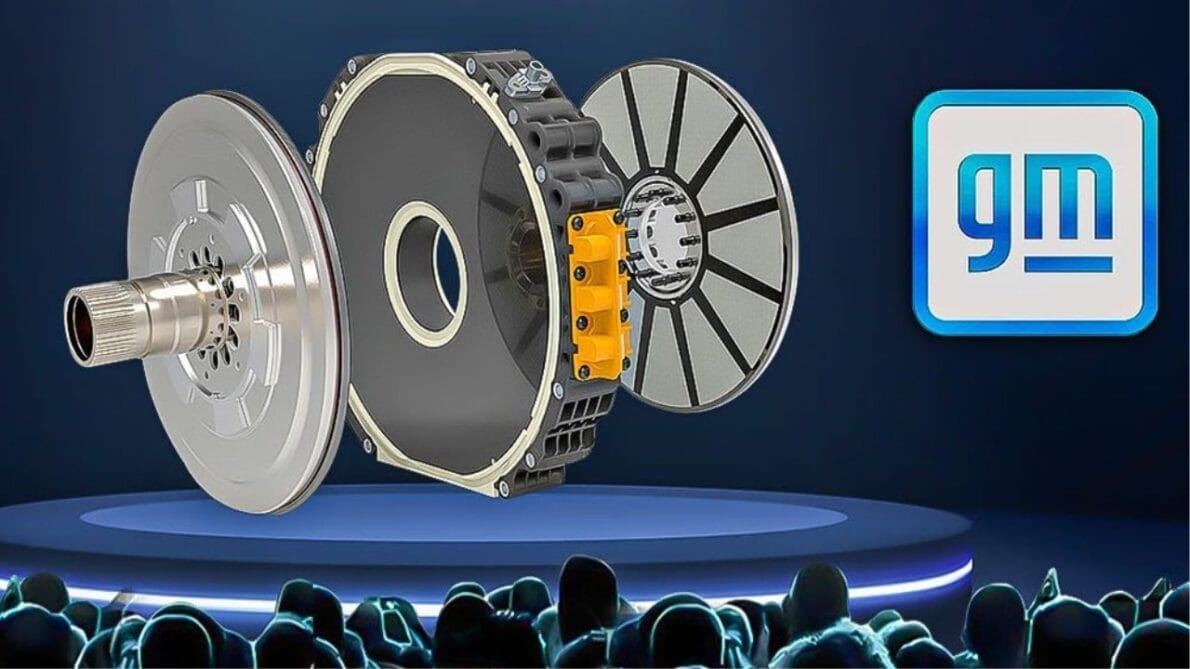

GM Is Revolutionizing Electric Vehicles With Its New Axial Flux Motor, Promising to Change the Market Forever.
Electric vehicles are becoming increasingly popular as a more sustainable alternative to gasoline-powered cars. However, there are still some challenges to overcome before they become the main mode of transport. Two of the biggest challenges are the cost and size of electric motors. These traditional motors are large and heavy, affecting the efficiency and range of vehicles. Additionally, they are expensive to manufacture, contributing to the high price of electric vehicles.
GM understands these challenges and has developed a new axial flux motor that promises to address these issues. This motor is more compact and lighter, making electric vehicles smaller and more affordable.
What Is the Axial Flux Motor?
The axial flux motor is different from traditional radial flux motors. In radial motors, the magnetic force travels perpendicular to the axis of rotation, making them long and barrel-shaped. In contrast, in the axial flux motor, the magnetic force flows parallel to the axis of rotation, allowing for a flatter and more compact design, similar to a frisbee.
-
The large jar blender has a rival: Oster Ultra Power bets on 1,000 W, six stainless steel blades, and two portable cups with leak-proof lids.

-
Tesla injected an additional $250 million into the German factory, doubled the battery cell target, and opened its own production line for startups.

-
No more TV stuck on the wall: Samsung The Freestyle+, the new projector with over 400 lumens projects on walls, floors, and ceilings, bringing cinema to any corner of the house.
-
A Japanese governor single-handedly stalled the construction of the world’s fastest train for nine years, and only now has he agreed to allow a tunnel excavated at a depth of 1,400 meters.



Axial flux motors offer several advantages over traditional motors:
Size and Weight: They are smaller and lighter, improving the efficiency and range of electric vehicles.
Power: Despite their compact size, these motors are equally powerful.
Efficiency: The design allows them to operate more efficiently at higher speeds, due to a concept called “mechanical field weakening”.
What Is Mechanical Field Weakening?
Mechanical field weakening is a technique that adjusts the distance between the stator (stationary part with coils) and the rotor (rotating part with magnets) to change the magnetic force. This allows the motor to operate more efficiently in different situations, providing high torque for acceleration and high speeds for cruising. GM plans to use a hydraulic system to adjust this distance, making the motor more versatile and efficient.
Impact on the Electric Vehicle Market
GM’s new axial flux motor has the potential to transform the electric vehicle market. It promises:
Smaller and Lighter Vehicles: The compact and lightweight design allows for the creation of smaller and more efficient electric vehicles.
Cost Reduction: With motors cheaper to manufacture, electric vehicles can become more accessible to the public.
Increased Efficiency: Technology enables better performance and greater range for vehicles.
The introduction of GM’s new axial flux motor represents a significant advancement for the electric vehicle industry. With a more efficient and compact design, these motors can help overcome cost and size challenges, making electric vehicles more accessible and practical for everyone. GM is leading the way with this innovation, promising to forever change the way we view electric vehicles.





Dito isto 200 mil um Bolt… não funciona, eu como funcionário antigo GM, sei que não vai resolver nada, capaz ficar mais caro
Com referência ao comentário sobre a fábrica GM, tenho uma S10 flex 2020, excelente mecânica e desempenho. O problema são os inúmeros pontos de ferrugem no contorno do para-brisa.
Assunto Importantíssimo sobre motores Elétricos Axiais. Que promovem sustentabilidade e preservação do meio ambiente.
Sem falar do custo menor e possibilidade de acesso de mais pessoas.
E ainda tem a potência e deslocamento com baixa emissão de ruídos.