






 Portuguese
  Spanish
  3 min of reading
  0 comments



The Cylindrical Shape of Tank Trucks Is Not a Coincidence. Understand the Engineering Behind This Choice and Its Benefits.
When analyzing the design of tank trucks used for transporting fuels, oils, and other essential liquids for the industry, there is a predominance of the cylindrical shape.
The structural choice is not merely aesthetic, but rather an ingenious solution based on principles of mechanical strength, dynamic stability, and operational efficiency.
In this context, the question arises: why is the cylindrical shape preferred over a rectangular design, which could theoretically optimize the stored volume and simplify the manufacturing process?
-
Cheaper than Civic and Corolla, this Korean sedan offers a giant 520-liter trunk, 2.0 flex engine, and 6-speed automatic transmission; the Kia Cerato EX 2.0 2022 stands out as an ideal option for those who prioritize interior space and comfort.

-
An old Nissan Bluebird received the motor, inverter, and battery from the Leaf, became electric, and kept the body intact in a conversion done in the United Kingdom.

-
The car that most Brazilians buy today may cease to exist by 2030, and automakers already know that the 1.0 aspirated engine with manual transmission is numbered in the country.

-
Cheaper than an Onix, Mobi, or Polo: with a 1.4 turbo engine and 185 hp compressor, 7-speed S-Tronic transmission, 270 liters of trunk space, and the performance of a compact sports car, this Audi hatch costs less than many new popular cars. Meet the Audi A1 Sportback 2014.


Structure and Strength
Cylindrical tanks are designed to ensure maximum safety and efficiency in the transportation of liquids.
Unlike rectangular tanks, which have corners and points of stress, cylindrical tanks distribute pressure evenly across their walls. This prevents structural failure and minimizes the risk of leaks or ruptures.
This homogeneous distribution of pressure is crucial, especially when dealing with pressurized liquids, such as liquefied gases.
A tank with flat surfaces would require extra reinforcements to withstand internal forces, increasing weight and manufacturing costs. The cylindrical shape, on the other hand, is more efficient and safer.
Better Stability in Transportation for Tank Trucks
The stability of the truck is a determining factor in the choice of tank shape.
Trucks with cylindrical tanks have a lower center of gravity, reducing the risk of tipping over in turns or sudden stops.
In contrast, a rectangular tank would have a higher center of gravity, making the vehicle more susceptible to tilting and accidents.
Additionally, the absence of corners and edges reduces wind resistance, improving the truck’s aerodynamics and optimizing fuel consumption.
Control of Liquid Movement
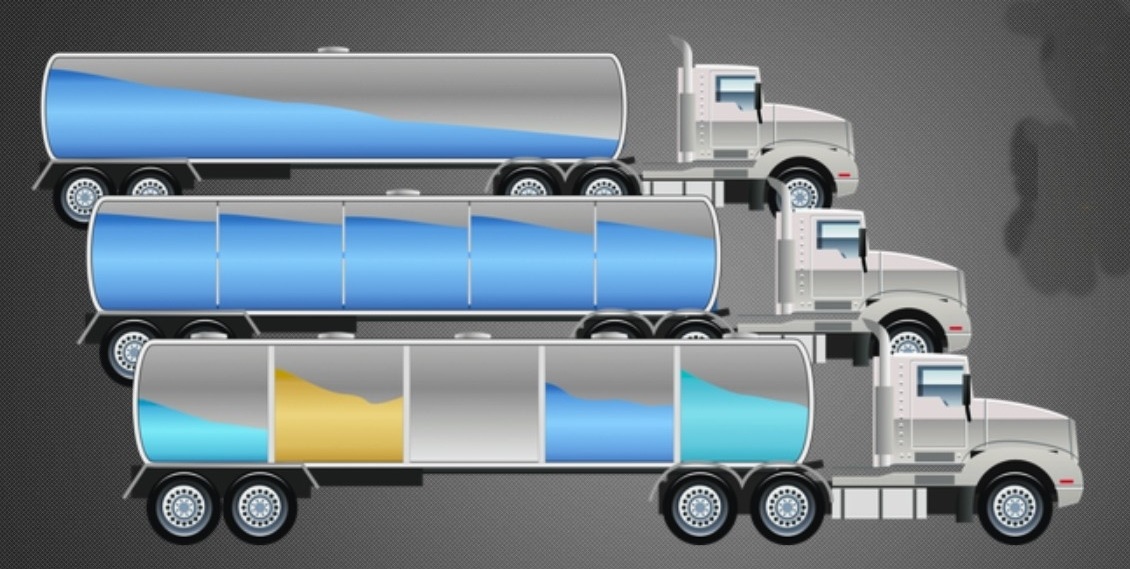
During transportation, liquids move within the tank due to inertia. This movement, known as “surge“, can compromise vehicle control, especially during braking or sharp turns.
To minimize this effect, cylindrical tanks often have internal partitions known as “baffle“, which reduce liquid sloshing and ensure greater stability.
If the tanks were rectangular, the impact of liquid movement would be greater, as there would be an uneven distribution of force against the tank walls. This would considerably increase the risk of losing control of the truck.
Ease of Extraction and Maintenance
Another important factor is the efficiency in liquid extraction. In cylindrical tanks, the liquid naturally flows to the lowest point, facilitating complete drainage.
In contrast, rectangular tanks could retain liquid residues in their corners, hindering the complete extraction of contents.
This characteristic also impacts the cleaning and maintenance of the tank. In cylindrical tanks, the absence of corners reduces residue buildup and facilitates sanitation, preventing contamination of the transported liquids.
This is particularly important for transporting chemical or food products that require a high standard of safety and cleanliness.
Cost Reduction and Efficiency in Production
The manufacturing of cylindrical tanks is more cost-effective and time-efficient. To produce them, it is only necessary to roll a metal sheet into a cylindrical shape and perform longitudinal welding.
A rectangular tank, on the other hand, would require multiple processes of cutting, bending, and welding, increasing production costs and manufacturing time.
Moreover, cylindrical tanks are lighter than reinforced rectangular ones, which means lower fuel consumption and higher cargo capacity for trucks.
Applicability of the Cylindrical Shape in Other Sectors
The principle of efficiency of cylindrical tanks also applies to other containers used in liquid storage, such as gas cylinders, plastic bottles, and industrial reservoirs.
The cylindrical shape not only ensures better pressure distribution but also facilitates the handling and transportation of these products.
Cylindrical tanks are the ideal choice for liquid transportation due to their structural strength, stability, efficient drainage, and simplified maintenance. Additionally, their optimized manufacturing reduces costs and enhances transportation safety.








-

-

6 people reacted to this.