Portuguese
  Spanish


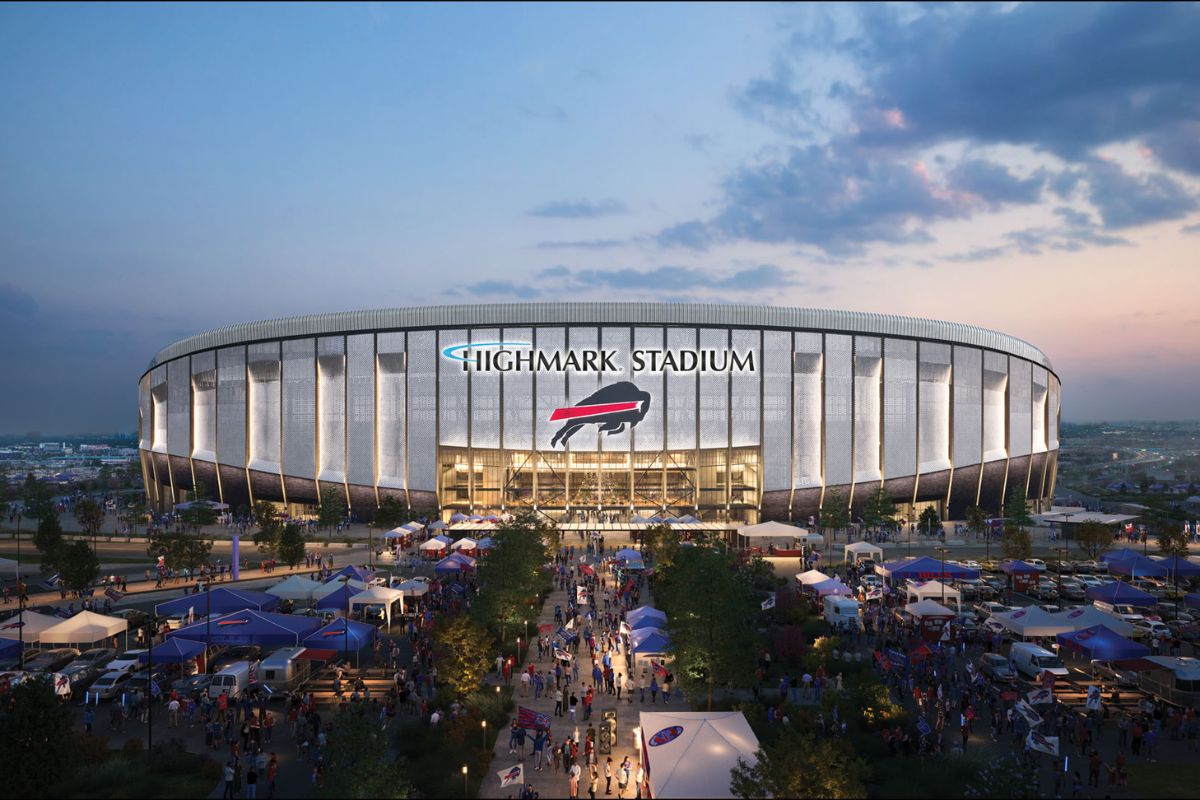


With a Total Cost of US$ 2.1 Billion and Public Funding of US$ 850 Million, the Open Stadium of the Buffalo Bills in Buffalo Strays from the Spaceship Standard, Reduces Capacity, Prioritizes Sound and Climate, Uses Perforated Steel and a Hydronic System for Wind and Snow Until 2026 Without Promising Events This Year
The stadium that the Buffalo Bills are building in Buffalo seems like a provocation in the midst of the glass arena era: open-roofed, with exposed brick and an old-school design, but with contemporary ambition behind it. The message is clear: instead of becoming a generic “event center,” the stadium aims to be a machine for sports advantage, designed for 2026.
The bill, however, is large and political. The stadium costs US$ 2.1 billion, includes US$ 850 million in public funds, and is being built at a time when the NFL is growing globally and pressuring franchises to modernize revenue and experience. The lingering question is why Buffalo chose the opposite path to the futuristic look and still treats this as the most calculated decision of the year.
Why Does the Stadium Look “70s” and This Is Not an Accident

The aesthetics of the new Highmark Stadium were designed to not look like a spaceship.
-
Giant Robots Build Entire Neighborhood of 100 3D-Printed Homes in the U.S., Showcasing Technology’s Impact on Construction Industry

-
Helsinki Residents Receive Water That Travels 120 Kilometers Through a Hidden Rock Tunnel from a Lake Before Treatment

-
Brazil’s Sertão Region Nears Completion of Latin America’s Longest Artificial River, Transforming Water Access in Drought-Prone Ceará
-
Pre-mixed stabilized mortar set to revolutionize construction in 2026: extends usability to 36 or 72 hours, boosts productivity, and minimizes waste in building projects.



Bricks at pedestrian level, metal in large planes, and an open design to the elements form a utilitarian, almost “industrial” set that could exist in various American cities from decades ago.
This choice is not gratuitous nostalgia.
The declared priority is to keep football at the center, focusing on the crowd, stands, and atmosphere, instead of maximizing an architectural showcase.
The result is a stadium that tries to transform climate, noise, and proximity into a product, not just a suite and convenience.
US$ 850 Million in Public Funds and the Friction That Comes Along

The public funding of US$ 850 million is one of the most sensitive points of the project.
The logic used to defend this type of spending often talks about “value for the city,” attracting visitors and an event calendar, but the public debate surrounding stadiums typically questions whether this converts into real gain for residents.
Here, the impasse is made even more evident because the stadium is open.
Without a roof, the ability to capture revenue during the off-season is more limited, and the argument of “year-round use” loses strength.
When taxpayers pay, engineering needs to prove there is a return, even if indirect, such as keeping the team in the city and avoiding relocation.
An Open Stadium That Tries to “Tame” Wind and Snow
The choice to keep the field open has a central justification: in Buffalo, the climate is part of the game and part of the identity, even as an advantage for the home team.
The project embraces this package but tries to mitigate the “worst” side of the experience, especially for those sitting and for the stadium structure.
The most visible strategy is the facade with thousands of perforations distributed across 4,400 steel panels.
The function is to manipulate the wind: instead of allowing air to gain speed and circulate freely, the openings break the flow and reduce the force before it enters the arena.
It’s an open stadium, but not unprotected.
Snow poses the toughest test.
The city receives about 241 centimeters per year, a volume that weighs on operations and the structural integrity itself.
To address this, the project describes a hydronic melting system: sensors trigger hot water circulating through pipes on the sloped roof, melting the snow as it falls and radiating heat downwards.
The covering protects approximately 60% of the audience without becoming a complete roof.
Sound, Proximity, and the Design to Intimidate Visitors


The decision not to close the stadium also relates to acoustics and atmosphere.
Open structures tend to “lose” part of the sound, so the metal covering was angled to reflect noise back into the arena, aiming to keep the sound contained and reverberating in the stands.
The goal is simple: to make the environment more hostile to outsiders.
The design also reduces capacity to around 60,000 seats, compared to approximately 72,000 of the old stadium, and adds a standing room area that can accommodate an additional five to ten thousand people.
The bet is that standing fans make more noise and create visual and auditory continuity in 360 degrees.
Another aggressive choice is proximity. The upper stands are described as the closest to the field among league stadiums, with general admission sections leaning against the grass.
This is not luxury, it’s psychological pressure and real-time game reading, with fans hearing more, seeing more, and participating more.
The Calculation for 2026 and What Is Left Out Without a Roof
The timeline indicates an opening in the summer of 2026, with the steel structure having already passed the completion milestone and the construction entering the final phase.
The message of the project is that form follows function: instead of resembling recent arenas like SoFi Stadium or Allegiant Stadium, the new Highmark aims to be “pure football,” with modern engineering hidden beneath a traditional appearance.
This path also comes with an opportunity cost.
The season runs from September to February, leaving free months where stadiums with roofs can monetize more predictably.
Without total coverage, the stadium relies more on the sports calendar and the appeal of “game day” as a unique experience.
Still, Buffalo treats the absence of a roof as a strategic choice, not as a cost-saving measure.
The argument is that there, the climate is not a flaw: it is identity, it is a competitive advantage, and it can be the differentiating factor of a stadium that wants to look old on the outside and operate like 2026 on the inside.
If the proposal is to turn wind and snow into a signature, the real question is how much this compensates for public money and the reduced flexibility for events. In your view, should a stadium prioritize the city as a multi-use space or the fans as a sports weapon, even if this limits use outside the season?