Portuguese
  Spanish


Gurgel’s electric project anticipated debates on urban mobility, charging infrastructure, and national production during a period marked by the oil crisis, technological limitations, and Brazil’s search for alternatives to traditional fuels.
The Gurgel Itaipu emerged in 1974 as one of the first initiatives of the Brazilian automotive industry aimed at producing a national electric car, amid the effects of the oil crisis and the debate on alternatives to fossil fuels.
Developed as a small, urban, and experimental vehicle, the model combined a French electric motor, lead-acid batteries, and the forecast of circulating with the support of a public charging network in Rio Claro, in the interior of São Paulo.
At that time, Brazil was still structuring its automobile industry and maintained a strong dependence on combustion engines, which placed the project in a field little explored by manufacturers installed in the country.
-
The Mystery of Roanoke: Entire Colony Vanished Without a Trace, Leaving Only “Croatoan” as a Clue and Becoming a Historical Legend

-
Namibia Plans to Build Homes for the Homeless Using Mushrooms and Invasive Plants to Tackle Housing Crisis

-
Brazilian Innovator Converts Old Car into Electric Vehicle Using Laptop Batteries and Forklift Motor, Achieves Nearly 90 km/h in Urban Settings

-
Brazil Launches Mobile ID as Mercosur Approves Mutual Recognition of Digital Identities for Public Services Across Member Countries


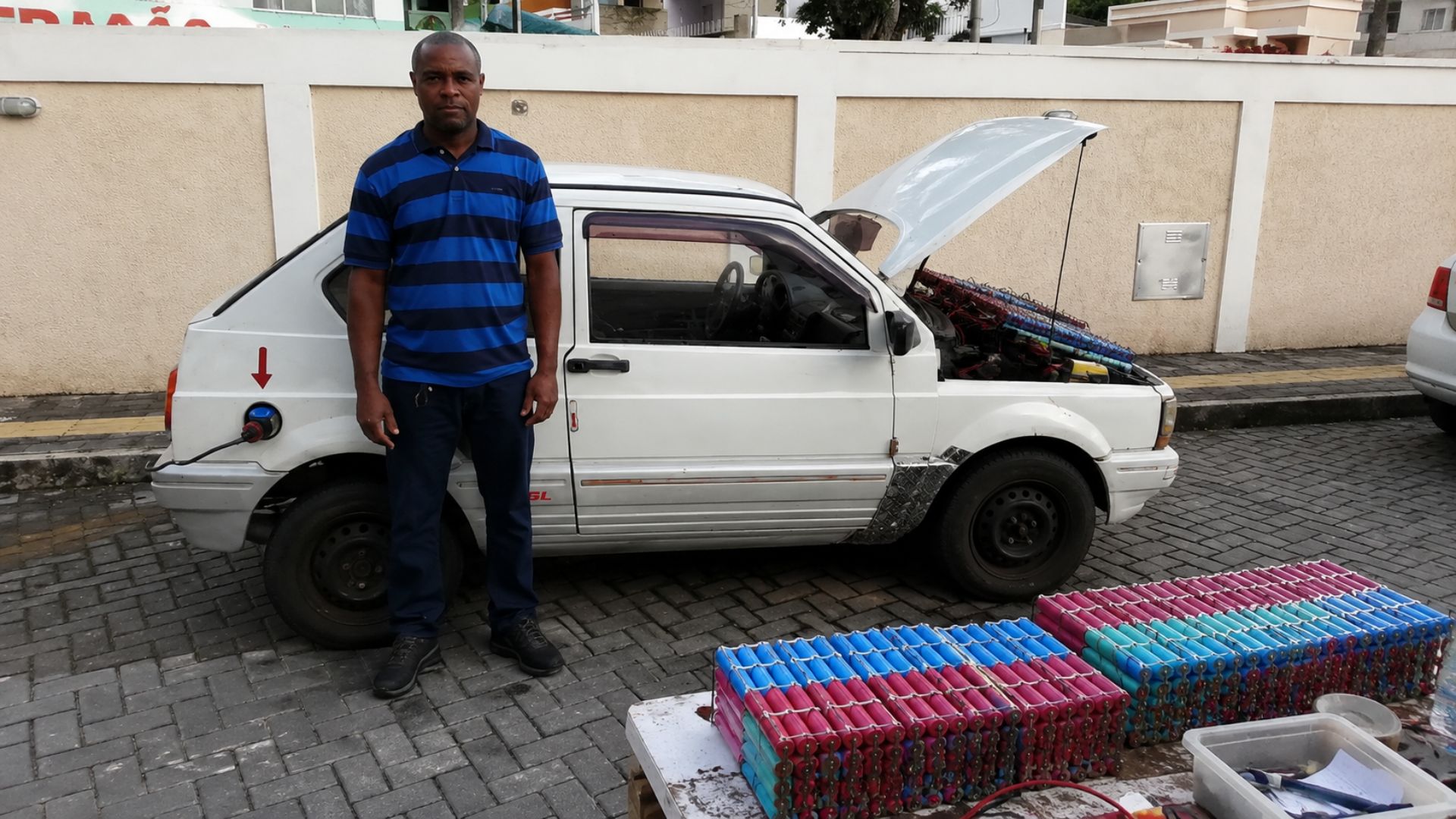

The Itaipu E-150, Gurgel’s first electric project, had a compact body, two seats, and dimensions aimed at short trips, especially in medium-sized cities, where urban routes could reduce autonomy limitations.
The initiative was developed by the company created by João Augusto Conrado do Amaral Gurgel, an engineer who founded Gurgel Motores on September 1, 1969, in São Paulo.
With an initial small-scale operation, the manufacturer became associated with projects of its own vehicles, using national solutions in chassis, bodies, and structural components.
Origin of Gurgel and the search for a Brazilian car
João Gurgel’s trajectory was linked to the advocacy of an automotive industry with greater participation of projects developed in Brazil, in a market then dominated by foreign automakers and imported technologies.
Still a student at the Polytechnic School of USP, in 1949, he presented a project for a popular two-cylinder car instead of the work requested by the professor, an episode associated with the phrase “cars are not manufactured, Gurgel, they are bought”.
After working at Ford, the engineer created his own automaker and directed the initial production towards light vehicles, mainly buggies and utility vehicles with Volkswagen mechanics.
The fiberglass-reinforced plastic body became part of the brand’s technical identity, as it allowed for weight reduction, simplified manufacturing, and adaptation of the models to the country’s usage conditions.

Among the first models were the Ipanema, the Bugato, and the Xavante, vehicles that helped establish the brand’s presence in recreational, rural, and utility segments.
The Plasteel system, based on the combination of steel tubes and reinforced plastic material, became one of the technical solutions employed by the Brazilian manufacturer in different projects.
This experimental environment opened the way for the development of the Itaipu, instead of limiting the company to adapting vehicles with combustion engines.
Gurgel began working on an urban electric vehicle at the same time as the 1973 energy crisis expanded the international debate on alternatives to oil.
Itaipu E-150 and the idea of public recharging
The Itaipu E-150 was presented as a prototype in 1974 and was named in reference to the Itaipu hydroelectric plant, a project associated with the expansion of Brazil’s energy capacity at that time.
The choice of name linked the vehicle to themes such as electricity, infrastructure, and national development, without eliminating the technical challenges still present in the automotive use of batteries at the time.
Gurgel’s proposal was not limited to the automobile, as it included the provision of exclusive parking spaces with energy points for recharging in Rio Claro, in partnership with the city hall and with electricity supplied by Cesp.
This plan brought the project, on a local scale, closer to the concept of public infrastructure for electric vehicles, a model that would only be widely discussed in the automotive market many decades later.
At the 1974 Auto Show, the Itaipu attracted attention for its geometric shape, with straight lines and a trapezoidal body, common features in compact urban prototypes of that period.
The steel tubular structure covered with fiberglass followed Gurgel’s experience in light vehicles and allowed the application of solutions already known by the factory in an electric configuration.
According to technical sheets published by Quatro Rodas, the E-150 had a central electric motor of 3,000 watts and 120 volts, power around 4.2 hp, single-speed transmission, and ten 12-volt batteries connected in series.
The set weighed about 780 kg, a value considered high for a subcompact due to the weight of the batteries, which represented a significant portion of the vehicle’s total mass.
The batteries were among the main technical limitations of the project because lithium-ion cells were not yet available for automotive use at that time.
Therefore, the Itaipu relied on lead-acid batteries, a heavy, bulky solution with lower energy density compared to the technologies used by modern electric cars.
Some historical information attributes about 320 kg of the assembly just to the battery pack, which helps explain the performance and range limitations of the prototype.
Technical limitations of the first Brazilian electric car


The performance of the Itaipu E-150 reflected the technological constraints available for electric vehicles in the 1970s, especially in energy storage and the relationship between weight, power, and range.
The top speed was close to 60 km/h, while the range reported in different records varied from about 50 km to 80 km, depending on usage conditions, load carried, and battery condition.
Although Gurgel planned for mass production, the electric urban car did not advance commercially, and development was limited to an experimental stage.
The weight of the batteries, the limited range, and the cost of the system reduced the product’s viability, especially in a market without a consolidated charging network and without consistent incentives for electric vehicles.
Another relevant factor was the political and energy context of the period, marked by the federal government’s priority given to Proálcool, a program created to encourage the use of ethanol as a national alternative to gasoline.
With this energy policy orientation, the proposal for a public electric charging network lost ground, and the small Itaipu project ceased to advance before reaching commercial scale.
Gurgel, however, continued studies on electrification and leveraged some of the E-150 experience to formulate a strategy aimed at fleet applications.
In this new design, the focus shifted from the individual urban consumer to include companies, public agencies, and services with predictable routes, where the limited range could be managed with greater operational control.
Itaipu E-400 brought electricity to public fleets
In the early 1980s, after another oil crisis, Gurgel resumed the electric project in a different format, aimed at commercial use and urban fleet operation.
The Itaipu E-400 was developed to transport up to 400 kg and serve maintenance, telephony, electricity, and delivery services over short and medium distances.
Production began in 1981, and the first model was presented in Brasília to then-president João Figueiredo during an agenda related to the project’s promotion.
The vehicle began to be used by state-owned and large companies, such as Telebras, Telesp, Telerj, Cesp, Banespa, and Receita Federal, which acquired units for their fleets.
Unlike the E-150, the E-400 used a national electric motor supplied by Villares, a Brazilian company known for producing industrial equipment and electromechanical systems.
The nominal power was 10 kW, about 13.5 hp, a suitable index for planned urban displacements but limited for long routes, steep slopes, or constant operation with a high load.
The utility vehicle maintained mechanical solutions known in the Brazilian market, such as a four-speed manual transmission and a Volkswagen-origin clutch.
This combination indicates Gurgel’s attempt to integrate electrification with components available in the country, which could reduce development costs and facilitate maintenance by user companies.
Lead-acid batteries remained among the project’s most significant technical and economic constraints, especially due to weight, recharge time, and replacement cost.
The E-400 used eight 12-volt units, with a total recharge time of around eight to ten hours, a range of about 80 km under usual conditions, and a replacement cost considered high for fleets.

Itaipu E-500 and the end of electric production
The next evolution was the Itaipu E-500, offered in pickup and passenger van versions, with an increased load capacity of 500 kg.
Historical records indicate a range of up to 120 km, a figure associated with this later stage of the project, and not with the small E-150 presented by Gurgel in 1974.
Even with changes in format and target audience, Gurgel’s electric vehicles continued to be conditioned by the limitations of the lead-acid batteries available at that time.
The expensive replacement, restricted range, and competition from combustion utility vehicles hindered commercial expansion, especially in a scenario of economic instability in Brazil.
The production of the electric Itaipu was terminated in the mid-1980s, after a trajectory concentrated on institutional fleets and specific urban applications.
Among the E-400 and E-500 models, surveys published by specialized media indicate about 86 units manufactured, almost all destined for companies, public agencies, and local operation services.
Over the years, some units ended up being converted to alcohol or gasoline engines, a practice favored by the structural similarity with components already used in Volkswagen vehicles.
The bodywork and part of the structural solution continued to be used in the Gurgel G-800, a model equipped with a Volkswagen combustion engine.
From there, the electric project lost space within the factory, which maintained its focus on jeeps, utility vehicles, and later, popular cars like the BR-800 and the Supermini.
Legacy of the Gurgel Itaipu in the Brazilian automotive industry
The Gurgel Itaipu is cited in reports and specialized publications as one of the initial milestones of automotive electrification in Brazil, especially for having emerged before the worldwide consolidation of modern electric cars.
This interpretation is supported by the contrast between the project’s proposal and the technical limitations of the period, when there were no modern batteries, consolidated charging network, or consumer market prepared for this type of vehicle.
The comparison with modern electric car manufacturers helps to contextualize the historical precedence of the Itaipu, but does not imply technological, commercial, or industrial equivalence between projects separated by decades of evolution.
The Itaipu did not achieve broad scale or performance comparable to current electric vehicles, but it represented a concrete experience of national electrification before the topic gained space in the agendas of governments and automakers.
The project remains relevant to Gurgel’s history for its attempt to combine an electric vehicle, charging infrastructure, and defined urban application in a single strategy.
This combination helps explain why the Itaipu remains present in research, reports, and collections related to the memory of Brazilian automotive engineering.