Portuguese
  Spanish


An impressive archaeological discovery has brought to light a forgotten part of Brazilian urban history: an ancient metal vessel linked to the 19th century appeared during excavations and revealed how rivers and streams shaped life before the advance of asphalt
A public work in Belém opened the ground and brought to light something that seemed impossible: the bow of a 19th-century ship, buried under a busy avenue, exactly where the modern city erased ancient rivers, streams, and navigation paths.
The find appeared during the works of the Nova Doca Linear Park, on Avenida Visconde de Souza Franco, and reignited a powerful question: how many parts of fluvial Belém are still hidden beneath the asphalt?
The avenue that hid a giant vessel
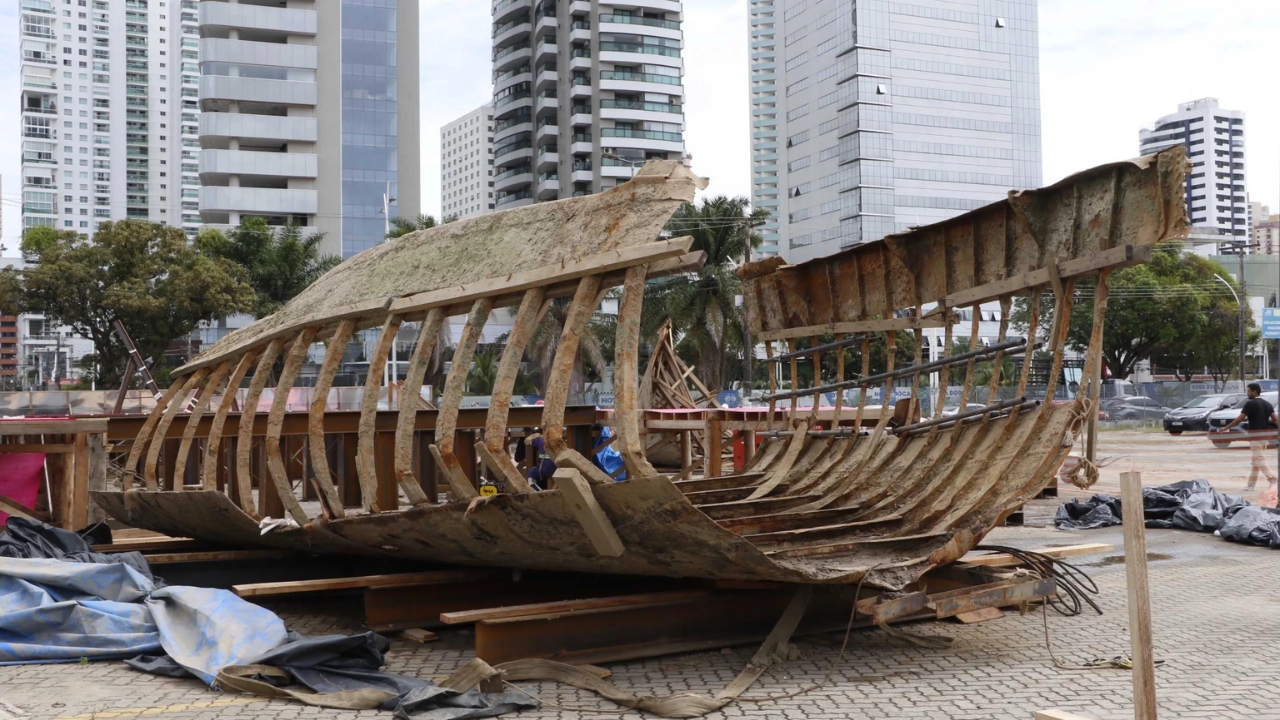
The metal structure caught attention due to its size. Iphan reported that the piece is about 22 meters long, 7 meters wide, and 2.25 meters deep, dimensions that turned the discovery into one of the most impressive archaeological finds of the work.
-
Brazilian Man Ingeniously Transforms Air Fryer into Functional Speaker with Radio and Volume Controls

-
Rows of “stone balls” emerge at low tide on California beach, with formations up to 1.5 meters aligned like a Pacific bowling alley

-
Japan Installs 800 Cameras in Tohoku Mountains Amid Rising Bear Attacks

-
Workers Installing Fiber Optics in French Town Discover 75 WWII-Era Concrete Training Bombs, Each Weighing 250 Kilograms




It was not just a small piece of old metal. It was part of a large, heavy vessel, corroded by time and buried in an area that, in the past, had a direct connection with water circulation.
The most intriguing part is the location. The Doca region, now marked by traffic, commerce, and buildings, was once connected to the ancient Igarapé das Almas, a circulation axis in a Belém very different from today.
The fluvial past appeared in the middle of the work
The discovery was made in August 2024, during the park’s excavations. From then on, the area needed to be isolated, and the rescue required a slow, technical, and careful operation.
The removal did not happen all at once. The vessel was removed in three stages, involving the bow and two other parts of the central hull. The strategy aimed to reduce damage and preserve as much of the original characteristics as possible.
A giant of iron corroded by time
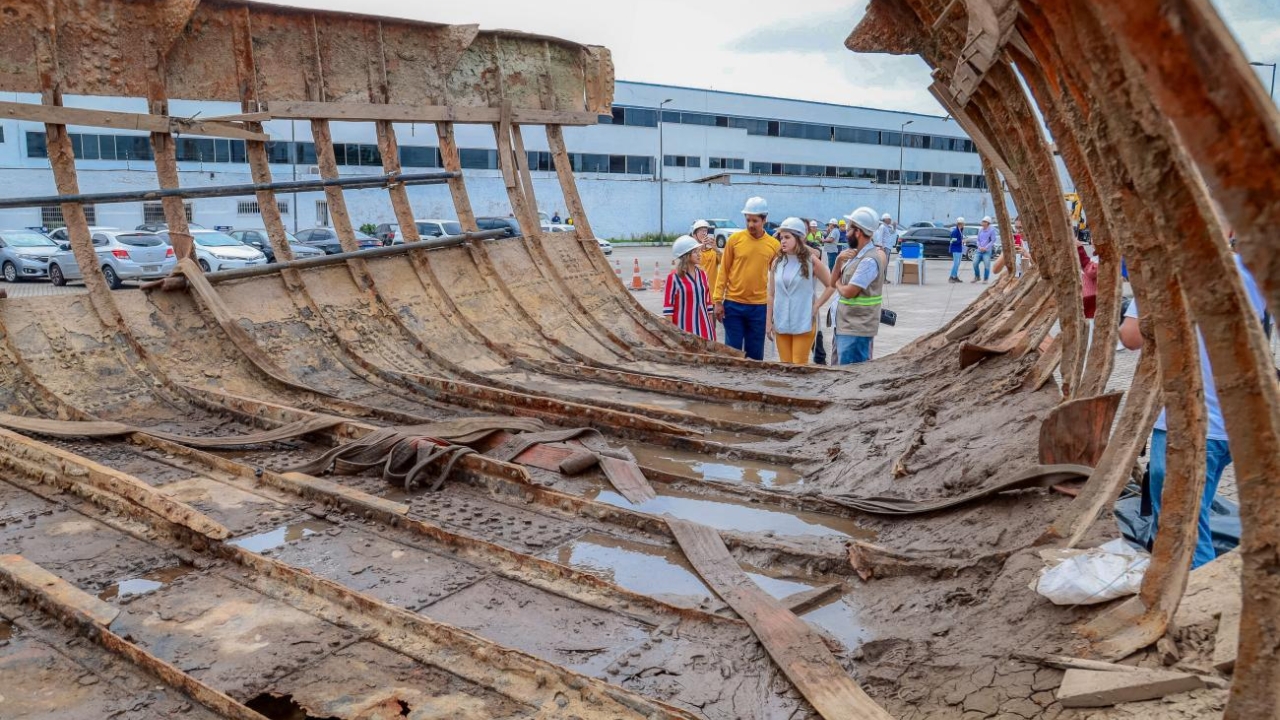
The vessel is described as a metal structure, with characteristics associated with the end of the 19th century and beginning of the 20th century. The strongest hypothesis is that it is linked to the old river trade of the capital of Pará, when rivers and streams functioned as circulation streets.
During the Rubber Boom, metal boats gained importance in the Amazon because they were more resistant and could transport large volumes. They connected Belém to riverside towns, rubber plantations, and product export routes such as rubber, cocoa, nuts, and wood.
There is still no definitive conclusion about all the details of the vessel. Experts continue to investigate its origin, function, and composition, including whether there were wooden parts or a connection to steam navigation.
Even older fragments emerged in the excavations
The find did not come alone. During the same excavations, fragments of crockery and bottles were also found, some associated with periods that may reach 200 or 300 years.
These objects expand the dimension of the discovery. They indicate that the work did not find just an old naval piece, but a material layer of Belém’s urban history, passing through moments linked to colonization, the Empire, and the beginning of the Republic.
It is precisely this set that makes the case so strong. The avenue did not hide just a ship. It hid traces of a city built on water flows, commerce, transportation, and successive landfills.
The city of rivers under the city of asphalt
The image is powerful: a modern avenue opened by machines reveals a giant iron vessel, buried in an area where water once organized urban life.
Belém was born facing the rivers. Over time, part of this landscape was filled in, channeled, and covered by urban structures. What was a path for boats became a street, avenue, construction, and concrete.
Therefore, the prow found in the Doca draws attention not only for its size. It draws attention because it materializes a profound change: the transition from a city driven by rivers to a city shaped by asphalt.
Restoration and Public Exhibition
After the rescue, the vessel was taken to a laboratory set up next to Porto Futuro I. The conservation process took place between February and July 2025, with the participation of professionals from fields such as archaeology, architecture, engineering, museology, and restoration.
Corrosion was one of the major challenges. The structure was buried for a long time in a humid environment, a condition that weakened parts of the metal and required specific techniques for cleaning, support, and coating.
The forecast released is that the piece will be exhibited to the public after the completion of the conservation and inspection stages. The Government of Pará also informed that the Nova Doca project includes 1.2 kilometers of canal, as well as drainage, urbanization, a bike path, landscaping, and new walkways.
Why This Discovery Matters Now
The case draws attention because it combines public works, archaeological heritage, urban history, and a huge physical piece, something rare to appear in the midst of a modern intervention.
As Belém transforms with new urban spaces, the ground revealed a concrete reminder of when the city was traversed by vessels, goods, and streams.
The 22-meter prow found under the Doca is not just an ancient relic. It is a visual proof that part of the city remains buried, waiting for a project, an excavation, or a chance to resurface.