Portuguese
  Spanish


Bowling Ball Beach, in California, reveals at low tide natural sandstone spheres up to 1.5 meters formed by mineral concretions.
On the rocky coast of Mendocino County, California, there is a beach that seems to have been organized by human hands. During low tide, dozens of stone spheres appear aligned in the sand, creating a scene that resembles a natural bowling alley in front of the Pacific Ocean.
The place is known as Bowling Ball Beach, a coastal strip north of Schooner Gulch. According to the California Geological Survey, the “balls” are natural concretions formed within tilted layers of sandstone and range from about 2 to 5 feet in diameter, approximately 60 centimeters to 1.5 meters.
The stone balls of California appear at low tide and seem organized in perfect rows on the beach
The phenomenon becomes more visible when the sea recedes. At high tide, many of the spheres are partially or completely covered by water, turning the visit into a sort of temporary geological hunt.
-
Brazilian Man Ingeniously Transforms Air Fryer into Functional Speaker with Radio and Volume Controls

-
Japan Installs 800 Cameras in Tohoku Mountains Amid Rising Bear Attacks

-
Workers Installing Fiber Optics in French Town Discover 75 WWII-Era Concrete Training Bombs, Each Weighing 250 Kilograms
-
Dogs Eating Grass: A Simple Act That Debunks Long-Held Myths About Canine Behavior




According to the California Geological Survey, some of the concretions are still embedded in the sandstone layers exposed on the cliffs, while others have already detached from the original rock and were left on the beach by the continuous action of coastal erosion.
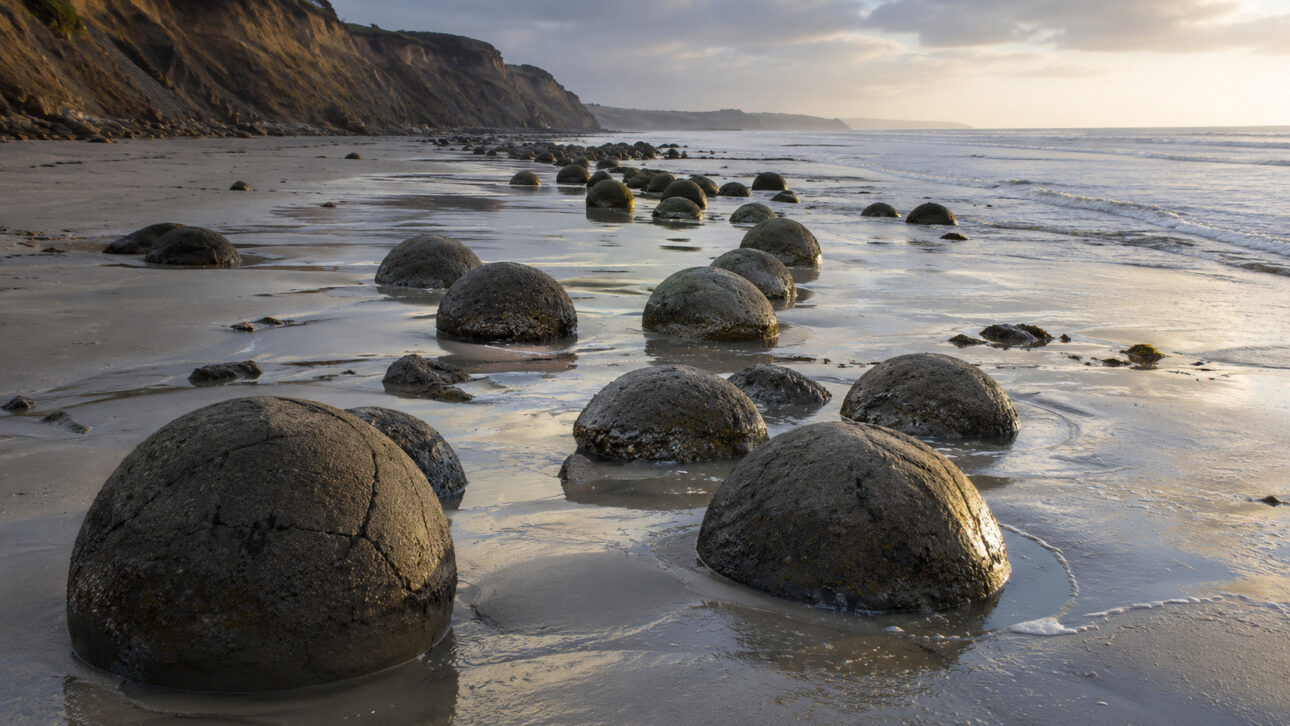
It is this combination of tilted rock, waves, and differential erosion that creates the unusual appearance of the site. The spheres were not brought to the beach by people, nor are they archaeological remains: they are resistant mineral masses that survived while the surrounding sandstone was removed by the sea.
Concretions form when minerals cement sediments around a core within the rock
The scientific explanation lies in the concretion process. According to the California Geological Survey, the decomposition of organic material can locally alter the pH of the sediments, favoring the precipitation of mineral cement around a core, often a shell fragment or fossil.
Over time, minerals such as calcite or silica crystallize around this center, forming a mass harder and more resistant than the surrounding sedimentary rock.


When the more fragile sandstone erodes, the concretion remains almost intact. This contrast explains why the balls seem to have “appeared” ready-made, when in fact they were slowly revealed by the action of waves, rain, wind, and geological time.
The beach functions as an outdoor lesson on erosion, geological time, and rock resistance
The case of Bowling Ball Beach is especially visual because the concretions appear grouped in a relatively small area. Some are embedded in the cliffs, others are exposed on the sand, and others appear partially buried, as if emerging from the ground.
According to geological material about the location, the concretions are more resistant to weathering than the host sandstone. As the surrounding rock wears away, new spheres tend to be slowly released from the original formation.
This means the landscape is not static. The same sea that reveals the stone balls also continues to wear down the coast and reshape the beach.
Natural spheres challenge the artificial appearance and show how geology can create almost perfect shapes
What makes Bowling Ball Beach so striking is the almost geometric appearance of the formations. The stones are rounded, repetitive, and aligned enough to give the impression they were placed there.

According to the California Department of Fish and Wildlife, the Schooner Gulch region is known for these spherical formations, described as concretions originating from the sandstone cliffs near the beach.
This type of formation also helps explain similar phenomena in other parts of the world, such as the Moeraki Boulders in New Zealand, and giant concretions found in deserts, riverbanks, and ancient marine formations.
Bowling Ball Beach shows how the ocean can transform common rock into a natural spectacle
The strength of the theme lies in the contrast between appearance and origin. At first glance, the spheres seem artificial, as if they were sculptures forgotten in the sand.
According to geology, they are the result of millions of small accumulated processes: mineral cementation, selective erosion, worn cliffs, and waves working day after day.

On a coast marked by mist, cliffs, and rough seas, Bowling Ball Beach shows that nature also produces symmetry, repetition, and almost perfect shapes.
The question that remains is simple: how many landscapes still seem mysterious simply because the geological time scale is too slow to be perceived by us?