






 Portuguese
  Spanish


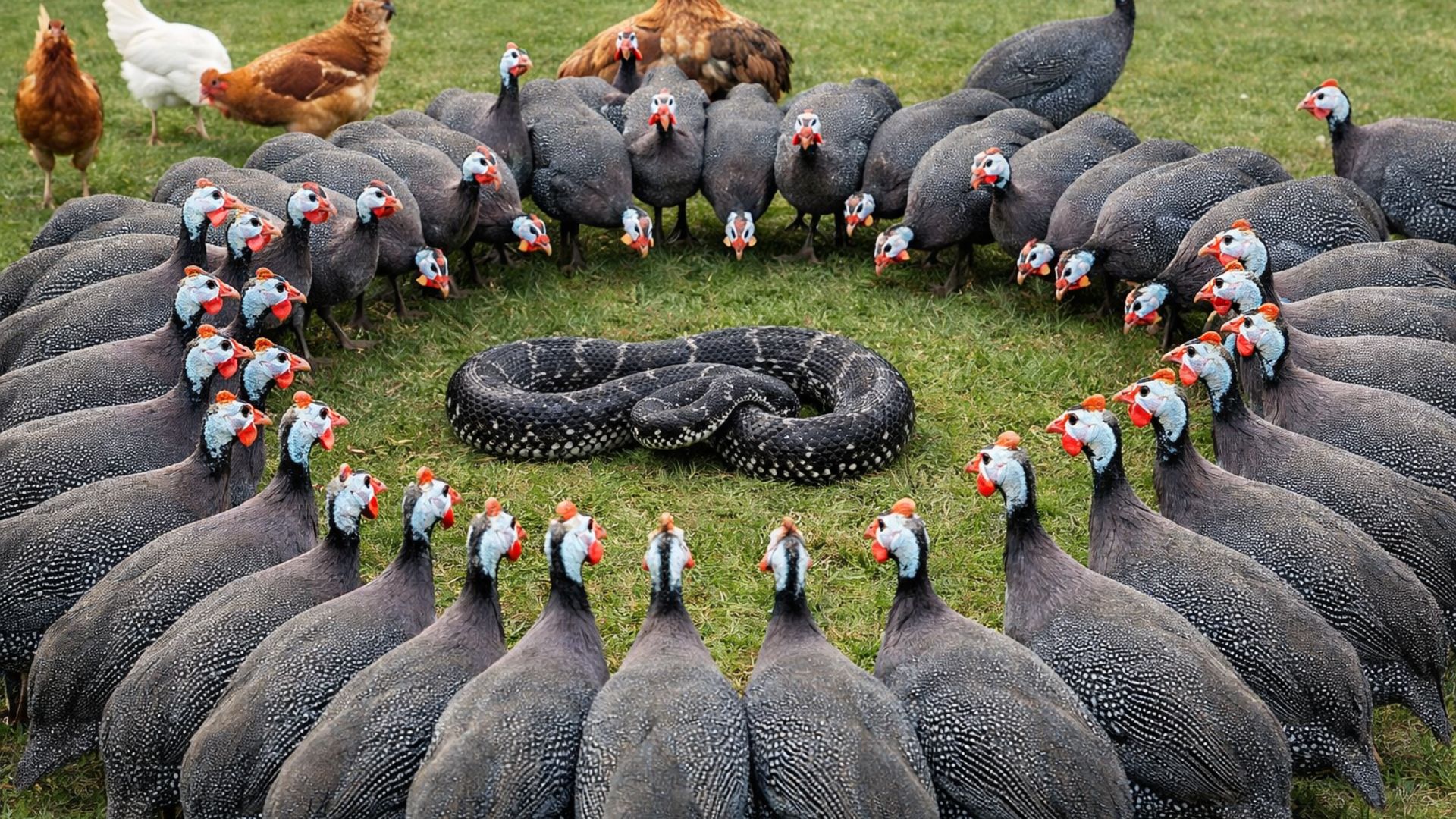


Collective Siege, Sound Alert, and Constant Pressure Explain Why Guinea Fowl Transform Backyards into Hostile Environments for Snakes and Other Venomous Animals, in an Instinctive Behavior Often Observed in Brazil.
When a snake appears in the backyard and, within seconds, several birds gather around it, what seems like staging is often real behavior observed in rural and residential areas.
Guinea fowl, especially the guinea hen, form an organized siege, keep the snake under constant pressure, and in many cases, make the animal retreat without the need for direct confrontation.
This movement draws attention precisely because it contradicts the most common expectation, as instead of fleeing, the group organizes and transforms the space into a hostile environment for the snake.
-
12-year-old girl develops a virtual receptionist with artificial intelligence for small businesses and demonstrates how the combination of creativity, programming, and automation can boost productivity, reduce repetitive tasks, and expand access to digital transformation.

-
A rock weighing almost 500 tons seems to defy gravity for over 11,000 years in Finland and remains balanced on a tiny base without collapsing or moving.
-
At 76 years old, a retired man reveals a subterranean labyrinth he dug by hand for 30 years under his own garden, descending 6 meters into sand dunes, erecting 1.5-meter concrete walls with calculations from his mathematician wife, and transforming a “crazy” idea into a hidden cave with a bridge and waterfall.

-
Seen from space, an astronaut captures in Canada a geometric carpet of crops drawn over the backdrop of a ghost lake that disappeared 12,000 years ago, was once larger than all the Great Lakes combined, and left a scar of fertile mud that still sustains agriculture.



Videos of this type often circulate on the internet and are frequently met with skepticism, but residents of farms, smallholdings, and rural areas report that the scene is part of the daily life where there are flocks of these birds.
In these places, the change is not limited to the reaction to the snake, as the presence of the guinea fowl alters the dynamic of the backyard and directly influences the movement of other animals.
Alert from Guinea Fowl Triggers Collective Behavior

The sequence usually starts when a single bird identifies the presence of the snake and reacts in an unexpected way, without immediately attacking.
Instead, it emits a shrill, loud, and repetitive sound, described by residents as an alarm, completely distinct from the usual crowing.
The noise intensifies and changes pattern, functioning as a clear warning that triggers the group’s response in just a few moments.
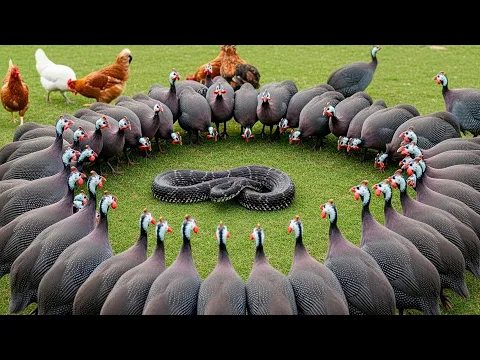
Quickly, other birds approach the area, movement increases, and, around the snake, an almost automatic ring forms.
The flock positions itself, encircles the point where the snake is, and starts to control the surrounding space, significantly reducing escape possibilities.
Why the Circle of Guinea Fowl Unsettles the Snake
The siege has well-defined objectives and starts by limiting the snake’s mobility, which depends on space to advance and strike accurately.
Surrounded by several bodies in constant motion, the snake loses clear attack references and no longer has an isolated target.
Moreover, the formation creates ongoing confusion, as the birds move all the time, change positions, and maintain the intense noise.
For the snake, the combination of movement, noise, and proximity generates stress, disorientation, and fatigue, factors that reduce the willingness to remain in that environment.
At the same time, the alert sound also serves as a warning for nearby humans.
In properties and backyards, this unusual noise often prompts residents to check what is happening, preventing accidents by revealing the presence of the snake before someone approaches without realizing.

Coordinated Attacks Exhaust the Snake Without Direct Confrontation
Even when the snake is large and poses a real risk, the birds do not immediately retreat or advance in a disorderly manner.
The pressure occurs strategically, with the group alternating approaches and retreats according to the snake’s movements.
When the snake attempts to strike, one guinea fowl moves away while another approaches from behind, keeping attention pointed to the side of its body.
The text describes quick pecking, directed mainly at the area near the tail, avoiding the head-on to reduce risk.
This attack pattern aims to exhaust the animal, test its limits, and keep it under constant tension, without offering a clear opening for a direct attack.
As minutes go by, the place becomes progressively more hostile, and the snake, most of the time, gives up on holding its position.
The most common outcome is not the death of the animal, but rather its fleeing, as the birds win through the persistence of the group and the continuous pressure.
Genetic Instinct Explains Reaction Even in Very Young Birds
Although the guinea hen is most associated with this behavior, the text makes it clear that the reaction is not exclusive to this species.
Common hens also display similar attitudes, with reports of very young chicks chasing small snakes and pecking without hesitation.
These episodes reinforce the idea that the behavior is not learned but is part of the bird’s instinct from birth.
The snake is perceived as a direct threat to the nest, the eggs, and the group, which explains why the response tends to be collective and coordinated.
Instead of relying on individual action, the flock organizes to protect the territory and reduce risk for all.
Guinea Fowl as Natural Pest Control
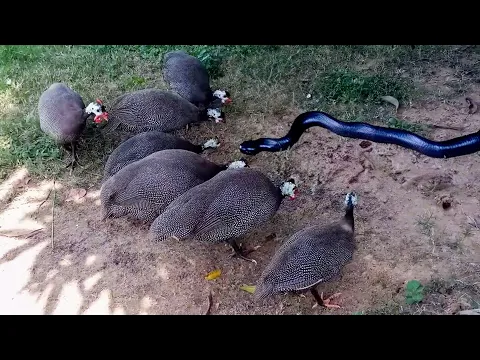
In rural areas, the presence of guinea fowl is often associated with backyards that have fewer records of scorpions, spiders, rats, and snakes.
In regions with scorpion infestations, many people have started raising these birds on purpose, using a natural control method instead of chemical products.
According to the text, demand has grown so much in some places that there were no birds left for sale, with breeders even negotiating chicks that hadn’t been born yet.
This movement has not been restricted to rural areas, as there are reports of condominiums adopting guinea fowl as a form of biological security.
The birds roam through common areas, feed on insects, emit sound alerts, and help reduce the use of poisons in the environment.
Limits of Behavior and Indirect Impact on the Environment
Despite their reputation for efficiency, guinea fowl are not described as invincible or capable of eliminating any threat.
The text emphasizes that they cannot kill very large snakes alone and that, in rare cases, when the snake is extremely aggressive or hungry, the risk exists.
Still, the main role of these birds is not to kill, but to scare away, alert, and drastically reduce the chances of attack.
There is also a significant indirect effect, as the constant presence of the guinea fowl reduces the food supply in the backyard, such as rats, insects, and small animals.
Without available prey, the snake loses interest in remaining in the area and tends to seek out another location.
The rise of guinea fowl in Brazil is attributed to their adaptation to the climate and life in backyards, which explains their wide distribution.
Known by names such as guinea, capote, cocá, woodland hen, and tô fraco, the bird maintains the same function in different regions.
To watch over territory, alert to threats, and act as a natural defense, without traps, poisons, or direct intervention.
If this siege already draws attention in videos, what does it reveal about the power of collective instinct and how the environment changes when the entire group reacts in a coordinated manner?






Faltou falar sobre o sabor e a consistência da carne da galinha d’angola. E também, sobre quem são os principais consumidores, já que o consumo caseiro é raro.
Venenosas ou não são cobras e as angolistas, não sabem distinguir, mas o intestino prevalece. Muito interessante! Deve ser por isso mesmo que no nosso sítio, tinda galinha de angola, outras galinhas, e não havia cobras…
Sem as aves as cobras começaram aparecer (?), quem sabe!
Importante é que elas unem forças para defesa, por instinto. O ser humano, tem raciocínio, não pensa e faz burradas …., né?
Impossivel ver a mensagem, texto coberto de comerciais, falta de respeito.