Portuguese
  Spanish


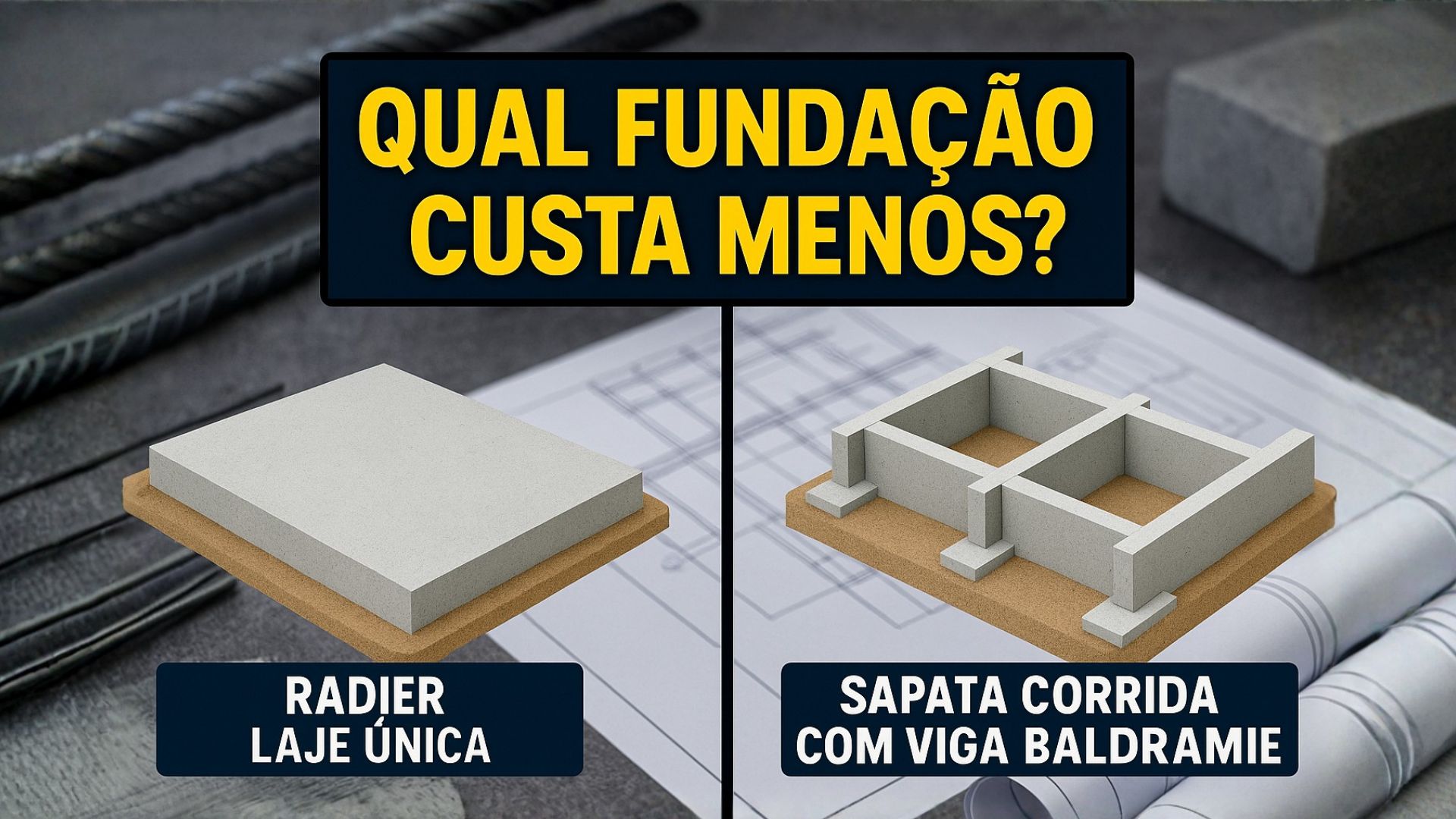


The Choice of Foundation Type Affects Costs, Deadlines, and Material Consumption in Popular Housing, Directly Impacting Works of 40 to 50 Square Meters and Depending on the Actual Soil Conditions and the Project.
The decision between executing the foundation in reinforced concrete slab or in strip footing with beam directly influences the total cost, the execution time, and the material consumption in small popular housing projects in Brazil, especially in projects of 40 to 50 square meters aimed at social housing.
Surveys based on official SINAPI compositions and academic studies simulating real works show that there is no single answer.
There are scenarios where the slab reduces costs and construction time and others where the strip footing solution remains cheaper, depending on the soil, the size of the building, and the structural detailing adopted.
-
$134.7 Million Project in São Paulo Installs Over 5 Kilometers of Pipes, Creates New Underwater Crossing to Boost Water Supply for Over 450,000 People

-
At 61, Former Homeless Wheelchair User Receives Key to Container Home in Brazil, Declares Independence
-
São Paulo Highway to Receive Over $260 Million in Upgrades, Including 90 Kilometers of Service Roads and New Infrastructure, by 2027
-
Couple Transforms Abandoned Seaside Public Restroom Bought for £33,000 into £295,000 Beach House After a Decade of Renovations





Technical Characteristics of the Two Foundations
According to Brazilian technical standards, the slab is classified as a shallow foundation and acts as a large reinforced concrete slab supported directly on the soil, covering almost the entire area of the construction and receiving more than 70% of the structure’s loads.
This system distributes efforts more evenly, which usually favors compact ground-level constructions on sites with adequate load-bearing capacity.

On the other hand, the strip footing is a continuous reinforced concrete element under walls and structural alignments, with a widened base designed to transmit loads to the ground, usually associated with the beam that connects, levels, and ties the structure together.
Both systems are classified as direct foundations by NBR 6122.
Execution Differences on the Construction Site
In practice, the difference in process between the two solutions is evident.
The slab is usually executed as a single plate, with a thickness of about 10 centimeters, supported by a gravel bed and protected by plastic tarpaulin, receiving metal mesh or steel bars.
Meanwhile, the foundation in strip footing with beam requires linear excavations, molding of the footings, execution of the foundation beams, assembly of forms, and, in many cases, waterproofing and backfilling.
This set of operations results in more work fronts for excavation, reinforcement, and concreting distributed over time, unlike the single concreting that characterizes the slab.
Cost References According to SINAPI
When observing the cost references from SINAPI, there appear to be magnitude indications for comparison.
There are specific compositions for reinforced concrete slab on soil, with granular bed, steel mesh, plastic tarpaulin, and forms.

For foundation slabs with 10 centimeters of thickness and concrete of 30 MPa, the base presents national average values of a few hundred reais per square meter, considering materials, equipment, and labor.
In the case of strip footings and beams, the compositions are provided per cubic meter of concrete and per kilogram of steel, plus excavation, forms, and backfill.
The conversion of these volumes into cost per square meter indicates that the unitary cost of concreting the footing typically exceeds several hundred reais per cubic meter.
Studies Comparing the Two Solutions in the Same House
The difference becomes clearer in studies that compile complete budgets for the same residence.
In an academic analysis of a popular single-story house, based on input prices from Caixa, the material budget indicated approximately 3.9 thousand reais for the strip footing, compared to about 3.4 thousand reais for the slab, considering the same project and soil.
In this simulation, the savings amounted to about 12% in favor of the slab.
Despite this, the study pointed out that the slab consumed more steel, reaching approximately 260 kilograms, versus about 185 kilograms in the strip footing solution with beam.
On the other hand, the slab required a lower total volume of concrete and concentrated execution into fewer stages, which reduced costs and deadlines in that case.
When the Slab Becomes More Competitive
This type of result aligns with reports from engineers and companies working in social housing.
Professionals working in popular works highlight advantages such as shorter execution time, simplified use of forms — concentrated mainly on the edges — and reduction of labor when sizing meets the characteristics of the terrain.
In lots with soil of low to medium load capacity, the slab often stands out for its ability to distribute efforts evenly.
When the Strip Footing Presents Lower Cost

However, not all research points to a cost advantage for the slab.
Recent works show houses where the isolated or continuous footing presented a lower final cost.
In a small house, the isolated footing was almost a quarter cheaper than the slab designed for the same building.
Another study, in two-story popular housing, concluded that the footing represented just over half the estimated cost for the slab, making the foundation slab economically unfavorable in that context.
This contrast reinforces that economic performance depends on slab thickness, house geometry, loads, and soil resistance.
Construction Time and Sequence of Activities
When the criterion becomes the timeline, analyses tend to favor the slab.
In the simulation where the footing was about 12% more expensive, the study highlighted the greater number of successive services: segmented excavations, reinforcement, and concreting in sections, assembly and disassembly of forms, and punctual waterproofing.
The slab solution, on the contrary, requires a more streamlined sequence before the major concrete pour of the slab.
Technical texts also remind that foundations with strip footing tend to require more time for team mobilization, plumb adjustments, leveling, and backfill execution, extending the timeline.
Material Consumption: Steel and Concrete
In material consumption, the behavior is divided. The slab concentrates a larger amount of steel per square meter, necessary to ensure rigidity and control deformations.
The strip footing, on the other hand, requires a larger volume of concrete and, in some projects, additional layers of protection and waterproofing.


In popular single-story houses between 40 and 50 square meters, this relationship means that the slab uses more steel, but reduces the total volume of concrete.
The strip footing concentrates concrete under each wall and relies on the beams for tying the structure.
Absence of Standardized National Survey
The publicly available databases allow us to affirm that both systems have proven advantageous in real studies.
There is still no standardized national survey comparing, by type of soil and by model of single-story residence of 40 to 50 square meters, the cost per square meter of slab and strip footing in different regions of the country.
The existing data comes from isolated projects, with specific geometries and conditions. This lack of standardization means that the choice continues to depend on the technical analysis of the soil, the anticipated loads, and the compatibility between project, budget, and timeline.
For builders, this raises a practical question: in your region, which solution has appeared as the most economical in recent popular works — the concrete slab or the strip footing with beam?