Portuguese
  Spanish




Petrobras President Comments on Historical Drop of Brent Amid Discrepancy Between Domestic Prices and International Quotations
The president of Petrobras, Magda Chambriard, commented on October 15, 2025, about the sharp drop in the price of Brent oil.
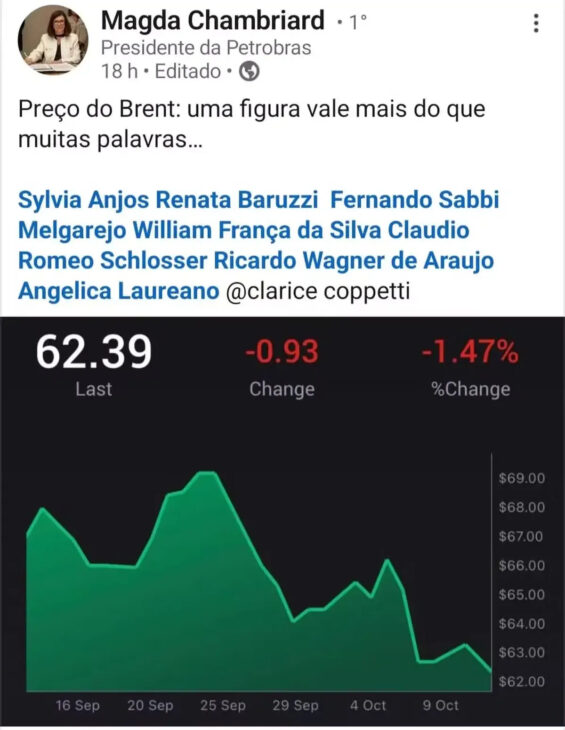
The price approaches US$ 62 per barrel, the lowest level since June. In addition, the executive posted a chart on her social media with the phrase: “A picture is worth a thousand words.”
The post, therefore, highlighted the downward movement in international quotations.
The chart, referring to the period between September 16 and October 10, clearly shows the downward curve of the barrel.
Oil has lost about US$ 15 in four months, reflecting a continuous trend.
This movement occurs in a context of cooling global demand, pressured by trade tensions between China and the United States, as explained by the Brazilian Center for Infrastructure (CBIE).
Petrobras Keeps Gasoline More Expensive and Diesel Cheaper Than Abroad
As Brent declines, Petrobras continues to maintain a significant difference in fuel prices sold in the country.
According to data released on October 16 by the Brazilian Association of Fuel Importers (Abicom), the state company sells gasoline 9% more expensive and diesel up to 4% cheaper compared to the international market.
For this reason, specialists consulted by the newspaper O GLOBO state that this behavior constitutes a possible cross-subsidy.
The company, therefore, compensates for losses in diesel with higher margins on gasoline. Sérgio Araújo, president of Abicom, also highlighted that the pricing criterion “is not transparent and seems to mix import and export parity.”
He added that, in addition, there is an apparent imbalance in the pricing policy, as diesel has been below international parity for weeks, while gasoline remains more expensive.
Magda Defends Stability and Transparency in Pricing Policy
During an event held in Rio de Janeiro on October 15, Magda Chambriard avoided anticipating any adjustments.
However, she reaffirmed that the company seeks stability to avoid shocks to the domestic market.
In addition, according to the executive, Petrobras’ strategy considers three fundamental pillars: import parity, export parity, and market share. “It’s about price stability, avoiding volatility for the Brazilian consumer.
This applies to both diesel and gasoline,” Magda stated, reinforcing the company’s commitment to predictability.
-
OPEC+ Boosts Oil Supply by 188,000 Barrels per Day in July 2026, Leading to Price Drop from $112 to $89 per Barrel in Under Two Months

-
TotalEnergies Signs 20-Year Deal to Purchase 2 Million Tons of LNG from Alaska, Boosting Project Viability
-
Turkey Deploys Çağrı Bey Drilling Ship to Explore New Oil Frontier Off Somalia’s Coast
-
Golden Pass LNG Ships First Liquefied Gas Cargo from the U.S., Completing $10 Billion QatarEnergy and ExxonMobil Investment




International Context Pressures Brent
The price of Brent has fallen from US$ 77 in June to around US$ 62 in October 2025, according to monitoring by the International Energy Agency (IEA).
This decline, in turn, reflects the weakening of global optimism and creates caution among investors. The expectation of a global oil surplus in 2026 also maintains downward pressure on prices, which directly affects corporate decisions.
Additionally, analysts note that geopolitical tensions and industrial slowdown in China reduce energy demand, directly impacting the global commodity balance. Therefore, the international scenario remains a crucial factor for price behavior.
Short-Term Trend
With Brent on a downward trajectory and fuels misaligned from international parity, the market is therefore waiting for the next update from Petrobras.
The state company, however, maintains a policy of avoiding sharp adjustments, prioritizing predictability and long-term stability. Thus, the situation illustrates the challenge faced by Magda Chambriard’s management, which needs to balance competitiveness and public policy in a scenario of global volatility.
Moreover, the combination of falling Brent and divergence in domestic prices keeps the state company under close market and consumer scrutiny.