Portuguese
  Spanish


The double tunnel of Morro do Vieira in Jaraguá do Sul will have 1,000 meters with concrete pavement instead of asphalt, a choice that ensures a lifespan of over 40 years in the Santa Catarina mountains, in a R$ 228 million project already 80% completed within the duplication of BR-280.
Concrete is replacing asphalt in the most important tunnel that Santa Catarina is currently building, and the reason goes beyond engineering preference: it’s a matter of mathematics. The double tunnel of Morro do Vieira, in Jaraguá do Sul, in northern Santa Catarina, will have about 1,000 meters of extension with rigid concrete pavement that can reach approximately 26 centimeters in thickness, more than four times the 6 centimeters of traditional asphalt, a difference that ensures a lifespan measured in decades instead of years. The structure is part of the duplication of BR-280 in the stretch between Schroeder and Jaraguá do Sul, a project with an investment of R$ 228 million that has already surpassed 80% completion according to DNIT (National Department of Transport Infrastructure).
The proof that concrete works is just a few kilometers away. In Serra Dona Francisca (SC-418), sections paved with concrete have withstood for more than four decades without the need for significant structural intervention, as explained by André Torrens, engineer and regional infrastructure coordinator for the north of the state. While conventional asphalt on mountain roads needs resurfacing every few years due to wear caused by heavy traffic and the slope that intensifies the friction between tires and road, concrete maintains the surface intact for an incomparably longer period, making the higher initial cost an investment that pays off over time.
Why concrete was chosen instead of asphalt for the BR-280 tunnel

The decision to pave the tunnel with concrete is directly linked to the conditions the material will face within the structure. Tunnels concentrate heavy traffic in a confined space where trucks and trailers repeatedly pass over the same stretch of floor without the lane alternation that occurs on open roads, a concentration that accelerates asphalt wear and would require frequent maintenance in an environment where any repair work forces partial or total traffic closure. Concrete eliminates this need by supporting the weight and repetition without deformation for a period that can exceed 40 years, as demonstrated by the sections of Serra Dona Francisca.
-
Giant 3,600-ton Crane Breaks Two World Records by Installing World’s Largest Single-Piece Forged and Welded Hydrogenation Reactor, Weighing 3,037 Tons, in Chinese Petrochemical Plant in Just Six Days

-
$80 Million Bridge in Brazil Cuts Travel Time from 30 Minutes to 1 Minute, but Audit Reveals Major Flaws
-
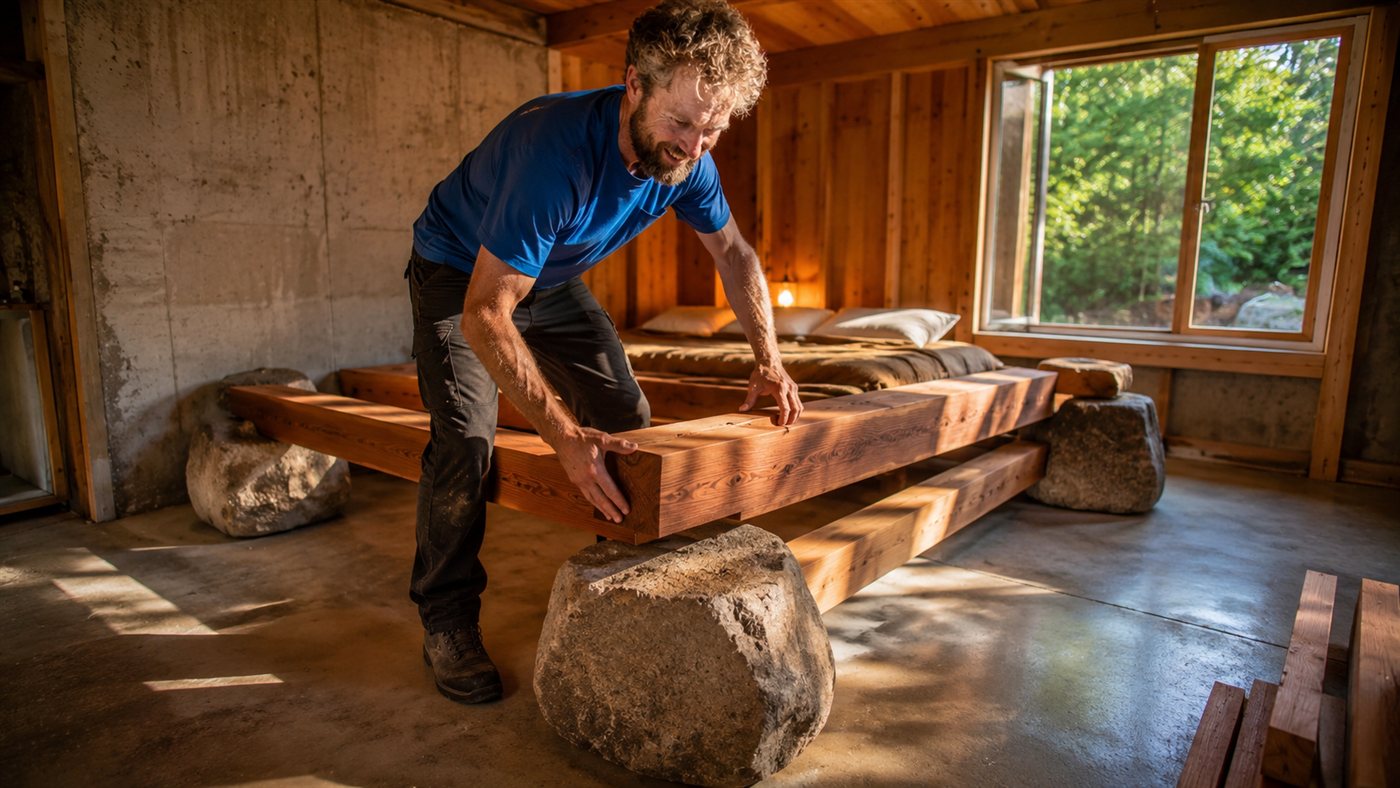
Man Builds Stone Bed with Granite Rocks and Hand-Sawn Cedar Beams, Home Extension Garners Over 437,000 Views on Bonus Bolts Channel

-
Brazilian Researcher Develops Color-Changing Roof Tile to Reduce Air Conditioning Use by Up to 15%



The thickness of the concrete is a fundamental part of the advantage. The approximately 26 centimeters of rigid pavement distribute the vehicle load over a larger area of the base, reducing the point pressure that causes the famous undulations and potholes in asphalt of only 6 centimeters. Inside the Morro do Vieira tunnel, where each meter of pavement will receive hundreds of daily passages of heavy vehicles over decades, the difference between 26 and 6 centimeters of thickness is what separates a road that lasts 40 years from one that needs repairs every 5.
What Serra Dona Francisca proves about the durability of concrete

The most convincing example for choosing concrete in the BR-280 tunnel is in the region itself. Serra Dona Francisca, state highway SC-418, has sections paved with concrete that were executed more than four decades ago and still withstand traffic without having undergone complete pavement reconstruction. These curves and ramps face severe conditions: frequent rain, temperature variation, loaded trucks braking on steep descents, and motorcycles accelerating on ascents, a scenario that would destroy conventional asphalt in a fraction of the time.
André Torrens contextualizes the difference between the two materials with an explanation anyone can understand. “Asphaltic concrete is made with asphalt cement, which is derived from petroleum, popularly known as asphalt. Portland cement concrete, on the other hand, is made with the cement you buy in bags at a construction material store, which is used for sidewalks and house slabs,” said the engineer, a comparison that illustrates why Portland cement concrete has superior rigidity: the same material that supports buildings for centuries is what maintains highway pavements for decades. The molecular structure of concrete resists wear in a way that asphalt, derived from petroleum, cannot replicate.
What is the difference between rigid pavement and white topping in concrete
Technical terminology distinguishes two ways of applying concrete on highways. When concrete is laid directly on a prepared subgrade, as will happen in the BR-280 tunnel, the method is called rigid pavement, a construction that starts from scratch with layers of ground preparation over which the concrete slab is molded with a thickness designed for the anticipated load. This is the technique applied in the Morro do Vieira tunnel, where there is no previous pavement and the surface is built entirely of concrete.
However, when concrete is applied over an existing asphalt pavement, the process is called white topping, an English expression translated as “white covering.” White topping acts as a reinforcement that transforms a worn asphalt surface into a road with concrete properties without the need to completely remove the previous pavement. Despite the application differences, Torrens emphasizes that both are Portland cement concrete and share the same advantages of durability and resistance that make the material preferred in tunnels, mountain roads, and sections with heavy traffic where asphalt would fail in a few years.
Why the higher initial cost of concrete pays off in the long run
The most frequent argument against using concrete on highways is the initial cost, which is significantly higher than that of asphalt. Paving the 1,000-meter BR-280 tunnel with concrete costs more than the asphalt alternative, and the R$ 228 million invested in the project partially reflects this choice for the more expensive material in execution. However, the financial analysis changes completely when the time horizon expands to 20, 30, or 40 years: each resurfacing that asphalt would require over these decades has an execution cost, a traffic interdiction cost, and a logistics cost that concrete simply eliminates.
The calculation is particularly favorable for concrete in tunnels. Maintaining paving crews working inside a tunnel requires reinforced ventilation, artificial lighting, complete diversion of traffic to the opposite tube, and material curing time that prolongs the interdiction, costs that are much lower in open structures. Each maintenance avoided by using concrete in the Morro do Vieira tunnel represents savings that can amount to millions of reais when adding up all the interventions that asphalt would demand over four decades of operation, a period during which the concrete will be functioning exactly as it did on the first day.
And you, have you ever driven on concrete sections of mountain highways? Did you notice the difference compared to asphalt? Leave your opinion in the comments.