Portuguese
  Spanish




After an unusual storm in the desert, satellites recorded the return of water over a vast salt flat, in a rare event that puts climate extremes back in the global spotlight
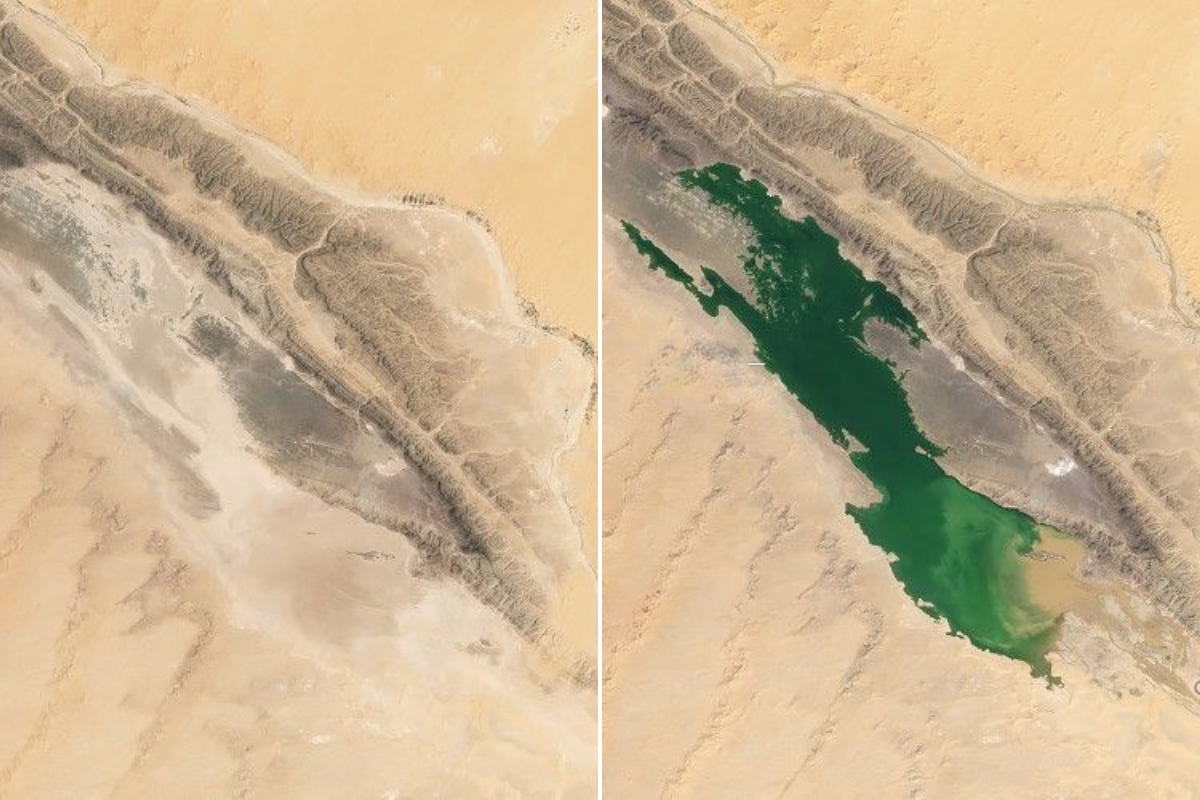
What was a white and dry bed turned into a large patch of water in western Algeria in just a few weeks. The advance of Sebkha el Melah returned a rare image to the Sahara and placed 191 km² under water.
The episode draws attention because it goes beyond the unusual landscape. It brings back to the center of discussion the impact of extreme rains on the formation of temporary lakes and the debate about a possible greening of the desert.
From dry August to flooded September in western Algeria
On August 12, 2024, the area appeared as a salt flat. By September 29, the lake was visible from space next to the Ougarta mountain range, fed by the Oued Saoura, a temporary river that only flows with heavy rains.
-
Engineers Develop Fridge-Sized Machine to Produce 95-Octane Synthetic Fuel from Air and Water, Aiming to Sustain Combustion Engines Without Oil

-
Two-Armed Robot Uses AI to Reassemble Destroyed Pompeii Frescoes, Solving an “Impossible” Puzzle
-
New Law in Brazil Requires Breaks for Type 1 Diabetes Management at Work, School, and Public Exams

-
Scientists Confirm “Greening” of Antarctica: Ice on the World’s Coldest Continent Turns Green as Mosses Multiply Over Tenfold in Four Decades


This rapid turnaround highlighted the magnitude of the event. What usually remains dry for long periods received enough water to recover a large body of water in one of the most arid areas on the planet.


Storm on September 7 and 8 brought extreme rain to the Sahara
On September 7 and 8, 2024, an extratropical storm swept through parts of Morocco, Algeria, Tunisia, and Libya. In some areas, the totals exceeded 200 millimeters, close to what the region usually receives in an entire year.
The combination of heavy rain and runoff over nearly barren soil helped push water into low areas of the desert. It was this movement that paved the way for the filling of Sebkha el Melah.
Sebkha el Melah reached 2.2 meters and was near one-third of capacity
According to NASA, the U.S. space agency that monitors Earth, on October 16, 2024, the water covered 191 km², reached 2.2 meters in depth, and left the lake near one-third of its capacity.
The estimate was made using satellite images and a three-dimensional map of the lake’s bottom. The result shows that it was not a temporary puddle, but a rare filling on a regional scale.
Between 2000 and 2021 only six episodes managed to fill the lake
Researchers identified hundreds of strong storms in the lake basin between 2000 and 2021, but only six generated enough water to initiate filling. Before 2024, the largest volumes of this century had appeared in 2008 and 2014.
This helps explain why the current case has gained so much attention. The Sahara may receive intense rain from time to time, but turning that water into a lasting lake requires a rare combination of intensity, duration, and a clear path for runoff.
Debate about the green Sahara returns, but without sign of permanent turnaround
The reappearance of the lake reignited the discussion about the ancient green Sahara, when parts of the desert had more water, vegetation, and lakes. Recent studies suggest that this history may depend not only on more average rain but also on the strength and frequency of extreme events capable of keeping water on the surface.
At the same time, the filling of Sebkha el Melah does not prove a stable change in the current climate. The more cautious reading is another: the desert responds explosively when the right rain falls in the right place, which broadens the debate without confirming a new permanent pattern.
The case of Algeria shows how a rare event can redraw the map of the Sahara in just a few days. A dry area turned into deep water and put North Africa back on the radar of those monitoring climate extremes and water availability.
In the short term, the episode reinforces the importance of monitoring severe storms and their effects on temporary rivers and hidden lakes. In the long term, it pressures the region and changes the climatic reading of the desert.