






 Portuguese
  Spanish


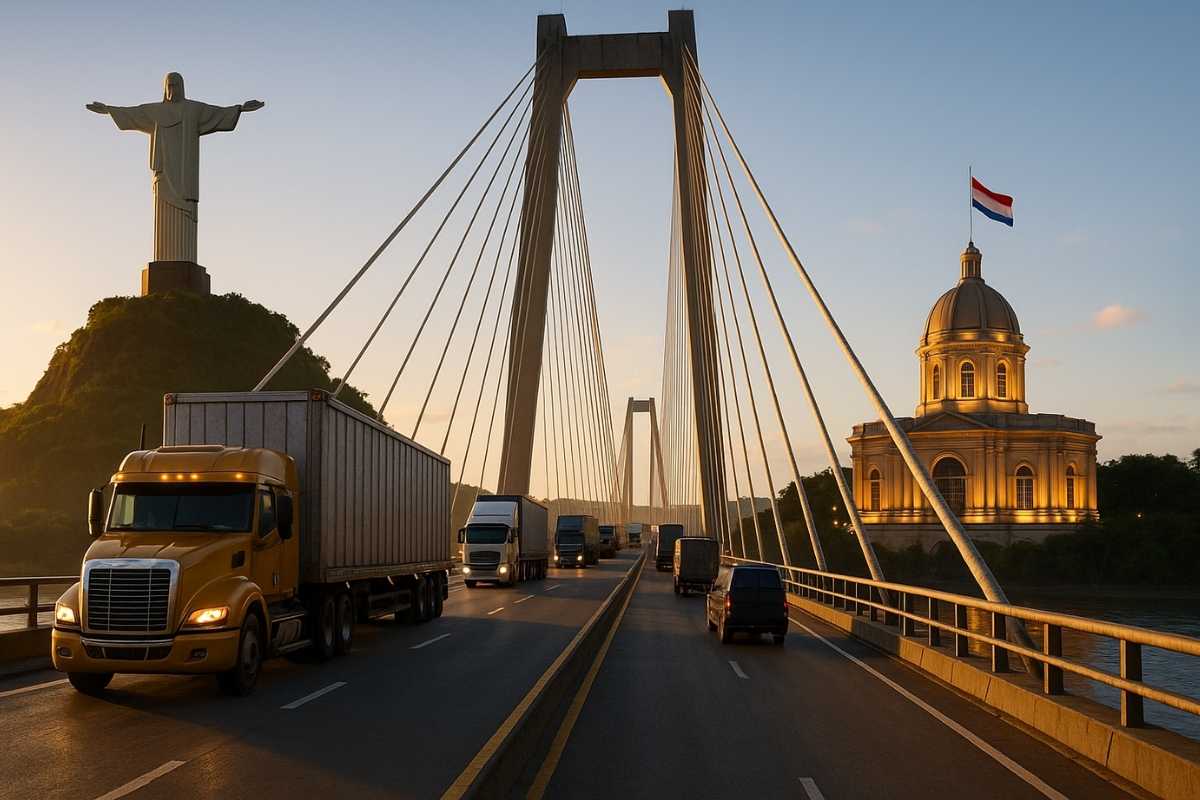

New Bridge Brazil-Paraguay, Expected to Be Delivered in 2026, Should Boost the Bioceanic Route and Reduce Logistics Costs Between Mercosur and Asia.
The Federal Revenue Service estimates that the Brazil-Paraguay bridge will initially handle 250 trucks per day when it is inaugurated in the second half of 2026. The structure will connect Porto Murtinho in Mato Grosso do Sul to Carmelo Peralta in Paraguay, consolidating a new axis of international trade.
According to UOL, the bridge is part of the Bioceanic Route, an international roadway corridor over 2,400 km long that connects the Atlantic to the Pacific. The expectation is a reduction of up to 30% in logistics costs and a 15-day transportation time for goods compared to the Panama Canal.
A Strategic Project for Brazil and Mercosur
The Brazil-Paraguay bridge will have 1,294 meters in length and 21 meters in width, including viaducts and a cable-stayed section with 125-meter towers.
-
Brazilian Job Market Surprises: Unemployment Falls to 5.6%, Hits Record Low for May, Brazilian Incomes Rise, and Underemployment Reaches Lowest Level Ever Recorded by IBGE

-
Chinese E-commerce Giant Predicts Robots Will Replace 700,000 Delivery Workers as Autonomous Vehicles Expand to 200 Cities, Offering Training for Workers to Maintain Their Machines

-
Trump warns Europe with 100% tariff threat on digital tax, potentially impacting wine and trade agreements
-
As Homeownership Becomes Unattainable in Brazil, Japanese Municipalities Offer Abandoned Houses for as Low as $3,000 to Revitalize Aging, Emptying Cities


Currently, the works are 75% completed, according to the State Secretariat for the Environment, Development, Science, Technology, and Innovation (Semadesc).
In addition to the physical link, integrated customs complexes in both countries are planned, which are essential for facilitating foreign trade.
For local authorities, Porto Murtinho will be a new entry and exit point for Brazilian products heading to the Pacific.
Economic Impact of the Brazil-Paraguay Bridge
The estimated flow of 250 trucks per day represents only the initial phase.
The Federal Revenue Service projects a gradual increase in this movement as the Bioceanic Route solidifies as a logistics alternative for exports and imports.
According to UOL, the new corridor is expected to mainly benefit sectors linked to agribusiness and industry, which will have faster access to Asian markets.
For mayors and businesspeople in the region, the expectation is for job creation, attracting investments, and strengthening local production chains.
What Changes for Exporters and Importers
With the completion of the Brazil-Paraguay bridge and the approximately 13 km of access roads on the Brazilian side, transportation will become more competitive.
Companies will be able to ship goods via the Pacific, avoiding long and expensive routes to the Atlantic.
UOL emphasizes that the reduction in transportation time can reach two weeks, a significant gain for perishable products or high-value items.
This logistical advantage should increase Brazil’s competitiveness within Mercosur and against other exporting countries.
Expectations for 2026
Brazilian authorities have confirmed that all works, including access roads and customs, will be ready by the end of 2026.
With this, the Bioceanic Route will cease to be just a promise and will become a concrete alternative for international trade.
The success of the Brazil-Paraguay bridge will depend on efficiency in customs integration and the capacity to attract large volumes of cargo.
Still, the Federal Revenue Service’s forecast indicates confidence in the transformative potential of the structure.
The Brazil-Paraguay bridge promises to become a logistical landmark for South America, expanding trade routes and reducing export costs.
The expectation of handling 250 trucks per day is just the beginning of a flow that can grow exponentially in the coming years.
Do you believe that the Brazil-Paraguay bridge will truly transform Brazilian trade with the Pacific? Or could bureaucratic challenges delay this impact? Share your opinion in the comments—we want to hear from those experiencing this firsthand.


