






 Portuguese
  Spanish


The almost automatic gesture of lowering the sound when parking has an explanation in how the mind distributes attention. Cognitive resources are limited, and science shows that sound and image compete for the same space when precision becomes a priority.
Lowering the music volume before parking is a habit as common as it is little understood, and it reveals how the brain manages its own limits. The gesture, which many people repeat without thinking, is not a sign of distraction or failure, but a strategy the mind uses to free up attention resources and direct them to vision when the task at the wheel requires more precision. Instead of a senseless habit, it is an intelligent adjustment in the face of overload.
The explanation lies in the fact that human attention capacity is finite, not infinite as we sometimes imagine. When driving ceases to be an automatic action, such as maneuvering into a tight space, looking for an address, or navigating an unknown city, the brain needs to choose where to invest its resources. Reducing the sound is the way found to decrease competing stimuli and prioritize what the eyes need to process.
Why sound and image compete for the same attention
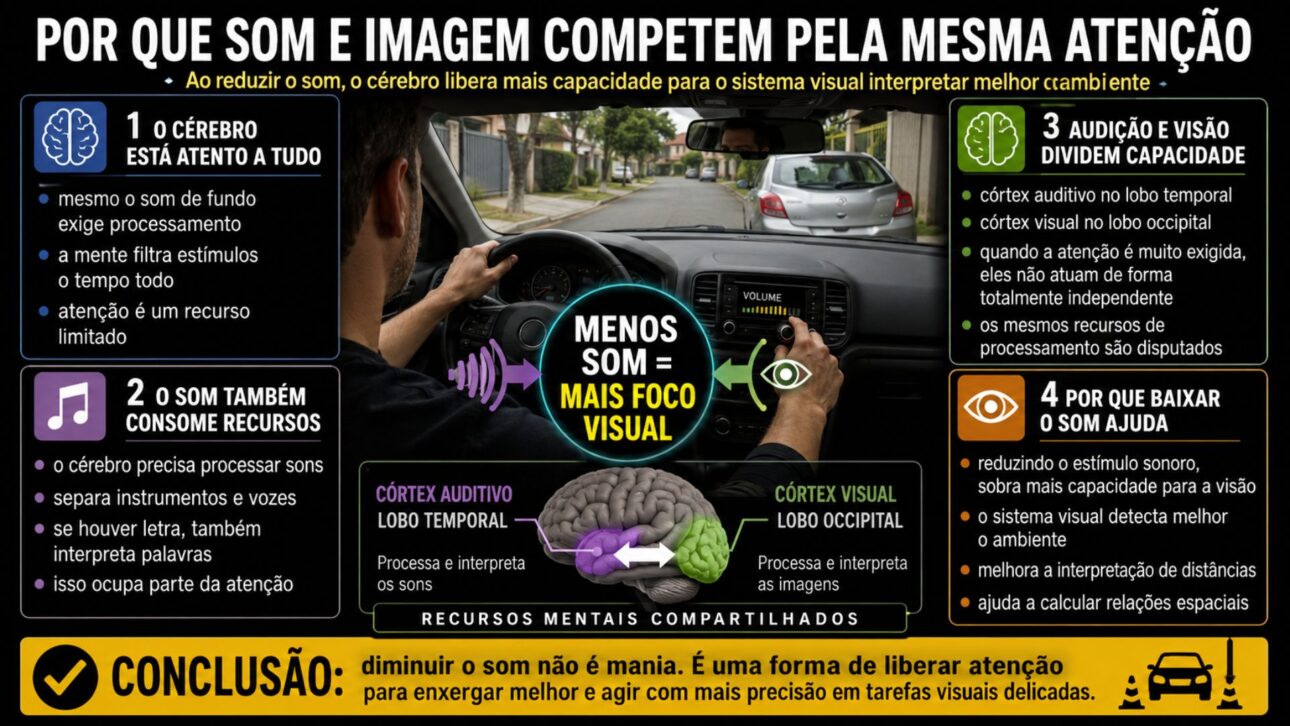
Music, even if discreet, occupies part of the attention capacity because the mind needs to process the sounds, separate instruments and voices, and, in the case of a song with lyrics, interpret the meaning of the words.
-
Polyformer Machine Converts PET Bottles into 3D Printer Filament, Reducing Costs and Expanding to Over 50 Countries

-
Realme C100x Launches in Brazil: Features 8,000 mAh Battery, Military Durability, 120 Hz Display, and Android 16

-
Clay Tubes Form Honeycomb Structure for Natural Air Conditioning, Cooling Air with Water and Evaporation Without Refrigerants, Turning Terracotta into Heat-Resistant Technology in India

-
Cassini Discovers Fresh Organic Molecules Emanating from Enceladus’ Hidden Ocean, Making Saturn’s Icy Moon a Prime Target in the Search for Extraterrestrial Life




This processing consumes resources that, in a delicate maneuver, would be missed for the visual task.
According to cognitive scientists, the areas of the brain responsible for hearing and seeing share the same processing resources.
The auditory cortex, in the temporal lobe, and the visual cortex, in the occipital lobe, do not operate entirely independently when attention is demanded to the maximum.
By reducing sound stimulation, a person frees up capacity for the visual system to better perform its job, which is to detect, interpret, and calculate distances and spatial relationships.
The myth of multitasking and the role of the prefrontal cortex
Although many people believe that the human brain performs multiple tasks at the same time, what it actually does is quickly switch between focuses of attention.
This constant switching, known to researchers as task switching, gives the sensation of simultaneity, but in reality, it means that one focus is prioritized while the others remain in the background.
The more demanding the activity, the more this switching affects the quality of concentration.
This is where the prefrontal cortex comes in, a region associated with the brain’s executive decisions.
When a situation arises that requires more than driving on autopilot, such as a difficult parking spot or heavy rain, this area tends to discard the stimulus considered less important to preserve the more relevant one.
Music is precisely the first item to be sacrificed because, at that moment, seeing well is more valuable than hearing.
When music helps and when it hinders
It’s important to note that this explanation should not be turned into an alarm; that is, listening to music while driving is not, by itself, a problem.
Under normal conditions, with traffic flowing and the road familiar, the brain alternates without difficulty between listening and driving, and there are even studies suggesting that music can help maintain attention on long and monotonous trips.
The issue only changes when the task becomes complex and starts to directly compete for attentional resources.
The addition of a human voice, whether in a conversation inside the car or in a sung song, further increases the chance of the brain jumping from one focus to another.
This happens because speech carries meaning and tends to capture attention more strongly than purely instrumental sound, forcing the mind to constantly decide what to prioritize.
Therefore, in maneuvers that require care, reducing not only music but also conversations usually facilitates concentration.
A sign that the mind knows its own limits
More than a weakness, the act of lowering the volume can be seen as a sign that the person realizes, even without rationalizing, that their attention has a ceiling.
This filter, which researchers call selective attention, is what allows prioritizing one stimulus and ignoring others, and some minds adapt better than others to ambient noise, which explains why certain people feel the need for silence in tasks that others perform without adjusting the sound.
There is no right or wrong here, but differences in how each brain manages overload.
It is important to note, however, that this isolated habit does not say anything definitive about anyone’s cognitive health.
Although some reports associate the gesture with personality traits or signs of sharper attention, these are simplifications that do not replace a professional evaluation.
What science confidently supports is the general mechanism, that is, the competition for attention resources, and not conclusions about the profile of those who lower the sound.
Next time your hand instinctively reaches for the volume button before a maneuver, it’s worth remembering that this is your brain working in your favor.
Far from being an eccentricity, the gesture translates the way the mind prioritizes vision when precision becomes essential, temporarily sacrificing sound to not compromise what really matters at that moment.
It is a reminder that, even powerful, the human brain operates within limits.
And you, do you tend to lower the music volume to park or concentrate while driving? Tell us in the comments if you have noticed this habit in yourself or someone close, if you prefer total silence during difficult maneuvers, and what other small rituals you use to concentrate better in traffic. The conversation is open for us to exchange experiences about the curiosities of our own mind.


