






 Portuguese
  Spanish


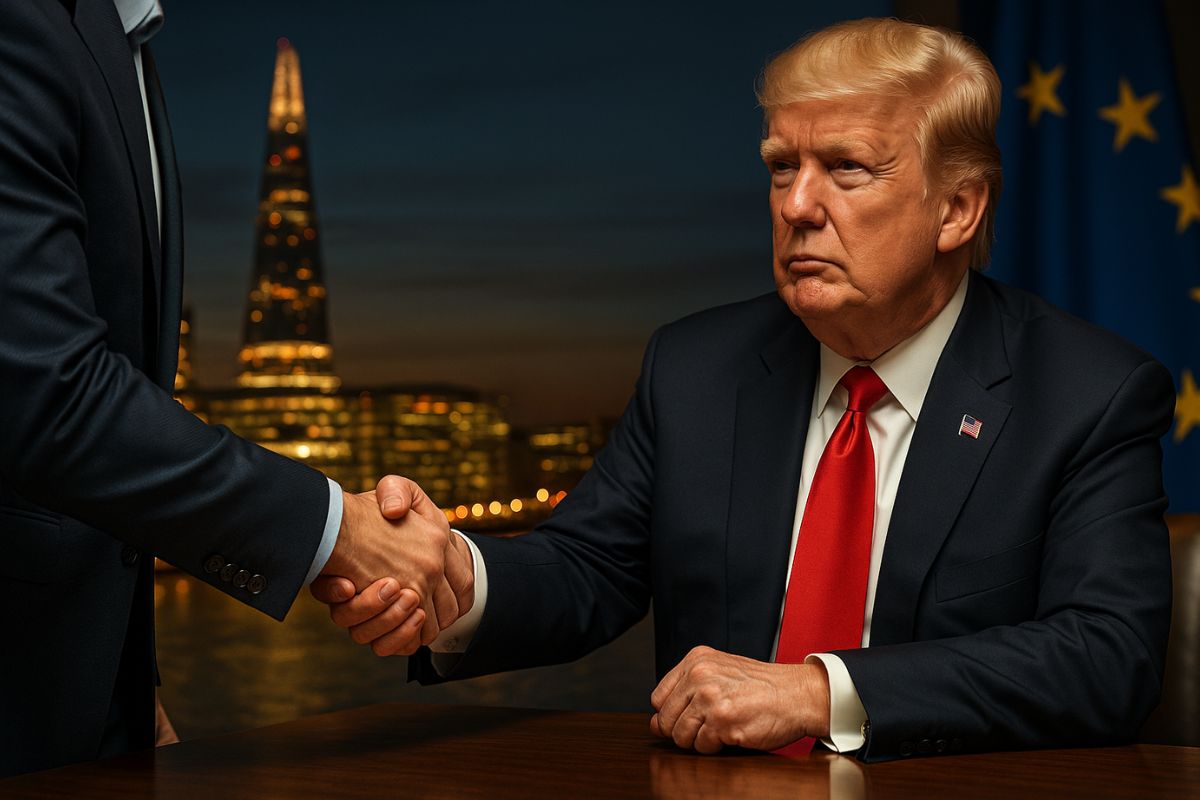


The United Kingdom Is About to Sign a Billion-Dollar Deal with Trump, Nvidia, OpenAI, and BlackRock, Focused on AI, Semiconductors, and Data Centers, While the European Union Fears Being Technologically Isolated.
The billion-dollar agreement that the United Kingdom is about to finalize with the United States and some of the largest technology companies in the world promises to redefine the map of global innovation. According to reports from Economy in Focus, the deal is expected to be signed during Donald Trump’s state visit to London next week and will involve massive investments in artificial intelligence (AI), semiconductors, and data center infrastructure.
The move is seen as a strategy by the British government to establish itself as a European tech hub, taking advantage of the flexibility brought by Brexit and the direct alignment with Washington.
The European Union is monitoring the process with concern, fearing that the investment exodus will deepen its gap with the US and China.
-
At 14 years old, she worked in a factory in Hong Kong, studied economics abroad, and then entered the Chinese real estate market, which helped change the landscape of Beijing.

-
While NATO secured more than $10 billion in missiles and space surveillance at a single forum, Brazil still spends 1.1% of its GDP on defense and is stalling its own anti-aircraft system.

-
Corn ethanol attracts R$ 23 billion in 21 new plants and prepares for a nearly 50% jump in Brazilian production by 2027, even with high interest rates.
-
A newly opened terminal in the middle of the Amazon has begun transporting soy and corn through Amapá, eyeing the queue of ships that is congesting the ports in the South.


What Is at Stake in the Billion-Dollar Deal
According to the United Kingdom’s Department for Science, Innovation and Technology, the deal will prioritize strategic areas such as AI, telecommunications, semiconductors, and quantum computing.
Secretary Liz Kendall, who took office in September, highlighted that these technologies “will transform our lives, from treating diseases to modernizing public services.”
The announcement is expected to be made in grand style, with the presence of Trump and influential CEOs, including Jensen Huang (Nvidia) and Sam Altman (OpenAI).
Both are expected to announce billion-dollar investments in British data centers, reinforcing the country’s positioning as a global cloud computing platform.
The American CoreWeave Inc., specializing in AI infrastructure, is also expected to formalize new investments.
BlackRock and the Weight of Financial Capital
The financial sector will play a central role in this movement. BlackRock, the largest asset manager in the world, is expected to announce investments of up to £ 500 million (US$ 678 million) in data center infrastructure.
Analysts believe that Larry Fink and his team’s involvement in the deal is a sign that the agreement goes beyond political rhetoric, gaining traction in the international financial market.
The presence of BlackRock adds greater solidity to the project, as it creates connections with institutional funds, private investors, and even governments interested in participating in the future expansion of British digital infrastructure.
The European Union’s Response
For Brussels, the deal reinforces a well-known risk: technological dependence on external partners.
The absence of a robust European program for semiconductors and AI contrasts with the British dynamism. Bloc leaders fear that companies and talent will migrate to London, exacerbating the competitive disadvantage compared to the US and China.
Experts point out that the EU’s competitiveness compass has already indicated the need for massive investments in technology, but the slowness of the 27 countries in reaching consensus hinders practical execution.
In this scenario, the United Kingdom gains an advantage by being able to negotiate directly with Washington without the constraints of European bureaucracy.
Geopolitical and Technological Impact
The billion-dollar agreement represents more than just an economic gesture. It symbolizes Trump’s attempt to consolidate a network of technological allies in contrast to China, while the United Kingdom seeks to position itself as a privileged link in this strategy.
If realized, the pact could reposition London as a global strategic hub in AI and semiconductors, attracting new production chains and research centers.
On the other hand, it tends to deepen the technological divide within the European continent, widening the gap between a United Kingdom aligned with the US and a European Union that is still seeking to define its role in the digital race.
And you, do you believe that the billion-dollar agreement between the United Kingdom, Trump, and the tech giants strengthens innovation or increases London’s political and economic dependency?
Leave your opinion in the comments; we want to hear your views on this new global landscape.








