Portuguese
  Spanish


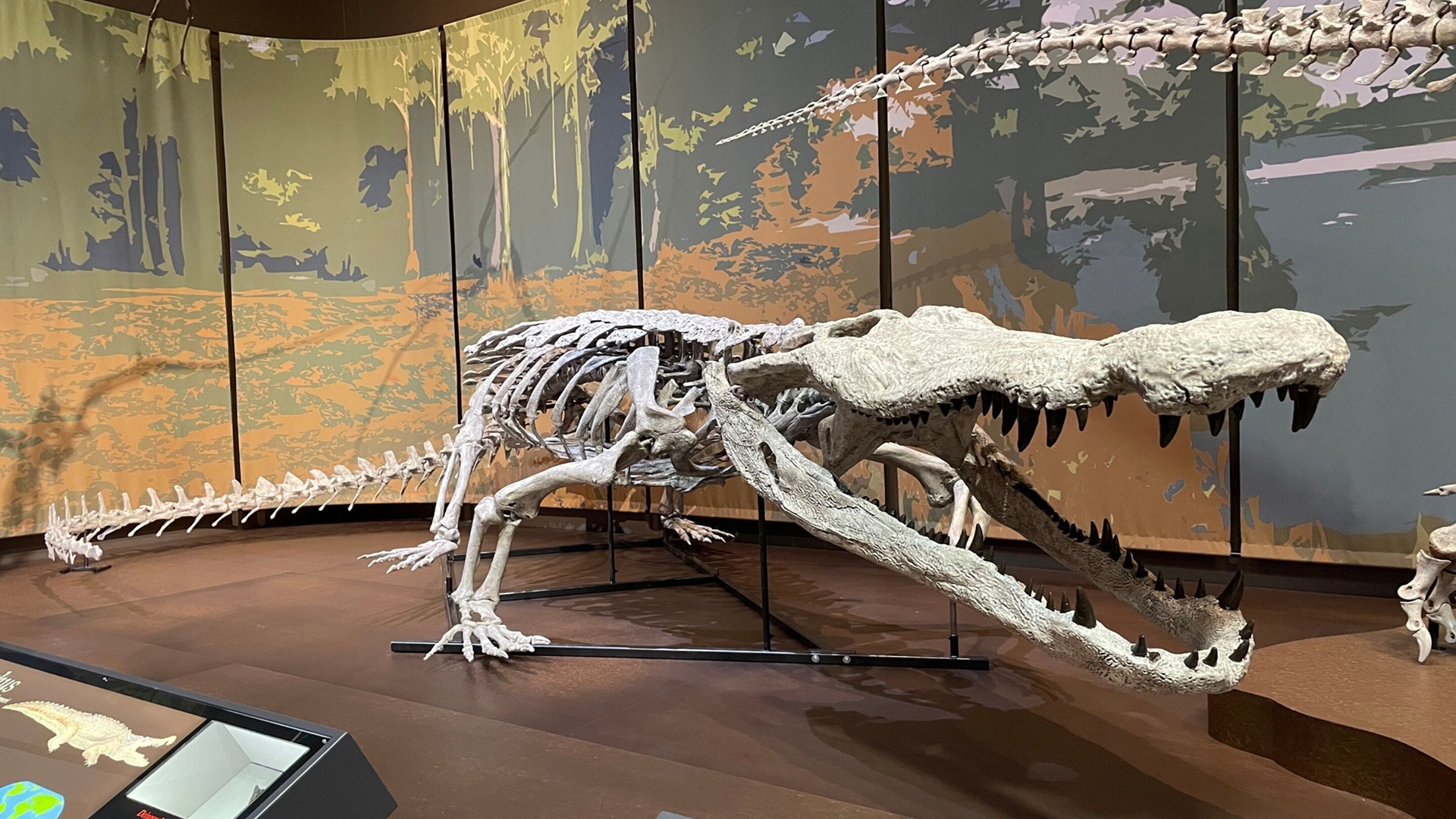


Life-Size Academic Replica Reveals for the First Time the Complete Anatomy of a Giant Cretaceous Crocodylian, Allowing Observation of Scale, Body Structure, Predatory Strategy, and Ecological Importance of One of the Largest Predators Ever Known
During the Late Cretaceous, between 83 and 76 million years ago, a colossal predator dominated the coastal swamps of the eastern United States; now, a life-size scientific replica reveals its anatomy, scale, and ecological role.
A Prehistoric Predator Finally Takes Complete Form
On December 22, the Tellus Science Museum announced the first academic, accurate, life-size replica of Deinosuchus schwimmeri, with a skeleton measuring 9.45 meters in length.
For the first time, visitors can face-to-face observe an animal that reached nearly 10 meters, showcasing a bite force estimated to be greater than that of a T. rex, according to associated morphological analyses.
-
China Develops Custom 140-Ton Electric Mining Truck with 770 kWh Swappable Battery, Deploys 290 Units in Xinjiang’s Largest Zinc Mine

-
Meta to Launch Arena, a New Prediction App Targeting 3.56 Billion Users, Competing with Polymarket and Kalshi

-
Scientist Challenges Famous Human Evolution Theory, Argues Homo Sapiens Evolved Gradually Over Thousands of Years
-
15-Year-Old American Builds Ocean Generator with PVC Pipe and 3D-Printed Propeller for $12, Wins National Prize, Presents at White House, and Makes Forbes 30 Under 30 List




The replica represents a top predator capable of splitting dinosaurs in half, occupying a unique niche in coastal ecosystems, where it did not rely exclusively on aquatic prey for survival.

Scientific Origin and Tribute to a Lifelong Research
Officially named in 2020, the species honors geologist David Schwimmer from Columbus State University, after four decades dedicated to seeking fossils in Georgia.
For 40 years, Schwimmer collected fossilized teeth and dermal plates from local sediments, helping to reconstruct the presence and distribution of the largest known Cretaceous crocodylian in North America.
The replica was not designed just as an exhibition attraction, but as a three-dimensional scientific model, allowing for complete anatomical analyses impossible to conduct with only fragmented fossils.
Anatomy Designed to Hunt Dinosaurs
The Deinosuchus occupied an unusual ecological role, hunting terrestrial dinosaurs in coastal environments, instead of limiting itself to fish or marine reptiles, as is the case with modern crocodylians.
Its massive jaws housed blunt teeth, comparable in size to bananas, adapted to crush the shells of giant sea turtles and the dense bones of hadrosaurs.
The bulbous snout featured two mysterious openings at the tip, a striking anatomical difference compared to modern alligators, whose exact function remains a source of scientific curiosity.
Digital Engineering and Construction of the Replica
Developing a life-size fossil replica required approximately two years of continuous work, involving detailed digital reconstruction and rigorous anatomical validation based on original fossil records.
The team utilized high-resolution 3D scans to virtually recreate the complete skeletal structure and dermal armor, respecting proportions, fittings, and patterns observed in the fossils.
Many of the scanned fossils were found less than 64 kilometers from Columbus, Georgia, strengthening the regional connection between the animal, scientific research, and museum exhibition.
Scientific Value Beyond Visual Impact
According to Schwimmer, isolated fossils only tell part of the story, while complete replicas allow for understanding how these animals moved, hunted, and dynamically interacted with their environment.
The model aids researchers in deciphering predatory strategies and evolutionary adaptations, providing a solid foundation for interpreting how large predators dominated transforming ecosystems in the Late Cretaceous.
The replica also illustrates how body geometry, mass distribution, and dentition combined to make Deinosuchus one of the most feared predators of its time.
Unique Exhibition in the World
The Tellus Science Museum is currently the only place in the world to house a complete replica of Deinosuchus schwimmeri, providing a unique experience for the public and the academic community.
According to the curatorial coordination, verbally describing creatures of this scale is limited, while observing them physically allows for immediate understanding of proportions, grandeur, and ecological impact.
By bringing together science, digital engineering, and public exhibition, the replica transforms the so-called terror crocodile into a concrete model of study, going beyond metaphor and revealing a real predator.