Portuguese
  Spanish


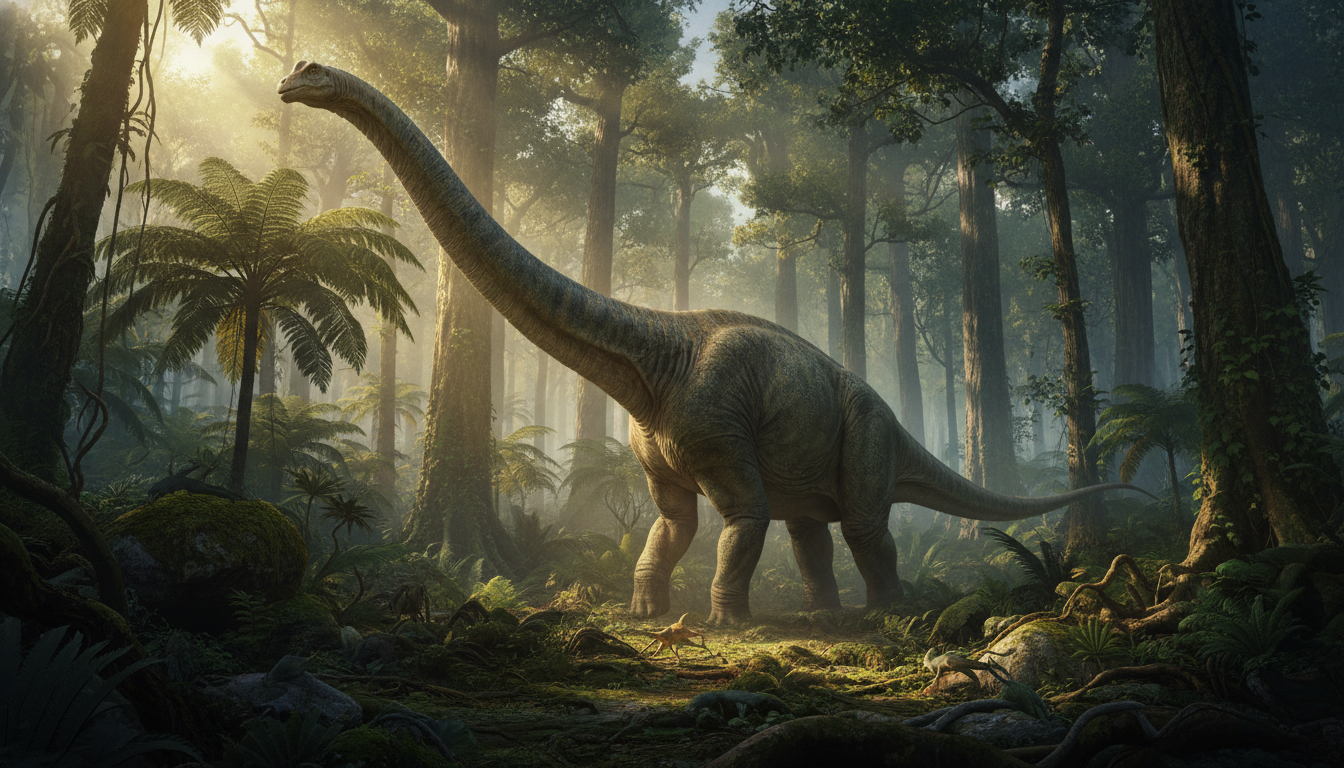


Nagatitan chaiyaphumensis is 27 meters long and up to 28 tons, becoming the largest dinosaur in Southeast Asia
In May 2026, paleontologists published the first results about the Nagatitan chaiyaphumensis in Sci.News. It is the largest dinosaur ever identified in Southeast Asia.
The sauropod measured 27 meters in length. The estimated weight is between 25 and 28 tons, equivalent to nine adult African elephants.
As detailed in the study published in Scientific Reports (Nature), the animal lived about 113 million years ago. It belongs to the Early Cretaceous.
-
Driver Crosses 100-Year-Old Railway Bridge Over Uruguay River, Encounters Rural Couple Preserving Traditional Farming Methods

-
Rural Producer Returns to Brazilian Farmland, Builds Family Agricultural Business with Children’s Support and Industry Backing
-
Goiás Couple Boosts Artisan Cheese Production from 25 to 70 Kilos Daily with Technical Support, Transforming Family Life in Rural Brazil
-
13-Year-Old Discovers Ancient Roman Ring Near Mount Carmel, Now Set for Display in Jerusalem


Fossils emerged in Chaiyaphum, northeastern Thailand, in the Khok Kruat Formation
The bones of the Thai sauropod were excavated in the Khok Kruat Formation. The region is located in Chaiyaphum, a province in northeastern Thailand known for its Cretaceous fossil deposits.
In fact, the site has been yielding dinosaur, crocodylomorph, and prehistoric turtle remains for over two decades. Therefore, the site has established itself as a reference for Asian paleontology.
On the other hand, the discovery was first reported by a local resident. According to reports, the material was sent for analysis by the international team.
Team combines University College London, Mahasarakham, and Suranaree University in the study

The research unites institutions from Thailand and the United Kingdom. Compared to other regional paleontological studies, the team integrates universities from three different countries.
According to the paper, Thitiwoot Sethapanichsakul leads the work. The researcher is a Ph.D. candidate at University College London.
Similarly, the team includes scientists from Mahasarakham University, Suranaree University of Technology, and the Sirindhorn Museum.
Therefore, the publication combines local tradition with European research infrastructure.
Nagatitan belongs to the Euhelopodidae family of Asian titanosauriformes
According to taxonomic classification, the discovered fossil belongs to the Euhelopodidae family. It is a group of titanosauriform sauropods widely distributed in Cretaceous Asia.
In other words, the animal shares ancestors with other Asian giants like Euhelopus and Phuwiangosaurus. Consequently, it helps to assemble the evolutionary panorama of Asian fauna.
According to the publication, the discovery confirms that titanosauriformes thrived beyond China. The branch spread throughout Southeast Asia before the final continental fragmentation.
- Scientific name: Nagatitan chaiyaphumensis
- Length: 27 meters (89 feet)
- Weight: 25-28 tons (up to 9 elephants)
- Age: ~113 million years (Early Cretaceous)
- Family: Euhelopodidae (titanosauriformes)
- Location: Khok Kruat Formation, Chaiyaphum, Thailand
Nagatitan chaiyaphumensis equals 9 elephants but loses to Patagotitan

To get an idea of the scale, the prehistoric animal weighed the equivalent of nine African elephants. In comparison, it reaches about 90% of the length of a modern blue whale.
As noted in the paper, even with such dimensions, the Thai titanosauriform still falls short of the South American giants. The Patagotitan from Argentina weighed 60 tons.
On the other hand, the Chinese Ruyangosaurus reaches 50 tons. At that time, dinosaurs from the southern hemisphere grew larger than their Asian relatives.
Name honors Naga, mythical serpent of Asian folklore
The etymology of Nagatitan chaiyaphumensis has two parts. The first name comes from Naga, a serpentiform deity from Hindu and Buddhist Thai folklore.
In comparison, “titan” emphasizes the magnitude of the animal — a reference to the ancient titan gods of Greek mythology. Similarly, “chaiyaphumensis” indicates the province where the fossils were found.
Therefore, the scientific name of the animal combines three cultural traditions. Other recent Brazilian paleontological discoveries include the mapping of pre-colonial cities in the Bolivian Amazon via LiDAR.
Brazil maintains its own school of paleontology from São Paulo to Patagonia

Brazil maintains a strong paleontological tradition. Universities like USP, UFRJ, and UNESP regularly publish findings in international journals.
According to data from Brazilian institutions, the country has at least five sedimentary basins with relevant Cretaceous fossils. The Araripe Basin in Ceará is one of the most globally known.
In other words, the Brazil-Thailand exchange in paleontology is technically viable. On the other hand, it requires specific university agreements that are uncommon today.
Similarly, discoveries like the launch of SpaceX’s Dragon CRS-34 on May 13 reinforce how multiple scientific fronts coexist in May 2026 — space, paleontology, and archaeology.
In comparison, Brazil has also reported remarkable discoveries in recent years. The Tapuiasaurus macedoi, found in Minas Gerais, reached about 13 meters.
Similarly, the Maxakalisaurus topai from the Triângulo Mineiro reached 13 meters. According to data from Anchieta and the National Museum, both belong to the Late Cretaceous.
On the other hand, the Brazilian giant Austroposeidon magnificus, described in 2016, reaches 25 meters in length. At that time, it was announced as the largest dinosaur in the country.
According to the National Museum of UFRJ, the Bauru Basin houses one of the richest Cretaceous deposits in South America. Consequently, comparisons with Asian sites like Khok Kruat gain scientific relevance.
Next steps: additional analyses and search for new bones in northeastern Thailand
The team intends to continue excavation in the Khok Kruat Formation. Next, they plan geochemical analyses of the sediments around the bones.
According to the publication, new tests may reveal clues about the diet and habitat of Nagatitan. At that time, the expectation is to reconstruct the Cretaceous environment of Southeast Asia.
Consequently, more species of Asian sauropods may be described in the coming years. According to the scientific community, Thailand is consolidating itself as one of the centers of regional paleontology.
There are recognized limitations. Only part of the skeleton has been recovered so far.
According to the research team, vertebrae and part of the pelvic girdle are missing. Similarly, the skull has not yet been located.
In other words, dimensions and weight may still increase with new findings. Consequently, successive excavations at the Khok Kruat site remain a priority.
According to local scientists, dozens of other fragments have already been identified in the field. Preliminary analysis suggests the possible presence of juveniles and adults in the same deposit.
Will future excavations reveal a Nagatitan even larger than the already confirmed 27 meters? The answer depends on the next years of field research in Thailand.