Portuguese
  Spanish


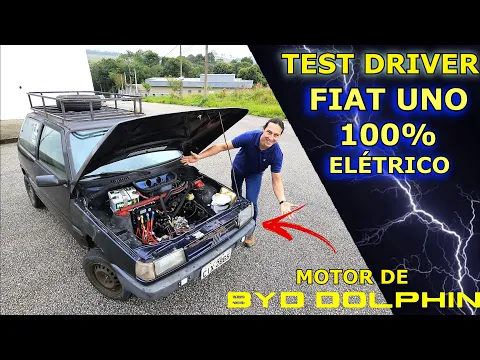
An old Fiat Uno received a repurposed BYD electric motor, manual transmission, Volvo battery, and generic controller in a homemade project that required rewinding the motor, handling high current, and proving on the street if the adaptation could actually drive.
It really worked.
The Fiat Uno still looked like an old car, with metal noises, heavy brakes, and pending adjustments. But when the electric motor started to spin and the car moved almost silently, the workshop became the scene of an unlikely transformation.
The idea seemed simple on paper but was full of obstacles. In the video published by the LetraJota channel on YouTube, the team responsible for the project shows, in a mechanical workshop, the practical stage of converting a Fiat Uno into an electric car: installing a repurposed BYD motor, already rewound to work at low voltage, and coupling it to the car’s manual transmission.
-
Free Internet Begins Testing in São Paulo Metro Stations, Network-Wide Rollout Expected by 2026

-
Man Transforms Desert Ranch into Forest by Harvesting Rainwater, Captures 15,000 Gallons in One Downpour, Builds 100 Dams with 6 Volunteers

-
16 kWh Solar Battery Powers Entire Home Off-Grid, Lasts Over 22 Years with 8,000 Cycles, Delivers 10,000 Watts for Appliances
-
Drones Can Now Detect Underwater Mines Hidden by Sand and Algae Using Aerial Images, Special Light, and AI




The recording documents the assembly on June 3, when the set with a low-cost generic controller and repurposed batteries was installed to check if the Uno could move at that stage of the project.
The challenge was at the heart of the adaptation. The original motor worked at 300 V, while the chosen controller operated between 70 V and 100 V. For the project to take off, it wasn’t enough just to fit parts together. It was necessary to alter the motor’s operation so that it could respond to a new electrical reality.
300 V Motor Needed to Be Rewound Before Entering the Uno
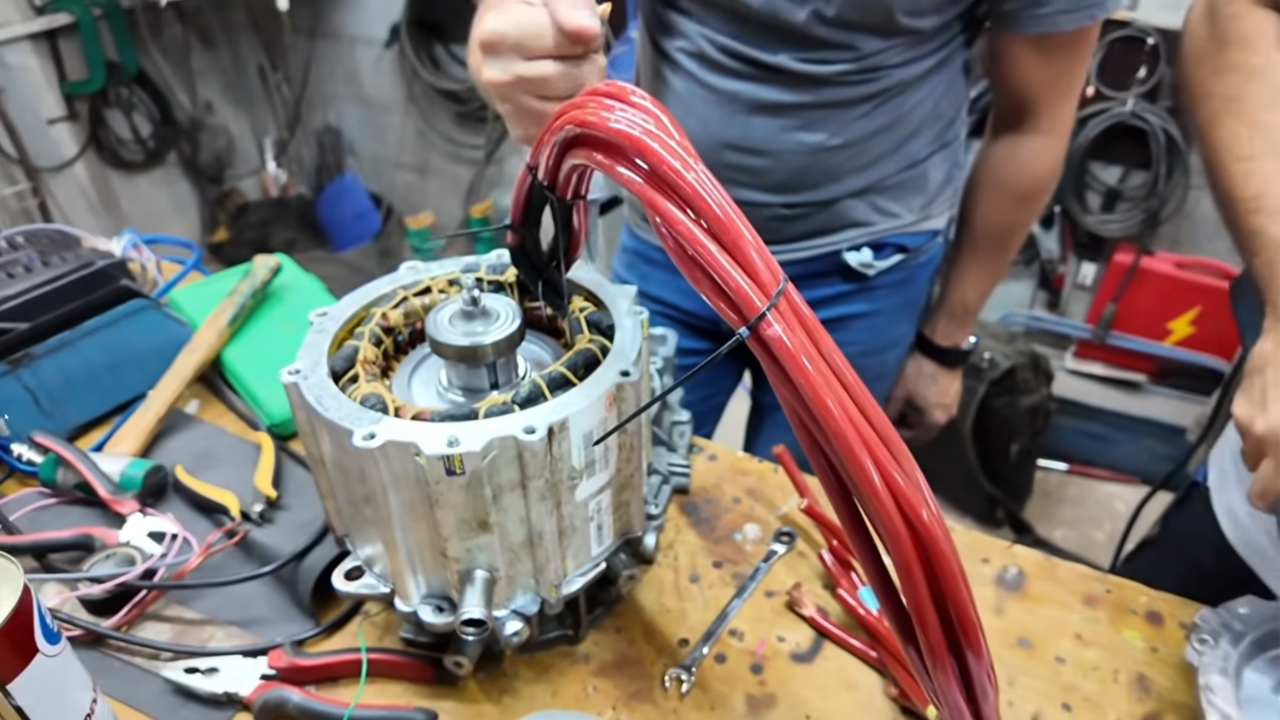
Before reaching the street test, the motor went through a decisive stage. According to the video’s own transcript, the set needed to be studied internally so that the connections could be understood and the motor could be rewound.
The goal was to adapt the equipment to a lower voltage range without losing as much power as possible. As a result, the wires became thicker since the current would be about three times greater than originally applied.
After that came the mechanical part. The group manufactured a steel flange to join the motor to the transmission and also a shaft to connect the rotor to the Fiat Uno assembly. It was the bridge between two worlds: a modern electric motor and an old popular car, originally made for combustion.
On the bench, the system had already worked. But the real test was different. Putting everything inside the car, connecting the batteries, engaging gear, and finding out if the Uno would move.
Manual transmission became part of the experience
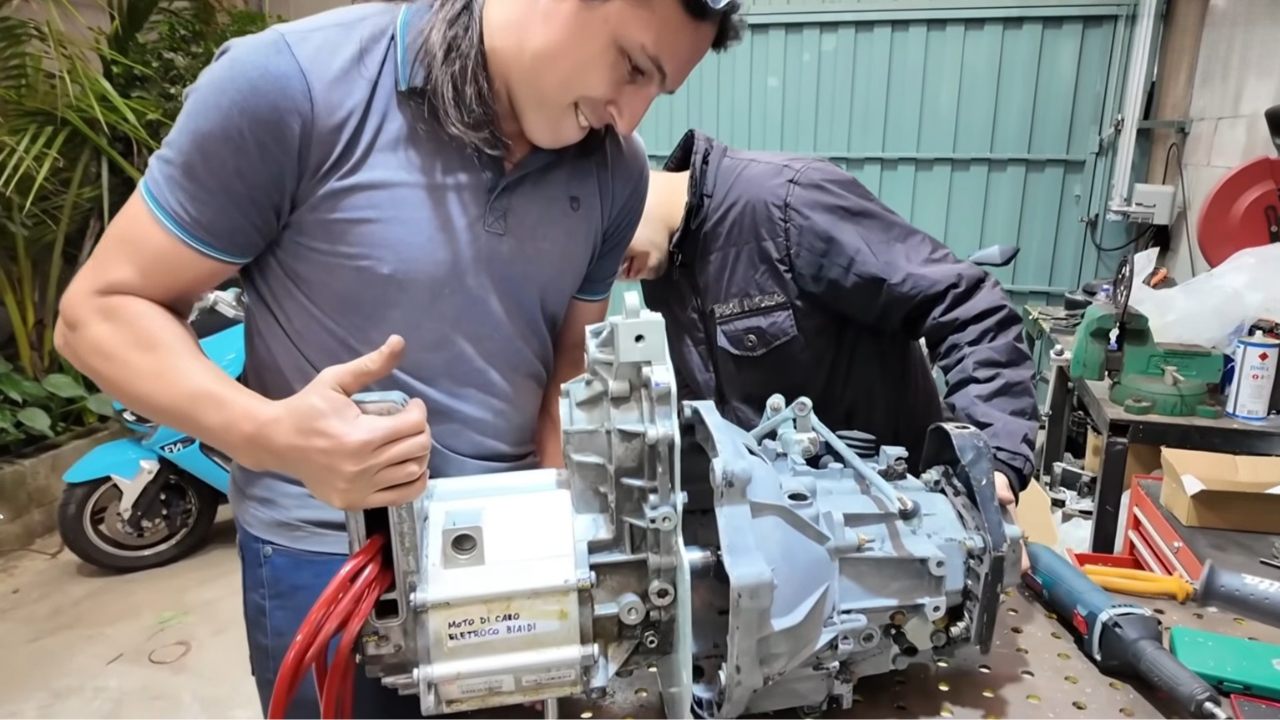
One of the project’s questions was how the manual transmission would react to the electric motor. In a combustion car, gear shifting depends on the engine’s rotation, the gears’ speed, and the synchronization between parts. In the electric Uno, the logic changed.
Since the motor rotor was light, weighing just over 2 kg according to the video conversation, the transmission wouldn’t feel the same weight as a combustion engine with a crankshaft, flywheel, and pistons. The expectation was that the gears would engage more easily.
The group also discussed electronic features that could be programmed into the controller, such as engine braking and regeneration. The controller was treated as the system’s brain, responsible for organizing much of the motor’s behavior.
Even so, the project was far from simple. Besides the rewound motor, there was a reused Volvo battery, a controller that would have cost around R$ 4,000, and a series of adaptations made in the workshop.
Batteries, cables, and improvisations marked the assembly
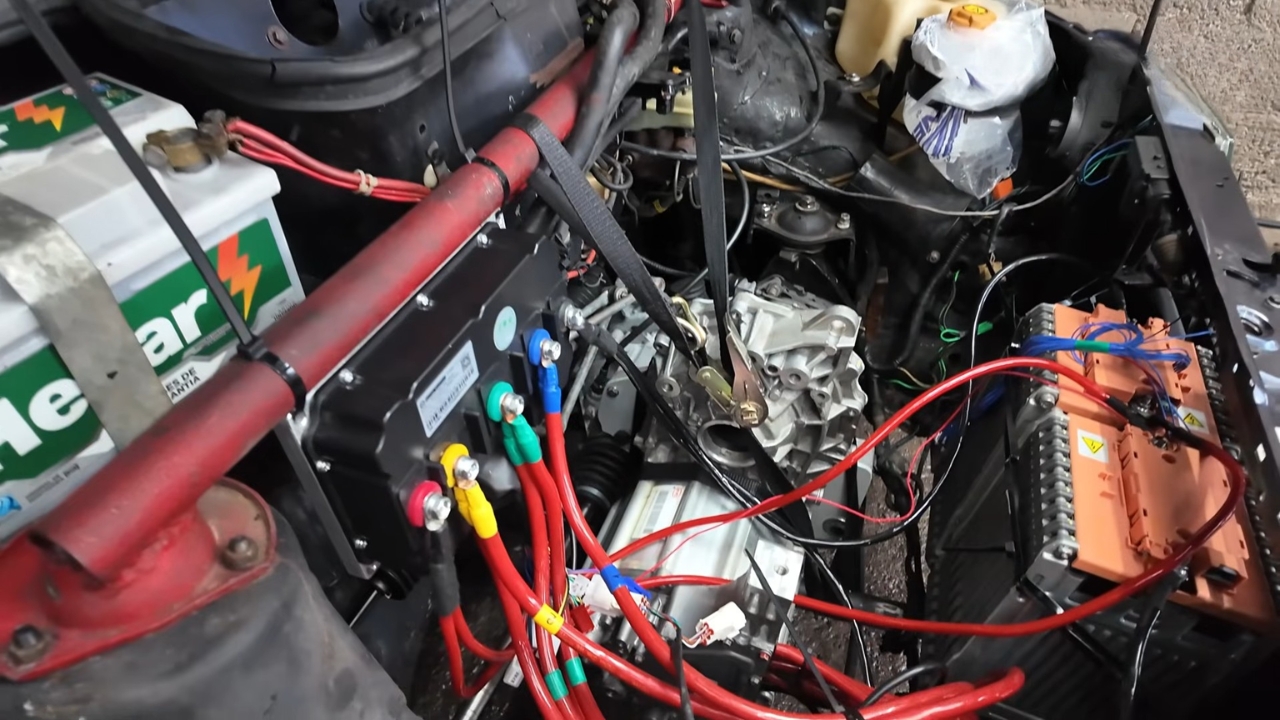
In the installation, the Uno received batteries positioned at the front. Each unit was mentioned to weigh about 13 kg, and the group discussed that four batteries could come close to the weight of the original engine and transmission set, estimated at around 70 kg.
The concern was not just to make it fit. It was to distribute weight, avoid the car’s front becoming unbalanced, and route the cables functionally. In the middle of the assembly, typical prototype details appeared: broken ground wire, doubts about key positive, brakes hastily revised, screws, clamps, and reused parts.
There was also an important alert about batteries. At a certain point, two units had a difference of 0.6 V between them, enough to generate a current of 8 A between them. The group commented that if one battery was fully discharged and another fully charged, the risk would be much greater.
It was a workshop test, not a ready car. But the decisive moment came when they turned on the system in neutral and the engine spun.
The Uno moved and surprised on the climb

The first outing was cautious. One accelerated, another stayed on the brake, and the car started to move slowly. With only 15% activation in the initial mode, the Uno already moved.
Then, the adjustment was made to a stronger configuration. The group mentioned 600 A of battery and 1200 A of phase, with a theoretical estimate of 55 horsepower. In practice, they themselves assessed that the controller used at that moment probably didn’t deliver everything, talking about something close to 30 to 40 horsepower during the fun.
Even so, the car moved. In first gear, it reached about 60 km/h. Then, it climbed an inclined street, started on a hill stopped in the middle of the slope, and ran in second gear, when the gearbox noise decreased.
The contrast was striking. On the outside, it was an old Uno. Inside, the experience resembled an improvised electric car, silent and strange precisely because the engine made almost no noise. What remained were the noises of the car itself, previously hidden by the combustion engine.
The test also showed the project’s limits
The excitement was accompanied by caution. The controller heated up after the pulls, and the engine was still without a definitive cooling system. The group even poured water to reduce temperature and continue the test, always making it clear that the set was not yet the final version.
There was also concern with the brake, with the car’s electrical commands, and with the assembly itself. The Uno moved, climbed, and surprised, but still needed adjustments to stop being a garage experiment and become a reliable project.
The charm of the video lies precisely in this tension. It’s not just an old car converted. It’s an attempt to prove, in practice, that reused parts, homemade engineering, and a lot of improvisation can get an electric vehicle running.
In the end, the electric Uno impresses not only by running silently. It draws attention because it shows the gap between making an engine spin on the bench and turning it into a car that climbs hills, shifts gears, heats up, requires brakes, and reveals all the problems that theory usually hides.