






 Portuguese
  Spanish


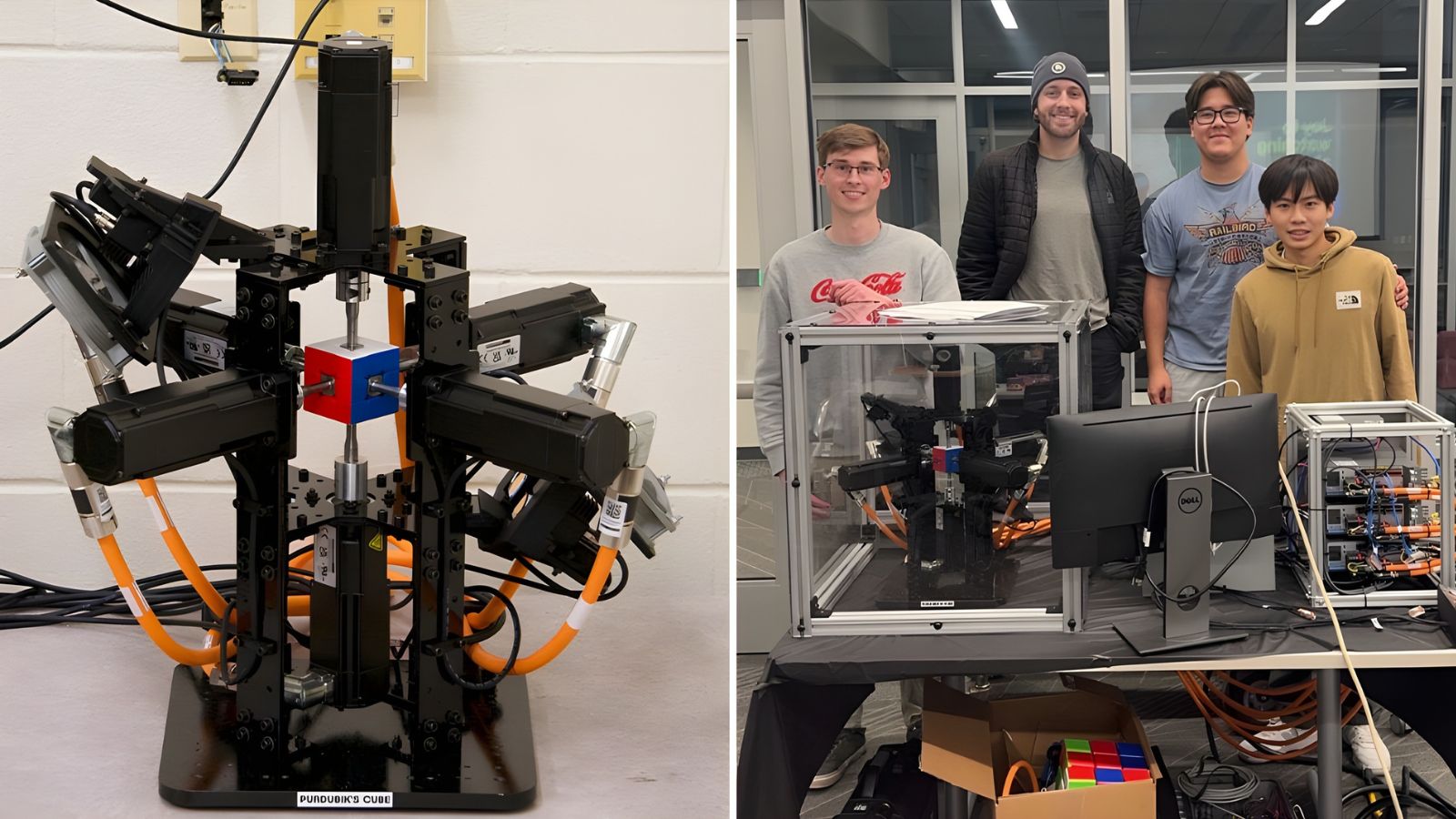

Purdue Robot Solves Rubik’s Cube in 0.103 s, Faster than a Blink, and Redefines High-Speed Robotics Limits.
In 2025, four students from Purdue University in the United States entered the Guinness World Records by developing the Purdubik’s Cube, a robotic system capable of solving a 3x3x3 cube in just 0.103 seconds. The achievement was announced by Guinness on May 14, 2025, and by Purdue University on May 12, 2025, which highlighted that the recorded time is shorter than a human blink, typically estimated between 200 and 300 milliseconds.
The project was created by Matthew Patrohay, Junpei Ota, Aden Hurd, and Alex Berta, students from the Elmore Family School of Electrical and Computer Engineering in West Lafayette, Indiana, and surpassed the previous record of 0.305 seconds, set by Mitsubishi Electric in 2024. The mark places the system on a speed scale almost invisible to the human eye, combining computer vision, ultra-fast motion control, and algorithms capable of coordinating mechanical movements in extreme fractions of a second.
This achievement places robotics at a level where the execution of complex tasks occurs in a time scale practically invisible to the human eye.
-
California Student Develops AI-Powered System to Detect Elderly Falls at Home, Even in the Dark, Earning Title of America’s Top Young Scientist

-
Workers Discover Ancient Sanctuary with Temples and Roman-Era Inscriptions While Clearing Bomb Debris for Highway Construction

-
Scientists Discover Over 600 Meteorite Glass Fragments in Northern Brazil, Evidence of a 6.3-Million-Year-Old Cosmic Impact with Unfound Crater

-
Philosophy Student Invents Self-Moving Wheelchair Controlled by Body Weight Using Pressure Sensors


Comparison with Human Performance Evidences Technological Breakthrough
To understand the magnitude of the achievement, it is necessary to compare it with human performance. The world record for manually solving a 3x3x3 cube is around 3 seconds, achieved by specialists known as speedcubers.
Even the best humans are limited by factors such as visual recognition time, cognitive processing, and motor execution.
The robot eliminates these limitations by integrating reading, calculation, and execution into a single continuous flow, without perceptible interruptions. This creates an order of magnitude difference between humans and machines in this type of task.
Robot System Combines Computer Vision with Real-Time Processing
The robot’s operation begins with capturing an image of the cube. Sensors and cameras identify the colors and the position of each piece almost instantly.
This information is sent to a computational system that calculates the ideal solution using highly optimized algorithms.


All this process occurs in fractions of a second, without the need for separate steps as happens in humans. The integration between hardware and software is one of the key factors for the achieved performance.
Algorithm calculates solution even before the movement starts
Unlike humans, who solve the cube in stages, the robot performs all the calculation of the solution before starting any movement. This means that, at the moment the motors are activated, all actions are already determined.
This approach eliminates delays and allows the system to execute movements continuously and in sync. The result is an extremely fast and precise sequence of rotations.
Motors operate at high speed with millimeter precision
The physical execution of the solution depends on motors capable of rotating the faces of the cube at high speed without compromising precision. These motors need to balance force, speed, and control to avoid errors or misalignments.
Any imprecision could prevent the correct completion of the cube within record time. Therefore, the mechanical system is designed to operate with extremely reduced tolerances.

At such high speeds, system control becomes one of the biggest challenges. The motors need to operate in sync to ensure that each movement occurs at the exact moment.
This requires an advanced control system capable of coordinating multiple actuators simultaneously. Synchronization is crucial to avoid internal collisions or incorrect movements. This level of precision brings the design closer to high-performance industrial applications.
Mechanical structure is designed to withstand intense forces
During execution, the cube is subjected to considerable forces due to the speed of the movements. The structure that supports the system needs to be sufficiently rigid to avoid vibrations or displacements.
Any instability could compromise the initial reading or the execution of the movements. Therefore, the design involves not only electronics and software but also precision mechanical engineering.
Time less than a blink redefines perception of speed
The fact that the robot completes the task in less time than a human blink creates a curious effect: the movement can hardly be visually tracked. For most people, the cube simply seems to change state instantly.
This type of performance redefines how we perceive speed in automated systems. The execution occurs in a timeframe that challenges human perception.
The record does not depend on a single technological breakthrough, but on the combination of various systems working together. Computer vision, algorithms, motors, sensors, and control need to operate in an integrated manner.
This integration is one of the main challenges of modern engineering and one of the factors that differentiate experimental designs from high-performance systems. The result is a highly efficient and coordinated system.
Applications go beyond the Rubik’s Cube and reach industry and automation
Although the Rubik’s Cube is the visual element of the demonstration, the technologies used have much broader applications.
Systems capable of identifying patterns, making decisions, and executing actions in milliseconds are relevant to areas such as: industrial automation, advanced robotics, and precision manufacturing.
The project demonstrates how complex tasks can be performed in extremely short times, increasing efficiency and productivity. This type of advancement can directly influence industrial processes.
Record evidences current limits of high-speed robotics
The mark of 0.103 seconds represents one of the current limits of robotics applied to manipulation tasks. Achieving even shorter times would require further improvements in hardware, algorithms, and control.
Every millisecond reduced requires exponential gains in performance and precision. This makes new records progressively harder to achieve.

Projects like Purdubik’s Cube are part of a competitive environment where teams constantly seek to push limits. This competition stimulates innovation and the development of new technologies.
The current record may just be a step towards even faster and more efficient systems. Continuous advancement is a central characteristic of this type of research.
Do you believe that machines can reach speeds even faster than the limit of human perception?
The achievement by the team at Purdue University demonstrates that robotics already operates at speed levels that challenge human perception. With continuous advancements in technology, it is possible that new systems will achieve even shorter times.
In light of this, a question arises: to what extent will complex tasks be able to be executed at speeds completely imperceptible to humans?


