Portuguese
  Spanish


Robots for offshore wind turbines were used to observe blades, towers, and parts below the water. The ATLANTIS project platform helped test inspections before sending vessels and teams. The experience shows where offshore maintenance can gain more planning, safety, and information.
A platform in the Atlantic put robots of different types to a task that challenges offshore wind energy: examining turbines far from the coast without having a team embark every time an initial inspection is needed.
The tests brought together machines that fly, navigate the surface, and dive to observe high parts, structures near the water, and elements hidden under the waves. The idea is to gather information before deciding when a vessel and a team need to be deployed.
The information was released by the EU Blue Economy Observatory, a portal of the European Commission on blue economy sectors. The publication presents ATLANTIS as a pilot infrastructure created to demonstrate robotic technologies aimed at the inspection and maintenance of offshore wind farms.
-
USP Plant Demonstrates Hidden Value in Daily Organic Waste Disposal

-
Brazil Unveils Innovative Monitoring System to Prevent Abandonment of Public Works, Boosting Efficiency and Reducing Waste in Infrastructure Projects
-
AI Video Generator Automatically Creates Subtitles and Animated Captions

-
São Paulo Unveils Latin America’s Largest Underground Reservoir, Holding 900 Million Liters, in the Greater São Paulo Area




Why offshore wind turbine maintenance is expensive and difficult
An offshore wind turbine depends on a very different operation than one on land. To reach the structure, technicians need to rely on vessels, specialized equipment, and a safe window of wind and waves.
This combination can delay a simple inspection. When the sea gets rough, the trip can be postponed, even if there is an area of the turbine needing attention.
The operation and maintenance of offshore wind farms can represent up to 30% of the total cost of offshore wind energy, the term used for electricity generation by turbines installed at sea. Therefore, each deployment needs to be carefully planned.
The difficulty is not just in the distance. Technicians may need to climb towers, observe blades at great heights, or check structures below the waterline, where visibility is limited and the work requires even more preparation.
Platform in the Atlantic separated the tests before going to the wind farm
The ATLANTIS project was created with two test areas. One of them is close to the coast and allows equipment to be evaluated in a more controlled environment before taking them to more challenging conditions.
This area replicates parts of a floating wind turbine. The goal is to allow robots, sensors, and communication systems to be adjusted before facing the continuous movement of the waves and the winds of the open sea.
The second area was installed within a commercial wind farm. There, the machines can operate in a situation more similar to the routine of a turbine that generates electricity far from the coast.
This division helps reduce risks during the tests. A robot can be analyzed near the land, undergo adjustments, and only then proceed to a demonstration on a structure installed in the ocean.
Robots in the air, on the water, and below the surface have different tasks
The aerial robots can observe blades, towers, and elevated areas. They function as eyes that reach high points without requiring a person to climb the structure just to make a visual check.
The surface robots navigate near the turbines. They can carry cameras and sensors, bringing equipment closer to areas where waves and distance make the work done directly by people difficult.
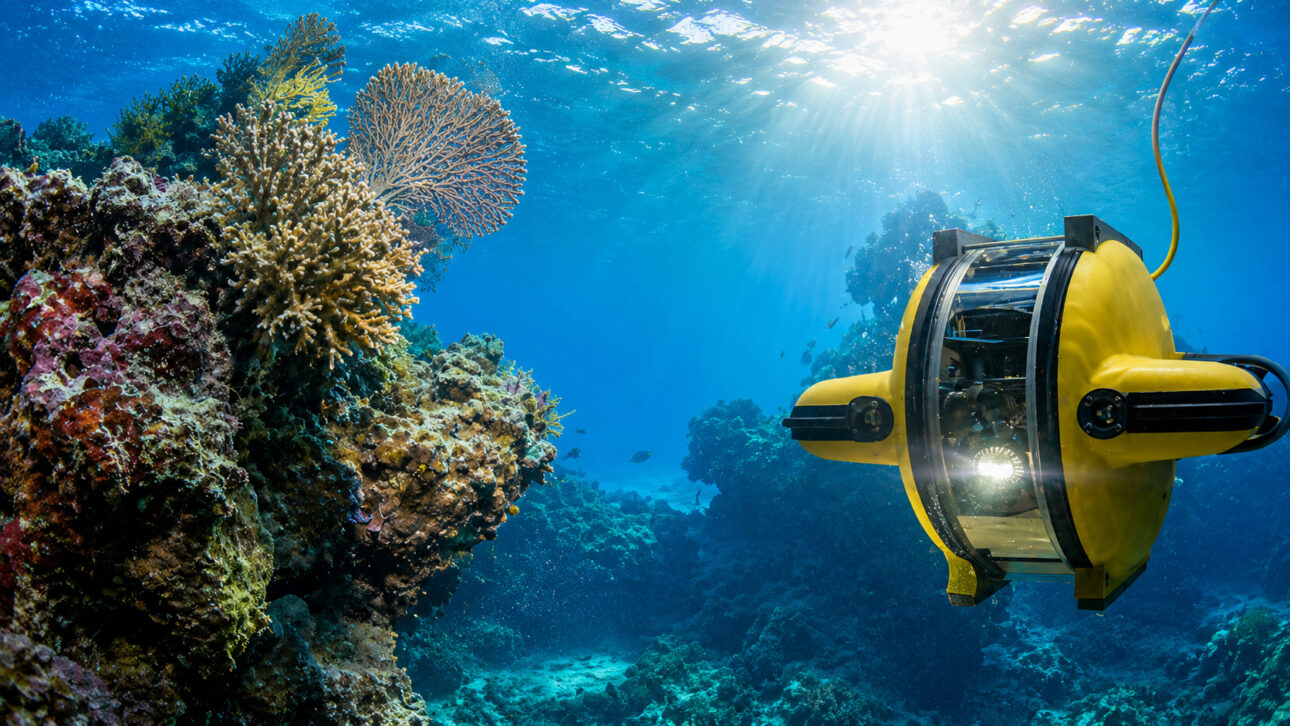
The submerged robots go below the water to observe hidden parts. This region may include bases, cables, and support elements, all exposed to the sea for long periods.
The presence of aerial, surface, and submerged robots allows an inspection to be divided into several stages. Each machine operates in an area where its characteristics can be most useful.
ATLANTIS Project ended on December 31, 2023, after demonstrating robots at sea
CORDIS, the European Commission’s platform for research results, recorded that the ATLANTIS project was completed on December 31, 2023. The infrastructure created by the group brought together robotics tests aimed at wind farms installed in the Atlantic.
The demonstrations involved robots capable of flying, navigating, and operating below the water. The focus was to verify how these machines could observe turbines and support decisions related to offshore maintenance.
The result does not mean that a turbine can be repaired on its own. The main function of the robots is to help identify areas that need attention, gathering images and data before a team decides what work needs to be done.
This point avoids a misunderstanding. ATLANTIS was a testing platform to validate technologies, not a system that automatically replaces technicians, vessels, and professionals responsible for safety.
How robots can change offshore maintenance
Offshore maintenance can become more organized when the team receives information before leaving the port. A robot can observe a part of the turbine and indicate if there are signs that justify a more detailed inspection.
In practice, this can help reserve vessels and professionals for tasks that truly require human presence. The trip ceases to be just a visit to look and can be planned for in-depth inspection or repair.
This type of planning also reduces the exposure of workers to transfers between boats and turbines in difficult conditions. Safety still depends on protocols, weather assessment, and the technical decision of professionals.
Automation acts as support. It expands the ability to observe structures spread across the sea, but does not remove from the teams the responsibility to interpret signals, authorize activities, and perform physical interventions.
Automation supports teams, but does not remove people from decisions
An offshore wind turbine involves large equipment, wave movement, intense wind, and hard-to-reach areas. Even with robots, someone needs to assess the risk, set priorities, and decide when an intervention can be made.
Technicians are still needed for repairs, adjustments, and tasks that require practical knowledge. Robots can arrive first to record images, but they do not take control of a structure that produces energy on their own.
There are also technical limits. Machines depend on battery, communication, well-functioning sensors, and suitable conditions to navigate or fly near the turbines.
Therefore, the main change is in using technology to make inspection more planned and safer, without turning offshore maintenance into a completely unmanned activity.
The platform in the Atlantic showed that robots can observe different parts of offshore wind turbines before the mobilization of vessels and teams. The experience included tests in the air, on the surface, and below the water, where human access is usually more difficult.
For offshore wind energy, the potential gain lies in using more complete information before each trip. This can help companies and teams better organize inspections, reduce unnecessary exposures, and prioritize repairs.
In your opinion, which part of an offshore turbine should be examined first by robots before a human team arrives? Leave your answer in the comments and share this post.