Portuguese
  Spanish




Scientists Are Puzzled By The Discovery Of White Rocks On Mars. These White Stones May Reveal Past Habitability, As Well As The Origin Of Mars.
On distant and arid Mars, the Perseverance rover, a robotic probe from NASA, found a quite curious phenomenon: thousands of white rocks scattered across the Jezero Crater. The whitish hue of these rocks, contrasting with the characteristic reddish tone of the Martian surface, raised intriguing questions among researchers about the origin of these formations on the red planet.
Understand Why The White Rocks On Mars Could Be So Important
Purdue University planetary scientist and member of the Mars 2020 science team, Candice Bedford, expressed perplexity with the discovery during the Lunar and Planetary Science Conference. The white rocks on Mars (with various textures and different compositions) were dubbed “floaters” by scientists due to being moved from their original locations.
Initial analyses indicate dehydration and a depletion of minerals, including iron, magnesium, calcium, and sodium. Researchers believe that understanding the formation of these rocks could shed light on Mars’ geological history, particularly concerning past water activity in the Jezero Crater.
-
Spain Launches World’s Largest Floating Dry Dock: 56-Meter Giant Produces Massive Concrete Structures in A Coruña Using Technology Proven in Brazil

-
AI-powered toys that talk, recognize faces, and collect data face scrutiny from Brazilian government over children’s privacy concerns

-
4,000-Year-Old Child’s Skull Unveils Ancient Burial in 7,500-Year-Old Norwegian Rock Shelter, Impressing Archaeologists

-
Norway Defeats Brazil in World Cup but Invests Billions to Preserve the Amazon, Strengthens Amazon Fund, and Joins Brazil in Leading Global Effort Against Tropical Deforestation




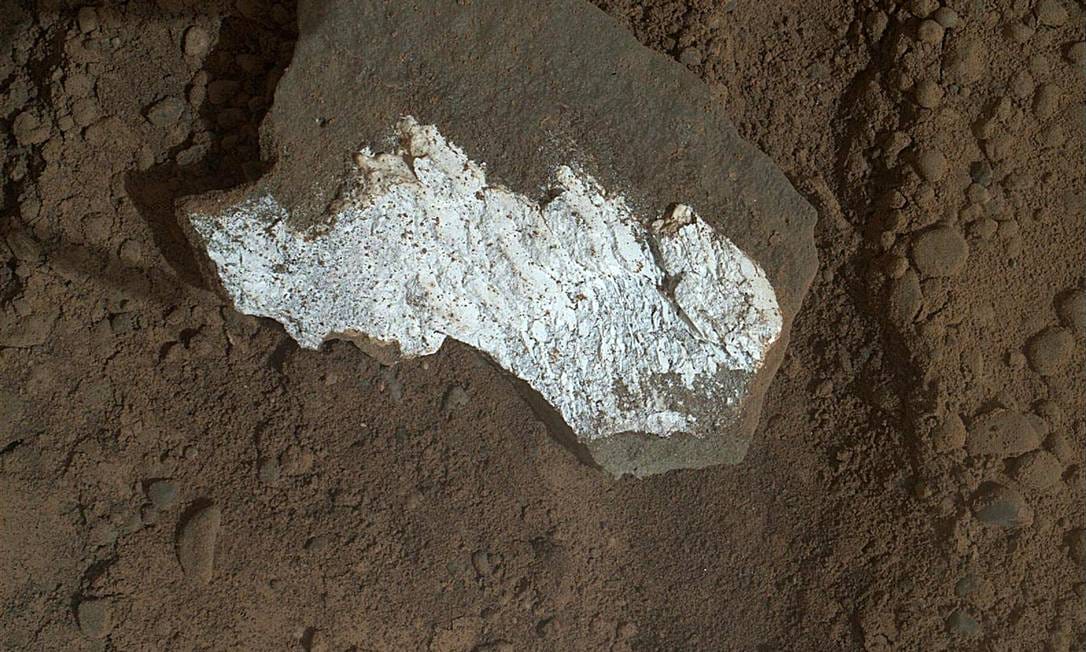
Despite the abundance of floaters, the lack of outcrops (parent rocks with similar properties) adds to the mystery of Mars’ origin. Bedford and her team hypothesize that the white rocks on Mars underwent heating and metamorphism, likely due to volcanic activity or asteroid impacts in other parts of Mars, before being deposited in the crater.
Scientists suspect that this process occurred relatively recently in the crater’s history. The total scientific potential of these samples can only be realized when they are brought back to Earth. MIT planetary scientist, Benjamin Weiss, emphasizes the revolutionary importance of returning Martian samples, allowing for precise dating and deepening human understanding of the origin of Mars.
White Rocks On Mars Could Reveal The Planet’s Early Climate

However, questions remain regarding the Mars Sample Return (MSR) program led by NASA. Concerns about excessive costs led to a review of the program’s architecture, with a revised plan and budget coming soon. The allocation of funds for MSR in NASA’s fiscal year 2025 budget remains uncertain, pending the outcome of the review.
Although Perseverance has already completed its main mission, it continues to explore the planet’s surface, approaching the edge of Jezero Crater. The rover’s long-range camera has recorded more sightings of white rocks on Mars in this area, further expanding scientific curiosity.
In addition to the mysterious rocks, scientists are eager to explore the unique geology at the crater’s edge, which may hold clues about Mars’ early climate and potential biosignatures.
Lisa Mayhew, a researcher at the University of Colorado Boulder, highlights the importance of sampling rocks from adjacent terrains like Nili Planum, which could provide critical information about the origin of Mars.
Check Out Some Curiosities About Mars
The planet is often nicknamed The Red Planet, due to its characteristic reddish hue that makes it unmistakable in the night sky.
The Martian red hue results from a combination of complex factors that work together. This interaction occurs between the composition of the planet’s surface, its atmosphere, and geological phenomena.
The surface of Mars exhibits a variety of shades. It is generally associated with reds or oranges. However, the reddish color of the planet’s surface results from the presence of rocks composed of iron-rich minerals.
Over billions of years, these rocks have undergone an oxidation process. This process is similar to the oxidation that occurs on Earth when iron comes into contact with oxygen and forms rust.