Portuguese
  Spanish


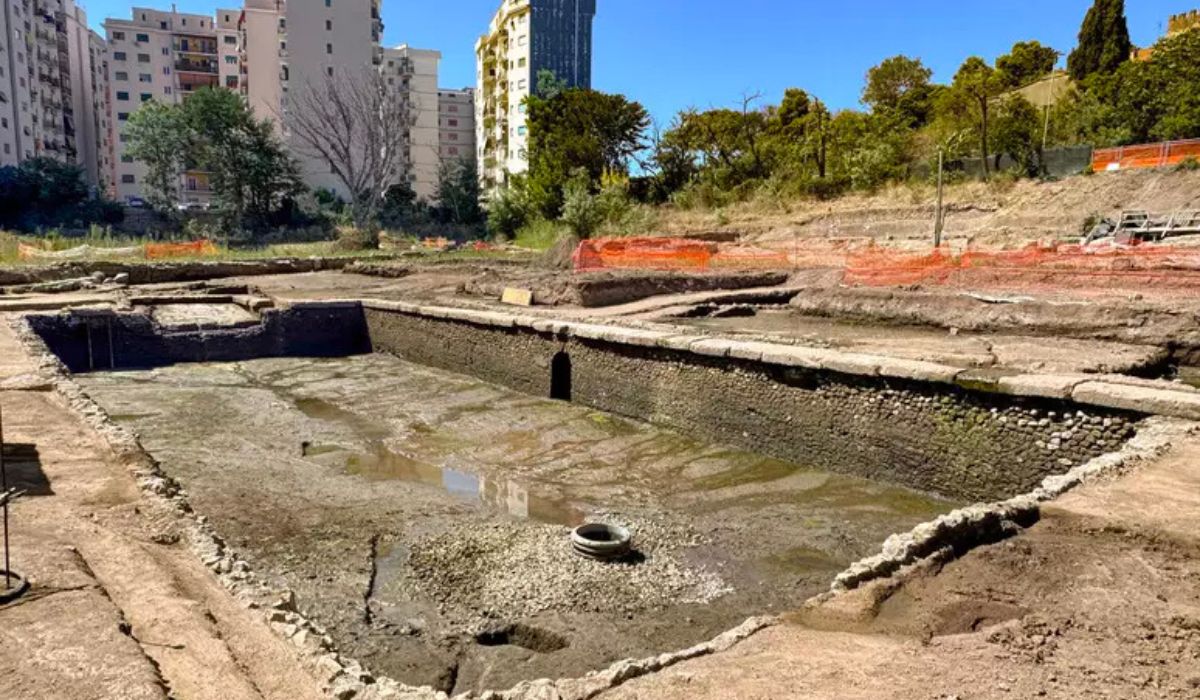


Excavations on Via di Pietralata in East Rome Revealed Monumental Structures and Funerary Remains Outside the Historical Center, Indicating Occupation Between the Republic and the Imperial Period, According to the Special Superintendency of Rome.
Archaeologists identified two large pool-like structures, a small sanctuary possibly associated with the cult of Hercules, and two tombs from the Republican era during excavations at Parco delle Acacie, in the Via di Pietralata area of East Rome.
The discoveries emerged from preventive archaeology work conducted by the Special Superintendency of Rome, an agency linked to the Italian Ministry of Culture, outside the more historically known area visited by tourists.
The Superintendency reports that research at the site began in the summer of 2022 and is progressing in an area estimated at four hectares.
-
Brazilian Airport to Receive $2.8 Million Investment, Completion Expected Within a Year

-
UN Warns of AI’s Environmental Impact and Calls for Greater Corporate Transparency

-
Former Atacadão Employee Turns Online Cake-Baking Lessons into a Confectionery Brand with Factory, Store, Delivery, and Nearly $400,000 in Revenue
-
Brazilian Startup Sells Nearly 9 Million Surprise Bags of Near-Expiry Food, Prevents Thousands of Tons of Waste, Aiming for $42 Million Revenue by 2026




Within this perimeter, the most recent core of findings occupies about one hectare and includes evidence of occupation between the 5th and 4th centuries B.C. and the 1st century A.D., along with more sporadic records from the 2nd and 3rd centuries A.D.
For the special superintendent of Rome, Daniela Porro, findings outside the traditional circuit help to broaden the understanding of the urban extent of the ancient metropolis.
“It is in contexts like this, seemingly distant from the most famous places of the ancient metropolis, that elements emerge that enrich the narrative of archaeological Rome as an extensive city that significantly contributed to its development,” she stated.
“Modern suburbs thus reveal themselves as repositories of deep memories yet to be explored,” she added.
Archaeological Discoveries on Via di Pietralata
The set includes two monumental “pools,” a sacello (a small building linked to religious practices), and two tombs excavated in the rock, attributed to the Republican period.
According to the Ministry of Culture, the land was also crossed by an ancient roadway and traversed by a watercourse that emptied into the nearby Aniene River.
According to those responsible for the intervention, the interpretation of the material depends on the progress of excavations and specialized analyses.
Therefore, some interpretations published so far appear as working hypotheses, subject to revision as new data is collected.

Sacello and the Cult of Hercules in Ancient Rome
The sacello located at the site measures about 4.5 meters by 5.5 meters, with walls constructed using ancient techniques with tuff and traces of plaster on the inner face, according to the official description.
Inside, the team recorded a square base aligned with the entrance, interpreted as a possible altar — or part of it — and, at the back, a structure that may have supported a cult image.
According to the statement, the building was likely erected over a deactivated votive deposit.
Among the materials associated with the context, fragments and pieces of terracotta were found, including heads, feet, small female statuettes, and representations of two bovines, elements that support the interpretation of devotional use.
The proposed dating for the construction of the sacello is between the late 3rd century B.C. and the 2nd century B.C., based on bronze coins mentioned in the technical note released by the Superintendency.
Republican Tombs and Funerary Complex in Rome
The two tombs were located on a tuff slope near Via di Pietralata and integrate the same funerary complex, according to the report.
Parallel corridors lead to two burial chambers, dated between the 4th century B.C. and the early 3rd century B.C.
In tomb A, access is described as monumental, with a stone portal and internal closure by a monolithic slab.
The interior contained a large sarcophagus and three urns, all made of peperino, as well as objects associated with funerary use, such as preserved vessels, a black varnish cup, a small jug, and a mirror, according to the preliminary inventory presented.
Tomb B, assigned to a slightly later moment — still in the Republican period — was sealed with large tuff blocks.
In this space, the Superintendency records the presence of lateral benches for deposition and reports that part of the skull of an adult male has been recovered, showing signs of surgical trepanation.
Commenting on the find, the technical team points out that the architecture of the funerary complex is compatible with the presence of a wealthy family group in the area, an interpretation presented as a hypothesis based on the construction pattern and the described materials.
Roman Monumental Pools and Still Uncertain Function
One of the structures, identified as east basin, measures about 28 meters by 10 meters and has an approximate depth of 2.10 meters.
The Ministry of Culture informs that it was built in the 2nd century B.C. and that part of the walls had white plaster; with abandonment, this coating would have come off almost completely, leaving traces.
The same document describes the presence of niches with vaults at some points, as well as a small ramp that does not reach the bottom.
Starting in the 1st century A.D., according to the Superintendency, the structure lost its initial function and entered a process of disuse, with definitive closure by the end of the 2nd century A.D.
Regarding its purpose, the report emphasizes that the interpretation remains open.
In the initial reading, the possibilities considered include a relation to ritual activities or, less likely, productive use or water capture, always dependent on future analyses and the evidence set.
The second, described as south basin, was excavated in the tuff bank and measures about 21 meters by 9.2 meters, reaching approximately 4 meters in depth.
The official text points out that it received external walls in blocks, also attributed to the 2nd century B.C., and that about a century later, elements for containment and finishing were added at the upper edge.
Two ramps allowed access to the bottom, according to the record: one formed by large blocks of tuff and another, narrower, paved.
In this case, the team reports that it has not yet identified clear channels for water entry or exit, which keeps the discussion about use and functioning open.
The statement mentions an analogy with a structure found in Gabii, attributed to the 3rd century B.C., where the hypothesis of sacred use was raised.
In Pietralata, on the other hand, the ceramic materials in the filling of the south basin are cited as indicative that abandonment may have occurred throughout the 2nd century A.D., without detailing, for now, a specific event associated with this change.
Ancient Road, Aniene River, and Occupation on the Outskirts of Rome
In addition to the monumental structures, the released documentation indicates that the land was crossed by an ancient road in two distinct sections.
One of them, closer to Via di Pietralata, had a dirt floor; the other, near Via Feronia, was carved into the tuff.
The initial interventions to regulate the axis, oriented northwest-southeast, are related to the mid-Republican phase, in the 3rd century B.C., when a large retaining wall is also said to have been built.
Subsequently, according to the Superintendency, this element was replaced by another construction technique.
In the 1st century A.D., according to the report, the road received a new surface and became bordered by other structures.
The team also reports marks interpreted as wheel ruts in the section carved into the tuff.
Later, between the 2nd and 3rd centuries A.D., small graves along the route are mentioned as one of the signs associated with the gradual abandonment of the pathway.
Excavations Continue and Area Enhancement Plan
The excavations continue, and the Superintendency states that once the field phase is completed, it intends to begin studies aimed at enhancing and publicly using the space, within the planned administrative and technical stages.
The aim, according to the agency, is to define how the area can be integrated into a revitalization plan.
“The in-depth scientific study will allow us to contextualize these discoveries and understand their role in antiquity, giving back to the community the true significance of these testimonies from the past,” said Fabrizio Santi, archaeologist at the Special Superintendency of Rome.
He further stated that the tombs “constitute an important testimony” of occupation by a wealthy family group and that the two pools “open up stimulating research scenarios.”
For Santi, the structures “may be” linked to ritual activities or, “less likely,” to productive or water capture purposes.