Portuguese
  Spanish


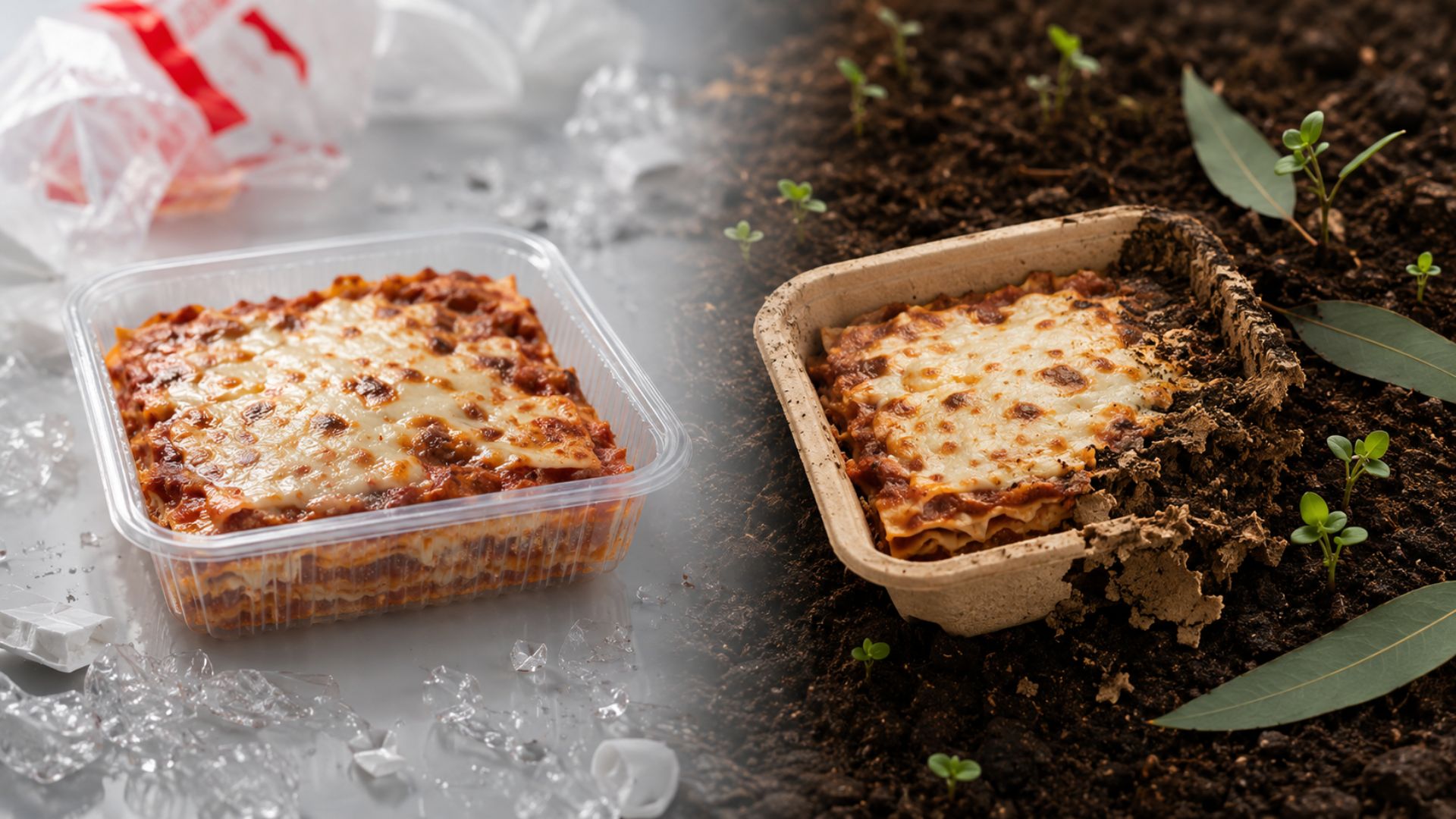

Sadia announced the adoption of compostable trays made from eucalyptus fibers in its line of 350-gram frozen lasagnas. The new Sadia packaging, developed in partnership with Biona, a Melhoramentos company, decomposes in 75 days under composting conditions. According to information from Época Negócios, the tray withstands temperatures from minus 40°C to 220°C and can go from the freezer directly to the oven, microwave, or air fryer. The line consumes about 9 million trays per year, and Sadia expects the entire line of lasagnas to use the new material within six months.
Sadia has just replaced the plastic trays of frozen lasagna with a compostable material made from eucalyptus fibers that disappears from the soil in 75 days. The new packaging, developed over three years by the MBRF Innovation Center in partnership with Biona, replaces disposable containers that would take decades or centuries to decompose in nature. Sadia is starting the transition with the mini 350-gram lasagna line, which consumes approximately 9 million trays per year, and plans to scale the solution to the entire lasagna line within six months.
The context makes Sadia’s decision even more relevant. Brazil generated 81.6 million tons of urban solid waste in 2024, and about 40% did not receive environmentally appropriate disposal, according to the Panorama of Solid Waste in Brazil 2025, from the Brazilian Association of Waste and Environment. Only 4.5% of the waste produced in the country returns to the production chain through recycling, which means that the overwhelming majority of discarded packaging ends up in landfills or the environment.
How Sadia’s tray decomposes in 75 days
The packaging is made from eucalyptus fibers and completely decomposes under composting conditions in 75 days. Luiz Franco, marketing and innovation director at MBRF, owner of Sadia and Perdigão, explained that the trays were tested by burying them in the ground and monitoring the decomposition process in the soil. The previous Sadia tray was also made of paper, but it did not have the compostable characteristic that allows the material to integrate into the soil as organic matter.
-
13-Year-Old Raises Funds to Build Well, Transforming Lives in Cambodian Community Lacking Clean Water

-
Man with Metal Detector Finds Medieval Silver Seal in England, Uncovers 2,000-Year-Old Roman Gem with ‘Richard’s Secret’

-
Thailand Converts 8 Tons of PET Bottles into 3,500 School Backpacks, Showcasing Circular Economy with Over 40 Factories Involved

-
Mysterious Bats Spotted in Paris’s Père Lachaise Cemetery, Drawing Tourists to the “Vampire Cemetery”



The packaging can be disposed of in regular trash, similar to organic waste, or in selective collection systems, as the material can also be recycled. This disposal versatility is important because most Brazilian municipalities do not have composting infrastructure, and the Sadia tray works in both scenarios without requiring consumers to change their habits.
What the Sadia tray can withstand
The biggest technical challenge was creating a eucalyptus fiber packaging that would function under the extreme conditions required by the frozen food category. The Sadia tray withstands temperatures from minus 40°C to 220°C, meaning it can go from the freezer directly to the oven, microwave, or air fryer without deforming, softening, or compromising food safety.
The packaging also needed to be firm enough to support the lasagna after heating, but without retaining excessive heat to the point of burning the consumer’s hand. Another requirement was to ensure that the components used in the paper composition did not compromise food safety. The development took three years of testing between the research teams at MBRF’s Innovation Center and Biona.
Why Sadia does not charge more for sustainable packaging
Franco was straightforward in explaining the strategy: “The consumer is not willing to pay more for sustainable solutions.” Sadia chose to absorb the cost of the transition without passing it on to the final price of the lasagna, a decision that reflects the understanding that, in Brazil, the environmental appeal alone does not justify a price increase for most consumers.
Economic viability was possible because the eucalyptus fiber packaging is not significantly more expensive than the previous one when produced on an industrial scale. Carolina Alcoforado, director at Melhoramentos, stated that “sustainability gains scale when accompanied by technical performance, commercial and industrial viability,” and that Sadia’s project demonstrates that forest-based materials can replace plastic even in complex applications.
What Sadia’s decision changes for the packaging market
The adoption by a brand as large as Sadia, with 9 million trays per year just in the mini lasagna line, sets a precedent for other frozen food companies. If the entire Sadia lasagna line migrates to compostable material in six months, the total volume of trays replaced could reach tens of millions per year, proportionally reducing the amount of disposable plastic entering the waste cycle.
The model also shows that replacing plastic doesn’t have to sacrifice functionality. Sadia’s eucalyptus tray does everything the plastic one did, from freezer to oven, with the advantage of disappearing in 75 days instead of remaining in the environment for decades. For the consumer, nothing changes in the usage experience. For the environment, everything changes.
Would you buy Sadia’s lasagna knowing that the tray disappears in 75 days? Do you think other brands will follow the same path or will plastic continue to dominate? Share in the comments.