






 Portuguese
  Spanish


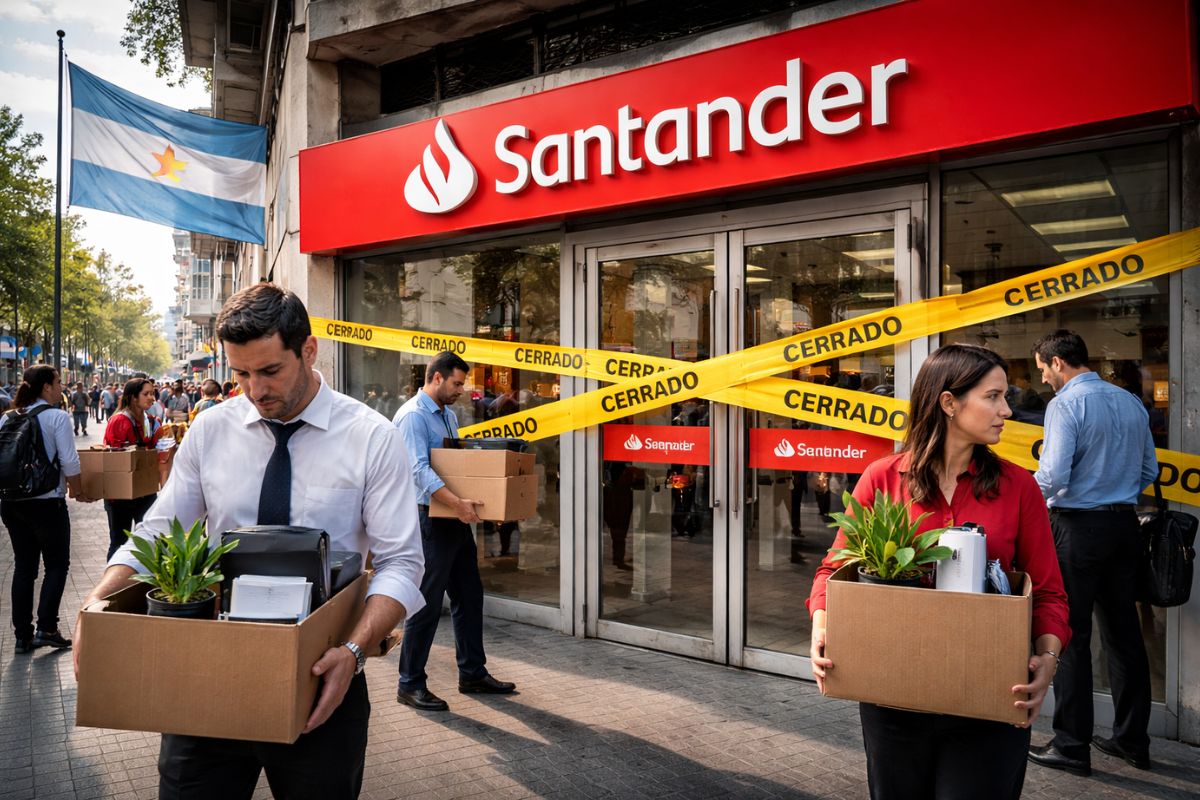

The Discussion About The Future Of Santander In Argentina Moved From Internal Conversations To The Ministry Of Labor, After The Union Cited More Than 30 Branches In The List, Mentioned Up To 500 Affected, And Pointed Out Comodoro Rivadavia And Las Heras As Symbols Of The Tension With Continuous Layoffs Since 2025.
The possibility of Santander closing more than 30 branches in Argentina has put employees and customers on alert and led the union to formally present the case to the Ministry of Labor, according to delegate Gonzalo Martínez’s report to the newspaper Crónica. The estimate presented by the representatives includes potential impact on up to 500 employees, in addition to outsourced workers.
At the heart of the impasse is the interpretation that digitalization does not practically replace in-person service in parts of the country. The concern is not only with employment but with basic access to banking services in regions where the app does not solve everything and the nearest branch may be over 200 km away.
What Is On The Table When Talking About Closing Branches

The debate about Santander branches in Argentina gained concrete outlines when the union stated that there is a plan to close more than 30 units in different cities.
-
Brazil’s 2026 Tax Refund: Record 9.58 Million Filers in Largest Payout Ever, But a Key Detail on Priority Recipients Draws Nationwide Attention

-
Itaú Alters Hybrid Work Model, Increasing Office Days from 2028, Prompting Employees to Adjust to New Routine
-
Facing Labor Shortage, Japan Plans to Invest $34 Million to Attract Foreign Workers in Construction, Healthcare, Industry, and Commerce

-
Brazilian City Makes Remarkable Leap, Becomes 4th Wealthiest in the Country with GDP of R$ 134.1 Billion




According to the representation, discussions have already begun, but without a final picture of which points will be maintained or replaced by remote service.
This scenario is seen as a continuation of a process that, according to the union, has been ongoing since 2025 with layoffs.
When a physical network shrinks, the routine of those who depend on the counter changes before the statistics show any effect and cities like Comodoro Rivadavia and Las Heras appear as examples cited in the complaint.
Ministry Of Labor Becomes A Stage For Negotiation And Demands
By bringing the case to the Ministry of Labor, the union is trying to transform a series of internal decisions into formal negotiations, with records, deadlines, and demands for answers.
The visit to the Ministry of Labor indicates that, for the representatives, the discussion has shifted from being merely corporate to public interest.
In practice, what the union says it is seeking is predictability for workers and for the communities served by the branches.
Without clear information about relocation, compensation, or early retirement, the closure becomes an unknown that spreads throughout the city and, so far, these points appear as undefined in the mentioned locations.
Layoffs Since 2025 And The Allegation Of Pressure During Dismissal
The union maintains that layoffs related to Santander in Argentina are not occurring merely as a result of targeted cuts, but continuously since 2025.
Part of the argument is that the closure of branches acts as a trigger for layoffs and reductions in support teams.
Another sensitive point is the accusation of pressure during termination, with workers being informed that there would be only one alternative for exit.
This is the part that usually sets the tone for a labor crisis because it involves voluntariness, fear, and power asymmetry.
The available basis does not currently provide a public stance from Santander on these specific allegations.
Digitalization, App, And The Limit Of Remote Service
Santander attributes some of the changes to digitalization and the migration of clients to online platforms, a common argument in the banking sector.
The logic is straightforward: fewer people at the counter means less need to maintain branches with high fixed costs across the urban network.
The union contests the premise with a point that weighs outside the major centers: retirees and residents of regions with limited internet access.
When digital service becomes the rule without accessible alternatives, those left behind are not exceptions, they are part of the public and the complaint takes shape when basic operations require long travels, in cases described as over 200 km to the nearest branch.
Comodoro Rivadavia, Las Heras, And The Domino Effect In The Cities
By mentioning Comodoro Rivadavia and Las Heras, the union names real locations in what could seem like mere administrative restructuring.
In cities with a more widespread service network, the closure of branches alters the flow of people, travel time, and even the logistics of tasks such as withdrawing money, signing documents, or resolving issues that the app cannot handle.
In addition to direct employees, the estimate of up to 500 affected includes outsourced service providers, which extends the impact beyond Santander’s payroll.
Closing branches often also cuts the support economy, from transportation to maintenance services and that is why the discussion tends to spill over from the bank to local commerce.
What Could Happen Until The Next Decision
The tension concentrates on the lack of a public outline of what is to come.
The union states that it will continue to monitor the situation and demand guarantees, while Santander’s justification remains anchored in digitalization, without detailing how coverage would look in remote areas.
Until there is an agreement or an official definition about the branches, the case remains trapped between two times: the time of business planning and the time of those who need in-person service tomorrow.
It is in this interval that rumors become certainty and trust becomes a variable especially when the topic is salary, retirement, and access to money.
The possible closure of more than 30 Santander branches in Argentina, brought to the Ministry of Labor by the union, encapsulates two anxieties at once: layoffs since 2025 and a sense of physical abandonment in cities where digital does not cover everything.
The next stage, with formal negotiation, should indicate whether there will be real protection for workers and clients.
If you use Santander in Argentina, what weighs more in your life today: does the app solve almost everything or is the branch still essential? Have you ever needed to travel dozens or hundreds of kilometers to resolve something simple? And when branches close, who should be heard first, customers, employees, or the bank’s headquarters?








Mais uma empresa que está fugindo do caos econômico do Milei. Entre as empresas que DESISTIRAM da Argentina do Milei ou estão reduzindo sua participação estão:
Saíram ou reduziram operações (2024-2025):
Varejo/Consumo/Serviços:
Carrefour (redução/reestruturação),
Walmart (saída),
Zara (saída).
OLX Autos
Alimentação:
Burger King (venda de operações),
Starbucks (redução).
Finaceiro:
HSBC (saída),
Banco Itaú (vendido).
Automotivo/Peças:
Mercedes-Benz (encerramento de fábrica própria),
Axalta
PPG.