Portuguese
  Spanish


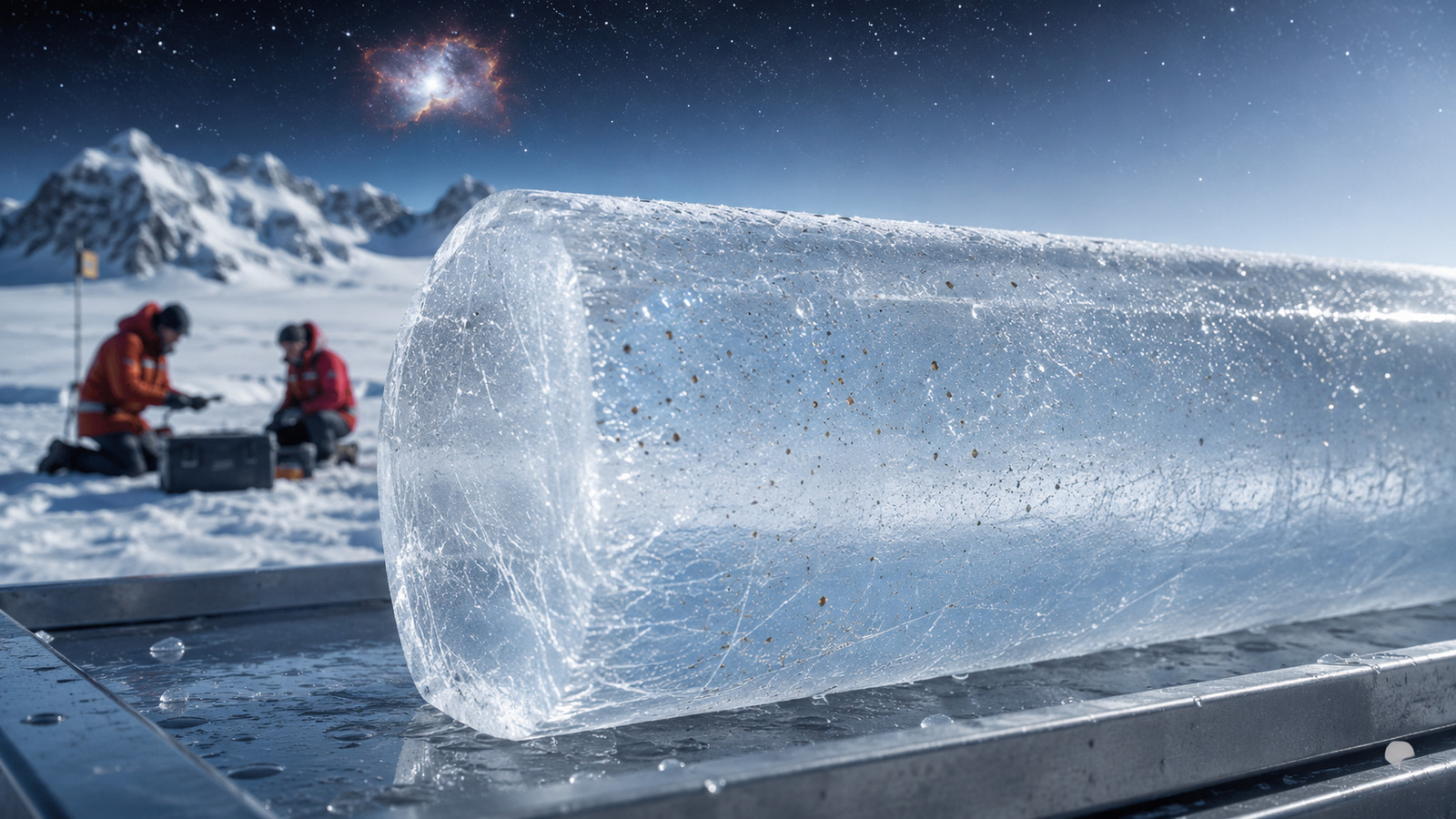


Researchers analyzed over 300 kilograms of ancient Antarctic ice and identified iron-60, a rare isotope associated with supernovas, reinforcing the connection between Earth and the Local Interstellar Cloud
Traces of radioactive stardust were identified in Antarctic ice samples aged between 40,000 and 80,000 years, indicating that particles formed by ancient stellar explosions reached Earth and were preserved in the ice. The discovery involves iron-60, a rare isotope associated with supernovas.
Iron-60 in ice points to stardust, material coming from supernovas
A team led by Dominik Koll, from the Institute of Ion Beam Physics and Materials Research at HZDR, analyzed ancient Antarctic ice in search of signs of radioactive material produced outside Earth.
The study, published in Physical Review Letters, identified iron-60 atoms embedded in the samples. This isotope is considered important for astrophysicists because it is not naturally produced in large quantities on the planet.
-
Spain Launches World’s Largest Floating Dry Dock: 56-Meter Giant Produces Massive Concrete Structures in A Coruña Using Technology Proven in Brazil

-
AI-powered toys that talk, recognize faces, and collect data face scrutiny from Brazilian government over children’s privacy concerns

-
4,000-Year-Old Child’s Skull Unveils Ancient Burial in 7,500-Year-Old Norwegian Rock Shelter, Impressing Archaeologists

-
Norway Defeats Brazil in World Cup but Invests Billions to Preserve the Amazon, Strengthens Amazon Fund, and Joins Brazil in Leading Global Effort Against Tropical Deforestation



The discovery directly links Antarctic ice to interstellar dust particles. According to the researchers, this material may have formed after a stellar explosion, condensed into small grains, and traveled through space before reaching the solar system.
Iron-60 had already been found in ancient ocean sediments. The difference, in this case, is that the Antarctic samples provide a much more recent record of the arrival of this type of interstellar material on Earth.

More than 300 kilograms of ancient ice were processed
To achieve the result, the researchers collected and processed over 300 kilograms of Antarctic ice.
The samples were melted, underwent chemical treatment, and were examined by accelerator mass spectrometry.
The technique allows for the identification of extremely rare isotopes with a high degree of precision, counting atoms individually. It was this method that allowed for the isolation of traces of iron-60 in the analyzed material.
“We searched for individual atoms of the radioactive isotope 60Fe,” stated Dominic Koll. “This isotope is a fingerprint of exploding stars.”
The phrase summarizes why the finding is relevant for space research. Iron-60 functions as a marker of cosmic processes associated with supernovas, allowing the tracking of dust originating from outside the solar system.
Radioactive stardust may be linked to the Local Interstellar Cloud
The results suggest that material from a nearby supernova was trapped in the Local Interstellar Cloud, a region formed by gas, dust, and plasma dispersed among nearby stars.
The solar system has been moving through this region for tens of thousands of years, according to scientists. The presence of iron-60 in the ice helps investigate how this cosmic environment around the solar system may have formed.
The research expands on a study published in 2019, when members of the same team identified iron-60 for the first time in Antarctic snow. At that time, the origin of the isotope was still unclear.
“We didn’t know where it came from,” said Koll. “So we kept working on it, tracking the flow… and we came to the conclusion that it is related to the local interstellar cloud.”


Difference between recent snow and ancient ice reinforces new hypothesis
The researchers compared recent snow samples with much older ice layers. The analysis showed an important difference in the concentration of iron-60.
The older samples had smaller amounts of the isotope. This indicates that less interstellar dust reached Earth during that period, compared to more recent records.
The pattern also does not match the iron-60 deposits previously found in ocean sediments millions of years old.
This difference led the team to consider a more local origin, connected to the interstellar environment surrounding the solar system.
According to information shared with Space.com, the study offers one of the first direct opportunities to investigate the origin of the interstellar clouds around the solar system.
“This means that the clouds surrounding the solar system are linked to a stellar explosion,” stated Koll in a statement. “And, for the first time, this gives us the opportunity to investigate the origin of these clouds.”
Scientists estimate that the solar system entered the Local Nebula between 40,000 and 124,000 years ago. The next step will be to examine even older ice, deposited before this interval, to more accurately track the arrival of interstellar dust on Earth.
This article was prepared based on information from the study published in Physical Review Letters and information shared with Space.com, with data, numbers, and statements preserved as per the consulted material.